
The Backchannel
ZoomInfo vs Apollo: which B2B data platform is right for you? (2026)

Featured Blog


12 min read

12 min read

June 2026
ZoomInfo and Apollo are the two most-compared B2B data platforms, but they sit at opposite ends of the market, so the right choice depends almost entirely on your team size, budget, and whether phone outbound matters. The short answer: choose ZoomInfo if you are an enterprise or upper-mid-market team where data depth, direct-dial accuracy, and intent signals justify a premium annual contract. Choose Apollo if you are a startup, SMB, or mid-market team that wants an all-in-one platform (data plus sequences plus dialer) with transparent, public per-seat pricing and a free tier. Neither is a universal winner.
The bottom line: ZoomInfo wins on data depth, direct-dial and mobile coverage, and intent data, and it is built for the enterprise. Apollo wins on price, pricing transparency, all-in-one convenience, and speed to value, and it is built for SMB and mid-market. One independent finding worth knowing up front: both platforms hit a similar email-accuracy ceiling in third-party tests, so you should run a verification layer either way.
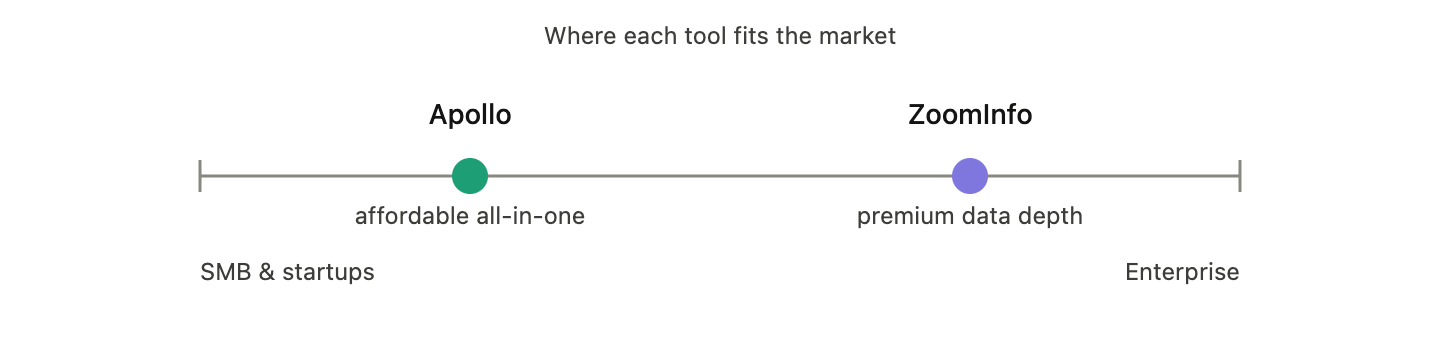
Here is roughly where each one sits:
ZoomInfo vs Apollo at a glance
A note on the numbers: database sizes are vendor-reported, and the accuracy ranges come from independent 2026 bake-offs rather than vendor claims, which run higher. Treat the pricing as directional, since ZoomInfo's is not public and Apollo's exact tiers and credit allowances change.
ZoomInfo: the enterprise data standard
Founded in 2000 and built up over two decades (including the 2019 acquisition that gave it the ZoomInfo name), ZoomInfo is the established enterprise leader, with a database of more than 600 million professional profiles and 135 million company records as of early 2026. Its core advantage is data depth and phone coverage: in a 1,000-lead March 2026 benchmark, ZoomInfo returned mobile numbers for 67% of records versus Apollo's 41%, and it holds the largest direct-dial database among major vendors. It also bundles serious go-to-market tooling beyond the database, including Bombora-powered and first-party intent signals, conversation intelligence through Chorus, org charts, technographics, and a compliance program built with enterprise buyers in mind.
The trade-offs are real. ZoomInfo does not publish pricing, and third-party procurement benchmarks put it roughly between $15,000 and $40,000 per year depending on tier and seats, on annual contracts. Its coverage is strongest in North America and can be weaker in European markets, where some teams supplement with a region-specific provider. And it is easy to overbuy, since many teams paying enterprise prices reportedly use less than 20% of the platform. Choose ZoomInfo if phone-based outbound is core, your ICP spans multiple verticals or non-tech industries, intent-led ABM is central to your motion, and your pipeline justifies a five-figure annual contract.
Apollo: the affordable all-in-one challenger
Founded in 2015, Apollo has become the default tool for startups, small businesses, and mid-market teams by bundling a large contact database with built-in outreach. It reports more than 270 million contacts and 60 million companies, and the platform combines data with multichannel sequences, a dialer, LinkedIn prospecting, AI features, and basic CRM functionality, so a small team can find prospects and reach out from one subscription. Its two structural advantages are transparency and speed: pricing is public, starting around $49 per seat per month on annual billing and topping out near $119, with a genuine free-forever tier, and the self-serve model means a rep can start prospecting in minutes without a procurement cycle.
The trade-offs run the other way. In independent tests, Apollo's email accuracy lands around 78 to 88%, below ZoomInfo's, and its phone and direct-dial coverage is noticeably thinner, which matters most for cold-calling teams. It relies on a single proprietary database, so when a contact is missing there is no fallback, and its intent data is more basic than ZoomInfo's. Coverage is strongest for SMB and mid-market contacts in North America, though some users targeting European markets actually find Apollo more consistent than ZoomInfo. Choose Apollo if you want an all-in-one platform at a price you can justify, you do email-first outbound, you value published pricing, and you want to start free before committing.
How to choose between them
The decision usually comes down to four questions. First, is phone outbound core to your motion? If yes, ZoomInfo's direct-dial advantage is hard to ignore. Second, what is your budget and team size? A 5-person startup spends a few thousand dollars a year on Apollo versus a five-figure ZoomInfo minimum. Third, how central is intent data and ABM? ZoomInfo is stronger there. Fourth, do you want engagement tools built in, or do you already run a separate sequencer and dialer? Apollo consolidates them; ZoomInfo typically does not.
One shared caveat from the independent benchmarks: neither platform cracked roughly 93% deliverability in third-party tests, and both reportedly resell the same Bombora intent data, so whichever you pick, add an email-verification step before launching sequences to protect your sender reputation.
Where Backchannels fits
ZoomInfo and Apollo are both database-first tools: their core value is the size and accuracy of a contact list you search and export. If your bottleneck is less about how many contacts you can pull and more about knowing which accounts are actually in-market right now, a signal-first tool takes a different approach. Backchannels is a buyer database with buying signals, built around surfacing accounts showing real buying behavior (funding, hiring, leadership changes, category intent) and pairing them with verified contacts, so the starting point is timing and relevance rather than raw database volume. It is a different lens on the same problem, and for teams whose constraint is reaching the right accounts at the right moment, it can complement or replace a database-first tool. The honest way to decide is to test data quality and fit against your own ICP before committing to any of them.
Frequently asked questions
Is Apollo or ZoomInfo better?
Neither is universally better. ZoomInfo is stronger for enterprise teams that need the deepest data, the best direct-dial coverage, and advanced intent signals. Apollo is better for startups and SMBs that want an affordable all-in-one platform with transparent pricing and a free tier. The right pick depends on your team size, budget, and whether phone outbound matters.
How much does ZoomInfo cost compared to Apollo?
ZoomInfo does not publish pricing, and third-party procurement benchmarks put it roughly $15,000 to $40,000 per year on an annual contract. Apollo lists pricing publicly, starting around $49 per seat per month on annual billing up to about $119, with a free-forever tier. Apollo is dramatically cheaper for small teams.
Is Apollo's data as accurate as ZoomInfo's?
Not quite, especially for phone numbers. In independent 2026 tests, Apollo's email accuracy landed around 78 to 88% versus ZoomInfo's 84 to 92%, and ZoomInfo's mobile and direct-dial coverage was substantially higher. For email-first outbound to SMB and mid-market North America, Apollo is often close enough; for phone-heavy or enterprise motions, ZoomInfo leads.
Which is better for a startup?
Usually Apollo. The free tier lets you start immediately, per-seat pricing fits a startup budget, and the built-in sequences and dialer reduce the need for separate tools. ZoomInfo's five-figure annual minimum is hard to justify for most teams under 10 reps.
Which has better intent data?
ZoomInfo. Its intent data combines Bombora's bidstream signals with proprietary first-party signals and covers more topics at a more granular, account level. Apollo offers intent data too, but it is more basic. For intent-led prospecting and ABM, ZoomInfo is the stronger option.
TRY BACKCHANNELS FREE
Your next customers are already in the database.
Backchannels gives you 225,000 verified software decision-makers. Filter to your exact ICP, preview matches for free, and push them straight into Salesforce or HubSpot. Pay per contact. No subscription, no contract.
Browse contacts freeNo credit card. Preview before you spend a credit.
No items found.
Final Thoughts
Published
November 25, 2026
Writer
Joe Backchannels
Share


Most Wanted

12 min read
12 min read
June 2026

12 min read
12 min read
June 2026
12 min read
12 min read
June 2026