The Backchannel
Apollo vs Clay: which should you use? (2026)
Featured Blog

12 min read

12 min read

June 2026
Apollo and Clay get compared constantly, but they are not really the same kind of tool, which is the most important thing to understand before choosing. Apollo is an all-in-one prospecting platform: its own contact database plus built-in email sequences and a dialer, built for speed and simplicity. Clay is a data enrichment and automation engine that connects to more than 100 data providers and lets you build custom workflows, but it has no database of its own and cannot send emails. The short answer: choose Apollo if you want one tool to find prospects and reach out fast, and choose Clay if you have a technical operator and need maximum data coverage and custom enrichment. Many teams use both.
The bottom line: Apollo wins on speed, simplicity, all-in-one convenience, and transparent per-seat pricing. Clay wins on data coverage through multi-source waterfall enrichment, workflow flexibility, and AI-powered personalization, at the cost of complexity and a steep learning curve. As one comparison put it, choosing between them without understanding the difference is like comparing a Swiss Army knife to a power drill because both can drive screws.
Here is roughly where each one sits:
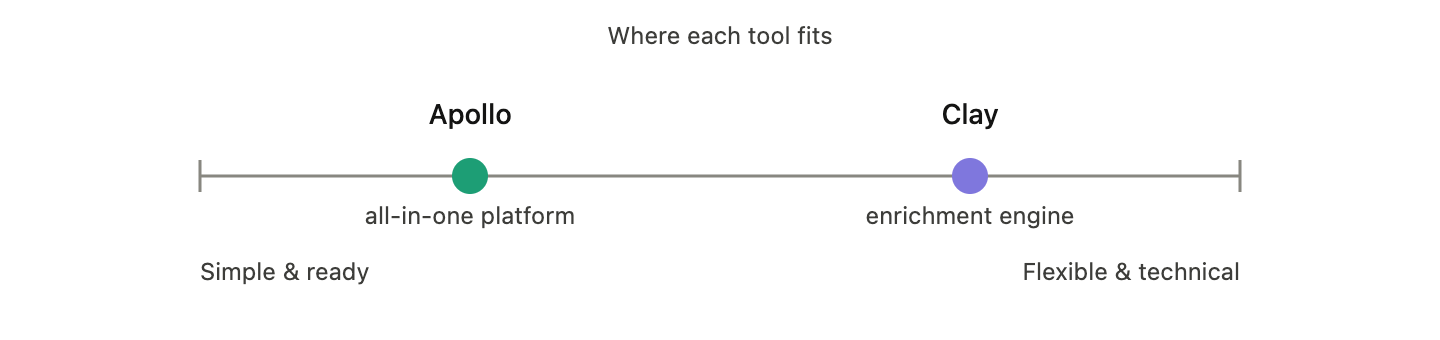
Apollo vs Clay at a glance
A note on pricing: Apollo's is public and per-seat (the Organization tier has a 3-seat minimum), while Clay's is credit-based with unlimited seats but layers the underlying data-provider costs on top, and Clay changed its pricing in 2026, so treat the figures as directional.
Apollo: the all-in-one prospecting platform
Apollo is a vertically integrated platform: a proprietary database of roughly 270 million contacts with native enrichment, multichannel sequencing, a dialer, CRM integrations, AI features, and a LinkedIn Chrome extension, all in one login. Its proposition is consolidation and speed, since you can go from a list to sending cold emails in under an hour, and most users are running sequences within a day or two with minimal training. Pricing is public and per-seat, at roughly $49 (Basic), $79 (Professional), and $119 (Organization) per user per month on annual billing, with a free tier.
The honest weakness is data. Apollo is single-source, so what you see is what Apollo has, with no fallback when a contact is missing, and independent testing puts its email accuracy around 73 to 88%, with catch-all domains a known issue (one re-verification of 900 Apollo "Verified" leads found a much lower share actually valid). Coverage is strongest for North American SMB and mid-market and thinner for European contacts and niche verticals, and because many teams query the same shared database, you can end up reaching the same prospects as competitors. Choose Apollo if you want one tool for the full find-and-reach-out motion, you value speed and simplicity, you do US-focused mid-market outbound, and you want published pricing with a free plan.
Clay: the enrichment and automation engine
Clay made waterfall enrichment accessible to non-engineers. The core workflow is to import a list, run it through a cascade of 100-plus data sources (Apollo, Clearbit, Hunter, Cognism, People Data Labs, Dropcontact, and many more) with fallback logic, then layer AI columns on top to generate icebreakers, qualification scores, or research with its Claygent agent. Its strengths are coverage and flexibility: querying multiple providers in sequence typically produces higher match rates than any single database (users report enrichment jumping from around 40% to 87% after switching, and waterfalls hitting 85 to 92% find rates versus 60 to 75% single-source), and the spreadsheet-style builder handles conditional logic, API calls, and per-row AI that would otherwise need a custom pipeline. Pricing is credit-based with unlimited seats, a free tier, and paid plans from roughly $134 per month up to $800 or more, plus the cost of the underlying providers.
The honest weakness is operational overhead. Clay is a power-user tool with a steep learning curve, and teams routinely report needing 3 to 4 weeks to ramp and 2 to 4 weeks to build a workflow that performs well. It does not send email or include a dialer, so you need a separate engagement tool, and the credit model rewards careful design but punishes sloppy enrichment passes, which makes total cost hard to predict. Choose Clay if you have a GTM engineer or technical operator, you run complex or multi-ICP targeting, data coverage for hard segments is a real constraint, and AI personalization at scale is your edge.
The "use both" reality
For many high-performing teams in 2026, the answer is not either/or. A common stack uses Apollo (or LinkedIn Sales Navigator) for list sourcing and its database, Clay for waterfall enrichment and AI personalization, and a dedicated sending tool like Instantly or Smartlead for delivery. Clay can even query Apollo's API as one of its data providers, so you get Apollo's database inside Clay's waterfall. If you are running both, the practical move is to treat Apollo as your cheap volume and database layer and Clay as the enrichment and intelligence layer on top.
How to choose
Three questions settle most decisions. First, do you have a technical operator? Clay rewards expertise and underperforms in casual hands, while Apollo needs none. Second, do you want sending built in? Apollo includes sequences and a dialer; Clay requires a separate sender. Third, is data coverage for hard ICPs (European contacts, niche verticals, technical buyers at smaller companies) a real constraint? Clay's multi-source waterfall will beat Apollo's single source there, including routing European enrichment through providers like Cognism and Dropcontact. If you are a solo founder or lean SDR team running US mid-market sequences, start with Apollo and add Clay only when ICP-specific enrichment becomes a genuine bottleneck.
Where Backchannels fits
Apollo and Clay are both fundamentally about building and enriching lists, whether from one database or a hundred. If your constraint is less about how to assemble or enrich a list and more about knowing which accounts are worth working right now, that is a different problem. Backchannels is a buyer database with buying signals, oriented around surfacing accounts showing real buying behavior (funding, hiring, leadership changes, category intent) and pairing them with verified contacts, so the starting point is timing and relevance rather than list-building or waterfall configuration. For teams whose bottleneck is reaching the right accounts at the right moment, it is a complementary lens. As always, the honest test is to try the data and the signal quality against your own ICP before committing.
Frequently asked questions
Is Clay better than Apollo?
Not better, different. Clay produces higher-coverage, more accurate enrichment through multi-source waterfalls and offers far more flexibility, but it has no database, cannot send email, and is much harder to learn. Apollo is simpler, faster, and all-in-one. The better tool depends on whether you value flexibility and data quality or speed and consolidation.
Can you use Clay and Apollo together?
Yes, and many teams do. A common pattern is Apollo for list sourcing and its database, Clay for waterfall enrichment and AI personalization, and a dedicated tool like Instantly or Smartlead for sending. Clay can even call Apollo's API as one of its data providers.
Is Clay or Apollo cheaper?
Apollo wins on headline price, with public per-seat plans from about $49 per month and a free tier. Clay starts around $134 per month with unlimited seats, but you also pay the underlying data providers and a separate sending tool, so total cost is higher and harder to predict, though it can be more cost-effective for larger teams.
Which has more accurate data?
Clay, generally, because waterfall enrichment across many providers fills gaps that any single database misses, and independent reports put multi-source find rates well above single-source ones. Apollo's single database is convenient but bounces more in independent tests, so many teams run a verification layer on top of it.
Do you need a technical person to use Clay?
Effectively yes for full value. Clay is a power-user tool, and teams report needing 3 to 4 weeks to ramp and weeks more to build workflows that perform. Without a GTM engineer or technical operator, much of its advantage goes unused, whereas Apollo is designed for a single SDR with minimal training.
TRY BACKCHANNELS FREE
Your next customers are already in the database.
Backchannels gives you 225,000 verified software decision-makers. Filter to your exact ICP, preview matches for free, and push them straight into Salesforce or HubSpot. Pay per contact. No subscription, no contract.
Browse contacts freeNo credit card. Preview before you spend a credit.
No items found.
Final Thoughts
Published
November 26, 2026
Writer
Joe Backchannels
Share


Most Wanted

12 min read
12 min read
June 2026

12 min read
12 min read
June 2026
12 min read
12 min read
June 2026