12 min read

12 min read

June 2026
12 min read
12 min read
June 2026
12 min read
12 min read
June 2026
A buying-signal outbound play is a repeatable sequence that fires when a specific buying signal appears (a funding round, a leadership change, a hiring spike, a pricing-page visit, an intent spike), reaching the right person with a message tied to that exact moment. It is the opposite of blasting a static list, and the performance gap is not subtle. Signal-based outreach with a specific event and a relevant value prop hits 15 to 25% reply rates, versus 1 to 5% for cold, because only about 5% of your market is in-market at any given time and a play reaches them inside that window. As one analysis put it, a cold email to a VP who is not evaluating anything is noise, but the same email sent 20 minutes after their team visits your competitor's G2 page is a conversation. This guide gives you the step-by-step framework, a signal-to-message map, and a copy-paste play template.
The short version: Build a buying-signal play in five steps. (1) Pick one high-intent signal to start, not ten. (2) Qualify every trigger against ICP fit, because a signal at a poor-fit account is still noise. (3) Write a message tied to that specific signal, since if you could swap the signal and the email still reads the same, it is too generic. (4) Match the cadence speed to how fast the signal decays, reaching out in minutes to days, not weeks. (5) Measure signal-to-meeting by signal type, not emails sent. The whole motion lives or dies on speed and data quality, because a stale email wastes the signal entirely.
Here is the core mechanic of every play:
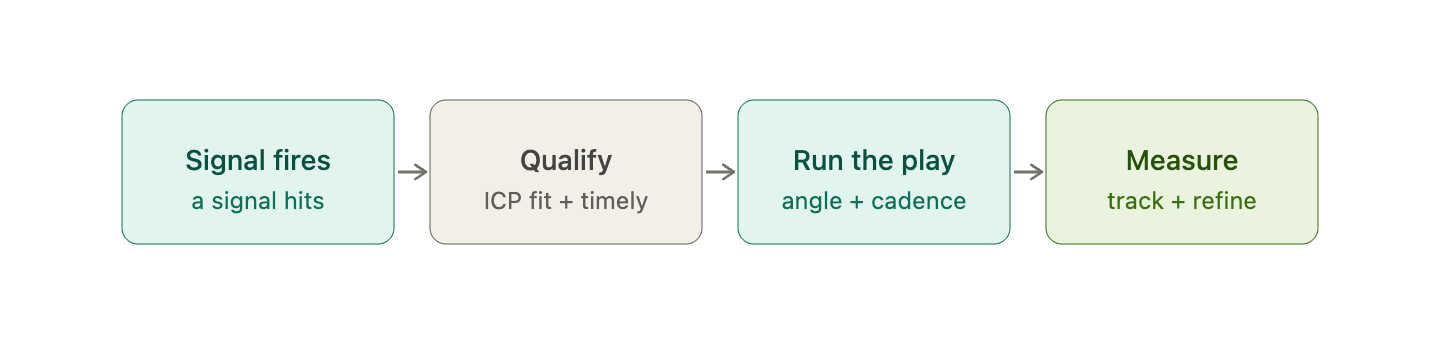
Most teams overwhelm themselves trying to monitor every possible signal, so pick depth over breadth and start with one to three. The highest-leverage signals with the least tooling complexity are former-customer job changes, new leadership hires, and high-intent website behavior like pricing-page visits, which are the easiest and most predictive to act on. Hiring signals deserve special mention, because a company posting for a Head of CRM has both budget and a felt problem, and one team built 48% of its pipeline from hiring signals alone. Master one play before stacking more, since a single working play live today beats a five-phase operating model that never ships.
This is the control layer that decides which signals deserve expensive human attention, and skipping it means firing fast at the wrong accounts. A trigger is useless without verified company fit, role relevance, and contact accuracy, so check ICP fit and confirm you can actually reach the right person before the play runs. Use a one-sentence test: if you cannot answer "why this person, why now" in a single sentence, the lead goes back in the pool. And resist acting on one flashy event in isolation, because a Series B by itself does not tell you a company is in buying mode for your solution. The stronger move is signal stacking, where you wait for a second signal (the funding round plus a relevant hire, say) to form a high-intent pattern before reaching out.
The entire point of a play is relevance, so if you detect a funding round and send the same template you would send to a cold list, you have wasted the signal. Every signal type should have its own angle, and the practical test is simple: if you can swap one signal for another and the email still reads the same, the template is too generic. Here is the mapping:
SIGNAL                ->  OUTREACH ANGLE
   Hiring spike         ->  capacity / process / team-build
   Pricing-page revisit ->  timing / evaluation
   New executive hire   ->  change-management / fresh-start
   Tech-stack change    ->  integration / migration / replacement
   Funding round        ->  scaling / new budget
   Competitor research  ->  switching / differentiation
Keep the email to 70 to 80 words, reference the specific signal in the first line, and end with one soft, interest-based ask.
Speed is the variable that separates a winning play from an expensive list with extra steps. The first seller to contact after a trigger event is about 5 times more likely to win the deal, and responding within 5 minutes makes you 21 times more likely to qualify a lead than waiting 30 minutes. The most common failure is collecting signals but acting on them three to five days later, by which point the moment has passed. So match cadence speed to how fast the signal decays: a hot, live signal needs same-day outreach (minutes, if you automate the first touch), while a softer signal can have more distance. Build a dedicated cadence per signal type rather than running one generic seven-touch sequence for everything, and aim for roughly 12 to 18 touches over 20 to 30 days across email, phone, and LinkedIn, since multichannel lifts response rates substantially over single-channel.
Once outreach is triggered by a real signal, the question changes from "how much did we send?" to "how efficiently did signals turn into pipeline?" Retire open rates, which Apple Mail Privacy Protection now inflates by 15 to 20 percentage points, and track signal-to-meeting rate and signal-to-opportunity rate per signal type, never in aggregate, because a champion's job change converts very differently from a generic website visit. Add pipeline per signal and time from trigger to first touch, then use those numbers to do the only thing that compounds: double down on the signals that create real conversations and kill the workflows that just generate curiosity.
BUYING-SIGNAL OUTBOUND PLAY   (build one play per high-value signal)

SIGNAL (trigger):  [e.g., new VP of Sales hired at a target account]
   Observable? ___   Predictive for us? ___   Fresh (< X days)? ___

QUALIFY  (the control layer — fire only if all are true)
   [ ] ICP fit (industry, size, geography, tech)
   [ ] Right person reachable (verified email + direct dial)
   [ ] "Why now, why them, why you" answerable in one sentence
   [ ] (Ideally) a second signal stacks (e.g., funding + hiring)

MESSAGE  (angle tied to THIS signal; run the swap-test)
   Reference the signal in line 1.  70-80 words.  One soft CTA.
   (Use the signal -> angle map above.)

CADENCE  (speed matched to signal decay)
   Hot / live signal  -> first touch same day (minutes if automated)
   Soft signal        -> first touch within a few days
   12-18 touches over 20-30 days, multichannel (email + call + LinkedIn)
   A dedicated sequence per signal type, not one generic 7-touch

OWNER + SLA
   Owner: [rep / pod]     Speed-to-touch SLA: [e.g., < 1 hour]

MEASURE  (per signal type, not aggregate)
   Signal-to-meeting rate   |   Signal-to-opportunity rate
   Pipeline per signal      |   Time from trigger to first touch
   (Retire open rate — Apple MPP inflates it 15-20 points.)
The seven that flatten a signal program: tracking too many signals at once instead of mastering two or three, firing on a single flashy event without ICP fit or signal stacking, sending a generic template that does not reference the signal (which leaves all the signal work on the table), acting days late so the window closes, running one generic cadence for every signal type, grading the program on emails sent and open rates instead of signal-to-meeting, and letting the data go stale, since a company hiring aggressively three months ago may have frozen headcount last week. The foundational mistake underneath several of these is firing fast at the wrong accounts because the trigger was never qualified.
This framework has one hard dependency, and it is the thing that breaks most signal programs: the gap between detecting a signal and acting on it with accurate data. Stale emails kill the entire motion, because a perfectly timed message to a bounced address reaches no one, and signals decay fast, so a play that fires three days late has missed the window. That gap is exactly what Backchannels is built to close. As a buyer database with buying signals, it is the detection layer and the data layer in one: it surfaces the buying signals (funding, hiring, leadership changes, intent) that trigger each play, supplies the verified contact so the first touch actually lands, and keeps both fresh so you reach in-market accounts while the window is still open. Every other guide in this series produces an input to this play (the ICP, the target list, the research angle, the cold email, the cadence), and a buying-signal play is where they all fire together, the moment a signal says now.
What is signal-based outbound?
It is a sales motion where outreach is triggered by real-time buying signals (pricing-page visits, job changes, funding rounds, intent spikes) rather than static contact lists. It prioritizes timing and relevance over volume, and it consistently outperforms cold outbound on reply rates, meetings booked, and pipeline.
What buying signals should you track first?
Start with two or three high-leverage ones: former-customer job changes, new leadership hires, and high-intent website behavior like pricing-page visits. Hiring signals are especially strong because a relevant job posting signals both budget and a felt problem. Add more categories only after the first ones reliably trigger qualified outreach.
How fast should you act on a buying signal?
As fast as the signal is hot. The first seller to reach out after a trigger is about 5 times more likely to win, and responding within 5 minutes makes you 21 times more likely to qualify than waiting 30. Live signals call for same-day outreach, ideally automated; softer signals can wait a few days.
Why does signal-based outbound get higher reply rates?
Because it reaches the right person at the right moment with a relevant message, instead of interrupting someone who is not evaluating anything. Only about 5% of your market is in-market at any time, and signal-based outreach lands inside that window, which is why it hits 15 to 25% replies versus 1 to 5% for cold.
How do you measure a signal-based outbound play?
Track signal-to-meeting rate and signal-to-opportunity rate per signal type, plus pipeline per signal and time from trigger to first touch. Avoid open rates, which are inflated by privacy features, and avoid measuring in aggregate, since different signals convert very differently.
Backchannels gives you 225,000 verified software decision-makers. Filter to your exact ICP, preview matches for free, and push them straight into Salesforce or HubSpot. Pay per contact. No subscription, no contract.
Browse contacts freePublished
November 24, 2026
Writer
Joe Backchannels
Share


Most Wanted
12 min read
12 min read
June 2026
12 min read
12 min read
June 2026