12 min read

12 min read

June 2026

12 min read
12 min read
June 2026
12 min read
12 min read
June 2026
A 30-60-90 day SDR onboarding plan is a phased ramp that takes a new sales development rep from day one to full pipeline production in three stages: learn, do, and own. It matters because the average SDR takes about 3.1 months to ramp, yet teams with a formal, structured plan get there meaningfully faster, generating pipeline 100-plus days earlier at the same cost, with around 82% better retention. The alternative, a laptop, a login, and "start dialing," builds bad habits and burns confidence, which is part of why roughly 20% of new hires walk out within 90 days. This guide gives you the three-phase structure, realistic quota and activity ramps, the milestones to measure, and a copy-paste plan.
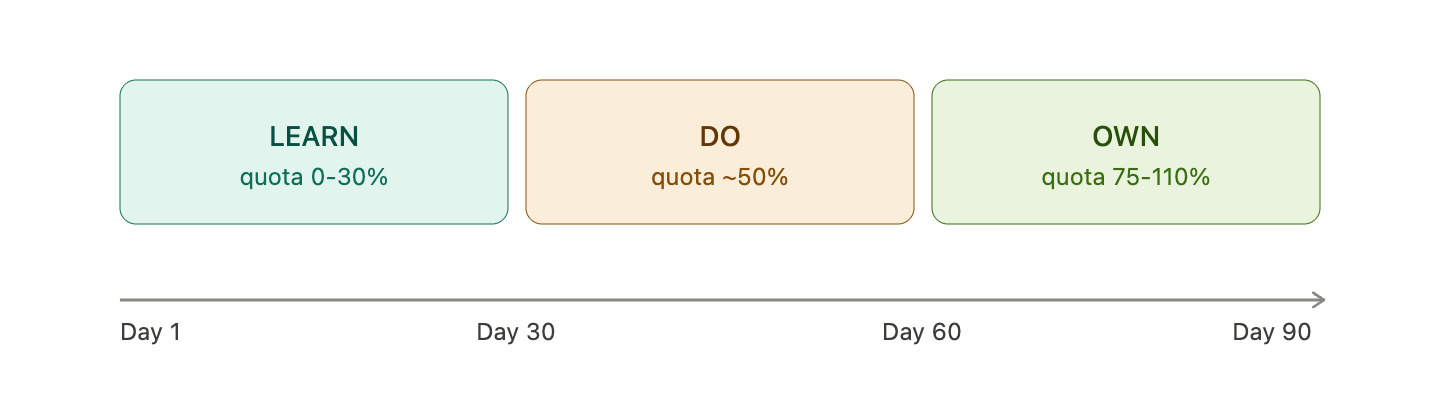
The short version: Structure the first 90 days in three phases. Days 1 to 30 (Learn): zero or minimal quota, all absorption of product, ICP, tools, and messaging, with no cold calling in week one. Days 31 to 60 (Do): ramp to about 50% of quota with heavy coaching and the first booked meetings. Days 61 to 90 (Own): reach 75 to 100% of quota as an independent rep. Use a graduated quota, never full quota on day one, measure leading indicators by phase, and set certification gates with a single clear owner.
Here is the three-phase ramp at a glance:
The new hire's success is largely determined before they walk in. Three things should be ready: a phased plan with actual daily numbers (not "ramp up gradually"), their full prospecting stack provisioned on day one (CRM, sales engagement platform, dialer, and a data-verification tool), and verified prospect data, because bad data kills new SDR confidence faster than anything else. Add an email domain warmup running from day one (most guides skip deliverability and new reps torch their sender reputation fast), a welcome pack with their scorecard and 30/60/90 milestones, and one named owner for the whole experience, usually the SDR manager, plus an experienced SDR as a mentor.
The first 30 days are for absorption at zero or minimal quota, focused on four pillars: company, customer, product, and process. The rep learns your ICP, personas, and competitors, your value proposition, your messaging frameworks, and your tools, while shadowing live calls, reviewing recorded calls, and running practice role-plays from your real call library. The hardest rule to follow is the most important: no cold calling in week one, because a rep who dials before they understand product, ICP, and process builds bad habits that take weeks to unlearn. Gate the phase with a certification test (around 85% to pass) and a manager sign-off on the rep's cold-call opener and email template. By day 30 they should articulate the value proposition in 30 seconds, explain the ICP in two minutes, and handle their first live conversations on low-stakes accounts.
Month two shifts from learning to doing, at roughly 50% of quota, and it is coaching-heavy. The rep runs cadences independently while you gradually increase daily activity (for example from 30 dials to 40 to 50), introduce more complex accounts, and teach advanced techniques like multi-threading and social selling. Move coaching beyond role-play to weekly reviews of the rep's actual call recordings, and drill objection mastery. This is also when AEs should join role-plays to give feedback on meeting quality. The milestone is clear: hit about 50% of quota by day 60, with first meetings booked that AEs accept as genuinely qualified.
The final phase transitions the rep to full productivity at 75 to 110% of quota as an independent operator. Roughly 85% of their time is now live outbound, they forecast their own meeting flow and manage their territory like a business owner, and they shadow AE discovery calls to see how their booked meetings progress through the pipeline, which sharpens their qualification. Check-ins become less frequent, the rep self-reviews recordings, and strong performers start mentoring newer hires. The milestone is hitting 75 to 100% of quota and graduating from a "ramping" SDR to a regular one. One honest red flag: a rep below 50% of quota at day 90 after full structured coaching is usually a hiring mismatch, not a ramp problem, and it is worth addressing directly rather than burning another month.
Across all three phases, the rule that prevents the most damage is a graduated ramp. The standard structure is roughly 0 to 30% of quota in month one, 50 to 80% in month two, and 75 to 110% in month three, with daily activity climbing in step. Expecting full quota from day one is one of the most common manager mistakes, because it demoralizes reps and incentivizes bad habits before good ones are formed. Tailor the curve to the role, since simple SMB products can ramp in 45 to 60 days while mid-market and enterprise realistically need the full 90.
A plan without measurement is just a suggestion. Track leading indicators by phase (daily calls, contacts, conversations, meetings booked, contact rate, show rate, qualified rate, and quota attainment) rather than waiting on lagging revenue, and make every goal SMART. Use certification gates at the end of weeks two, four, and eight, and require pipeline-quality checks so the meetings reaching AEs actually meet your qualification bar. The reason this matters beyond the rep: vague milestone tracking is one of the most common gaps in SDR ramp plans, and "is the rep doing well?" is not a benchmark.
30-60-90 DAY SDR ONBOARDING PLAN
Owner: [SDR manager]   Mentor: [senior SDR]
Quota ramp: 0-30% (mo 1) -> 50-80% (mo 2) -> 75-110% (mo 3)

BEFORE DAY 1
   - Welcome pack: mission, product, ICP, how the role drives revenue
   - Scorecard + ramp plan with milestones for day 30 / 60 / 90
   - Tools provisioned: CRM, sales engagement platform, dialer, data tool
   - Email domain warmup started (2-4 wks; SPF/DKIM/DMARC configured)
   - Verified prospect data ready (do not practice on bad data)

DAYS 1-30 — LEARN   (quota 0-30%; NO cold calling in week 1)
   Focus: company, customer, product, process
   - Product deep dive + top 3 pains (articulate in 30 seconds)
   - ICP, personas, competitors (explain ICP in 2 minutes)
   - Tool + CRM certification; messaging frameworks
   - Shadow 10+ live calls; review recorded calls and sequences
   - 50 practice role-plays from your real call library
   GATE: pass product/ICP/messaging certification (85%+); manager
         signs off on cold-call opener + email; first live
         conversations on low-stakes accounts

DAYS 31-60 — DO   (quota ~50%; coaching-heavy)
   Focus: move from learning to doing
   - Run cadences independently; ramp activity (e.g., 40-50 dials/day)
 - Complex accounts, multi-threading, social selling
   - Weekly call-recording reviews (beyond role-play); objection mastery
   - AEs join role-plays and grade meeting quality
   GATE: hit ~50% of quota; first meetings booked and accepted by AEs

DAYS 61-90 — OWN   (quota 75-110%; independent)
   Focus: full productivity, own the territory
   - ~85% of time live outbound; forecast own meeting flow
   - Shadow AE discovery calls to see meetings progress
   - Fewer check-ins; self-review recordings; mentor newer reps
   GATE: 75-100% of quota; graduated to a full SDR
   RED FLAG: below 50% of quota at day 90 after full coaching is a
             hiring mismatch, not a ramp problem

MEASURE BY PHASE (leading indicators, not just closed revenue)
   Daily calls | contacts | conversations | meetings booked
   Contact rate | show rate | qualified rate | quota attainment
The eight that stretch a clean 60-day ramp into a messy 120: jumping to full quota on day one, putting reps on the phones in week one, cramming everything into week one (reps forget about 70% of training within seven days), having no clear owner so people "drop in" with conflicting advice, skipping recorded-call review, setting vague milestones, using a one-size-fits-all plan that ignores experience level and sales-cycle length, and letting reps practice on bad data. And one cultural mistake: canceling onboarding sessions for "urgent" priorities, which signals development does not matter.
One onboarding input quietly determines how fast a new rep ramps, and it has nothing to do with coaching: the data they prospect into. Bad data kills new-SDR confidence faster than anything else, and one team cut ramp time from 8-to-10 weeks down to 4 simply by switching to verified data, with bounce rates falling from 38% to under 4%. That is where Backchannels fits. As a buyer database with buying signals, it gives new reps verified contacts so their first calls connect and their first emails do not bounce, an ICP-matched target list so they practice on the right accounts from day one, and buying signals that hand a new rep a credible reason to reach out before they have built the instinct to find one. The fastest way to shorten a ramp is to make sure a new rep's first conversations actually happen, and that starts with the data.
How long does it take an SDR to ramp?
The average is about 3.1 to 3.2 months, though many teams cite 4 to 6 months. Entry-level reps typically need 8 to 12 weeks to full quota and experienced reps 4 to 6. A structured 30-60-90 plan can cut ramp time by roughly a third or more.
What quota should a new SDR carry in their first 90 days?
Use a graduated ramp: roughly 0 to 30% of quota in month one (focus on learning), 50 to 80% in month two, and 75 to 110% in month three. Expecting full quota from day one is one of the most common and damaging onboarding mistakes.
What should an SDR learn in the first 30 days?
The four pillars: company, customer, product, and process. By day 30 they should articulate the value proposition in 30 seconds, explain the ICP in two minutes, know the top competitors, navigate the CRM, and pass a certification before running live outreach on low-stakes accounts.
When should a new SDR start making cold calls?
Not in week one. The first week should be pure absorption of product, ICP, tools, and process, because reps who dial before they understand those build bad habits and lose confidence. Most plans introduce live calls with structured support by the end of week one or in week two.
How do you measure SDR onboarding success?
Track leading indicators by phase, including daily calls, contacts, conversations, meetings booked, contact rate, show rate, qualified rate, and quota attainment, rather than waiting on closed revenue. Set SMART milestones and certification gates at the end of weeks two, four, and eight.
Backchannels gives you 225,000 verified software decision-makers. Filter to your exact ICP, preview matches for free, and push them straight into Salesforce or HubSpot. Pay per contact. No subscription, no contract.
Browse contacts freePublished
November 20, 2026
Writer
Joe Backchannels
Share


Most Wanted
12 min read
12 min read
June 2026
12 min read
12 min read
June 2026