.png)
The Backchannel
What is an ideal customer profile (ICP)?
Featured Blog


An ideal customer profile (ICP) is a description of the company that is the best possible fit for your product the type of organization most likely to buy quickly, succeed with what you sell, stay the longest, and grow. It's defined at the account level using traits like industry, company size, revenue, tech stack, and buying signals. Crucially, an ICP describes a company, not a person: it answers "which organizations should we pursue?" a separate question from "who inside them do we talk to?"
That distinction is where most of the confusion lives, so it's worth nailing down before anything else. An ICP is not the same as a buyer persona, and neither is the same as your total addressable market.
ICP vs. buyer persona vs. target market
These three terms get used interchangeably, but they answer different questions. The cleanest way to remember it: target audience determines reach, ICP determines focus, and buyer persona determines resonance.
In practice, you need all three, but in order: use the target market to size the opportunity, the ICP to filter which accounts to chase, and personas to write the actual message. As one guide puts it, ICP comes first it defines which accounts to pursue before you ever think about who to contact. Target the wrong accounts, and no persona strategy will save your conversion rate. Most B2B teams end up with one primary ICP and three to five personas to cover the buying committee
What goes into an ICP
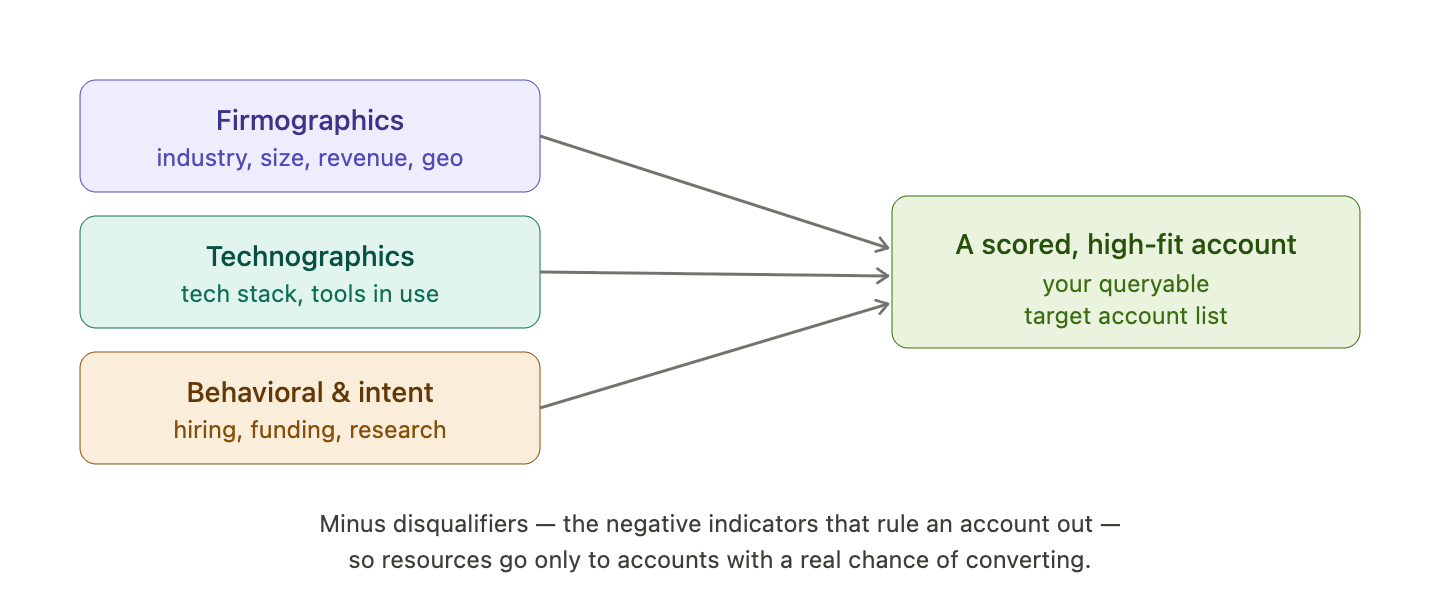
A useful ICP is built from a few stacked layers of data, and the order matters each layer narrows the universe so the next can sharpen it. Firmographics first, technographics second, intent and behavioural signals third.
Firmographics are the basic company attributes: industry, employee count, revenue, and geography. Technographics describe the tools a company runs often a strong fit signal (a company already using a complementary platform is frequently a better prospect). Behavioral and intent signals hiring patterns, funding events, and research activity are what separates a modern profile from a static firmographic checklist, turning a description into a trigger-based targeting system. Finally, disqualifiers (negative indicators that rule an account out) are what keep the profile sharp.
A good ICP is specific enough to be operationalized as a filter in your CRM or data provider and specific enough that it excludes at least 70% of your total addressable market. If your profile describes most of the market, it isn't doing its job.
Why a defined ICP matters
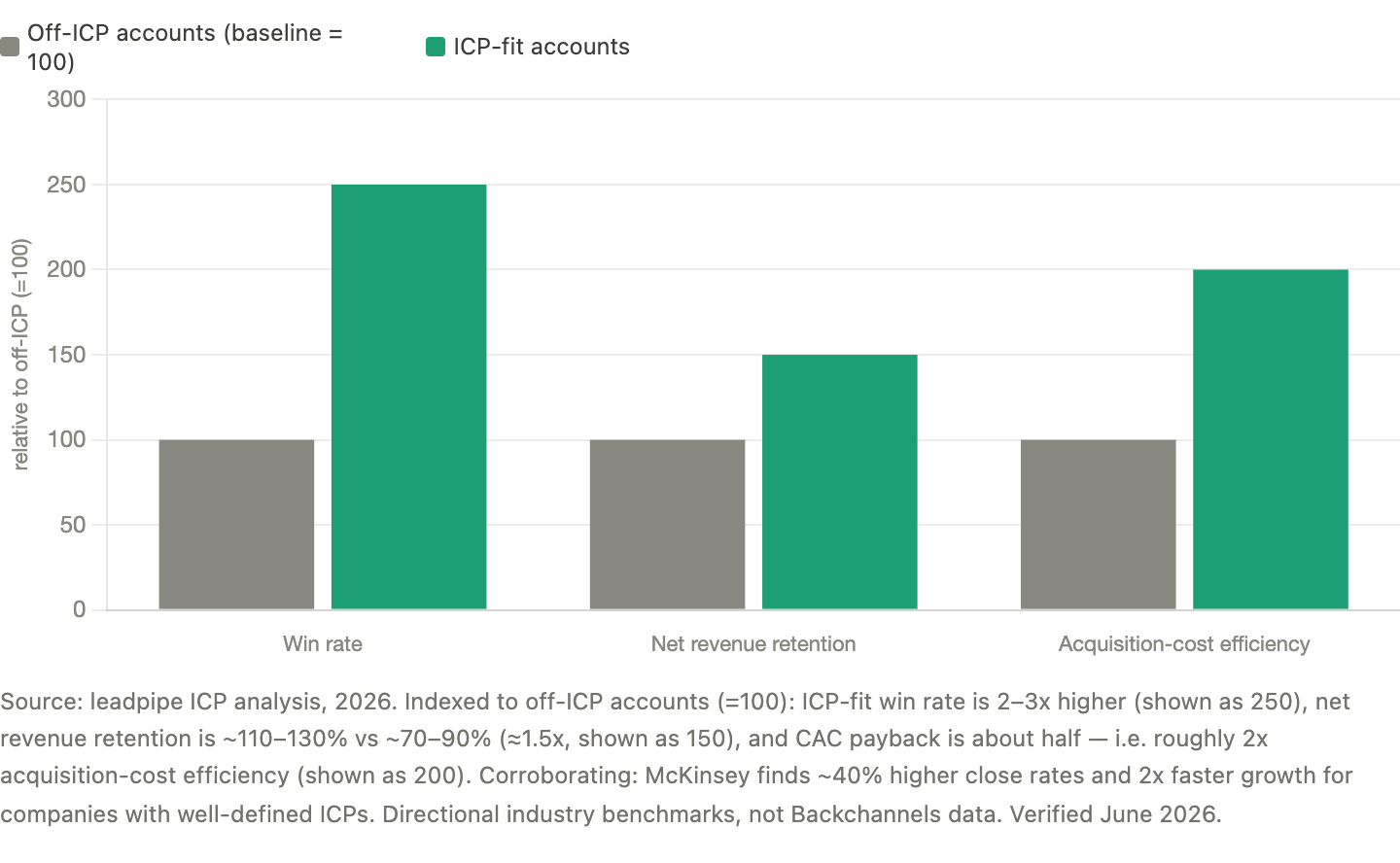
The case for a sharp ICP isn't theoretical the performance gap between in-profile and out-of-profile accounts is large and consistent across the data. Win rate on ICP-fit opportunities is 2-3x higher than off-ICP opportunities, sales cycles on fit deals run meaningfully shorter, and the retention difference is stark: Net retention on ICP-fit customers is 110-130%; on off-ICP customers it is 70-90%, with CAC payback on fit customers roughly half. At the company level, McKinsey's benchmark is blunt: companies with well-defined ICPs see 40% higher close rates and 2x faster revenue growth, and 71% of companies that exceed their revenue and lead goals have documented ICPs.
The chart below indexes the ICP-fit advantage against off-ICP accounts (set to 100) so the gap is easy to read.
How to build an ICP
Building an ICP is a structured analysis, not a brainstorm. The reliable method: start with the customers who actually paid you in the last 12–24 months, and segment them by value and retention. Your high-value, low-churn, expanding customers are the signal; everyone else is the anti-signal. For each of your best customers, document the firmographics, technographics, and buying triggers then look for the attributes that show up in the best cohort but not among the churned or never-closed ones. Those discriminating attributes are your ICP.
From there: write it as a concrete, queryable filter (not a personality sketch), translate every clause into something your CRM or data provider can actually filter on, validate it against your next batch of closed-won deals, and refresh it quarterly as a living document. Gartner frames the ICP as a foundational, organizationwide decision impacting downstream sales and marketing efforts which is why a stale or vague one quietly costs pipeline across every team.
This is precisely where Backchannels fits. Once you've defined your ICP, Backchannels scores your addressable market against it combining firmographic, technographic, and signal data so you can turn the profile into a real, prioritized target list and see which fit accounts are showing buying signals right now. It closes the gap between an ICP that lives in a doc and one that drives outbound every day.
Frequently asked questions
What does ICP stand for?
ICP stands for ideal customer profile a description of the type of company that's the best fit for your product, not the individual buyer.
What's the difference between an ICP and a buyer persona?
An ICP describes the company you want to sell to (industry, size, tech stack, signals). A buyer persona describes a person inside that company (their role, goals, and concerns). You target accounts with the ICP and engage contacts with personas.
What should an ICP include?
Five core elements: firmographics (industry, size, revenue, location), technographics (tech stack), behavioral and intent signals (hiring, funding, research), pain points or needs, and disqualifiers that rule accounts out.
How specific should an ICP be?
Specific enough to operationalize as a database filter and to exclude the majority of your total addressable market a common benchmark is excluding at least ~70%. If your profile fits most companies, it's too broad to be useful.
How often should you update your ICP?
Quarterly is the common cadence, owned by RevOps with input from sales, marketing, and customer success. ICPs drift as markets and products change, and a stale profile costs pipeline.
TRY BACKCHANNELS FREE
Your next customers are already in the database.
Backchannels gives you 225,000 verified software decision-makers. Filter to your exact ICP, preview matches for free, and push them straight into Salesforce or HubSpot. Pay per contact. No subscription, no contract.
Browse contacts freeNo credit card. Preview before you spend a credit.
No items found.
Final Thoughts
Published
September 15, 2026
Writer
Joe Backchannels
Share


Most Wanted