.png)
The Backchannel
What is intent data, and how does it work?
Featured Blog


What is intent data, and how does it work?
Intent data is information about the research behavior of potential buyers the topics they read about, the products they compare, and the content they consume used to infer which companies are actively in the market for a solution. It works by collecting these behavioral signals from across the web and from your own properties, scoring them by topic, matching them to specific accounts, and surfacing the result to your sales and marketing teams so they can reach buyers while they're actively researching rather than after they've decided.
In short, intent data answers a question that firmographics never could: not just who fits your ideal customer profile, but who is looking right now. It's the data layer that turns a static target list into a prioritized, time-sensitive one.
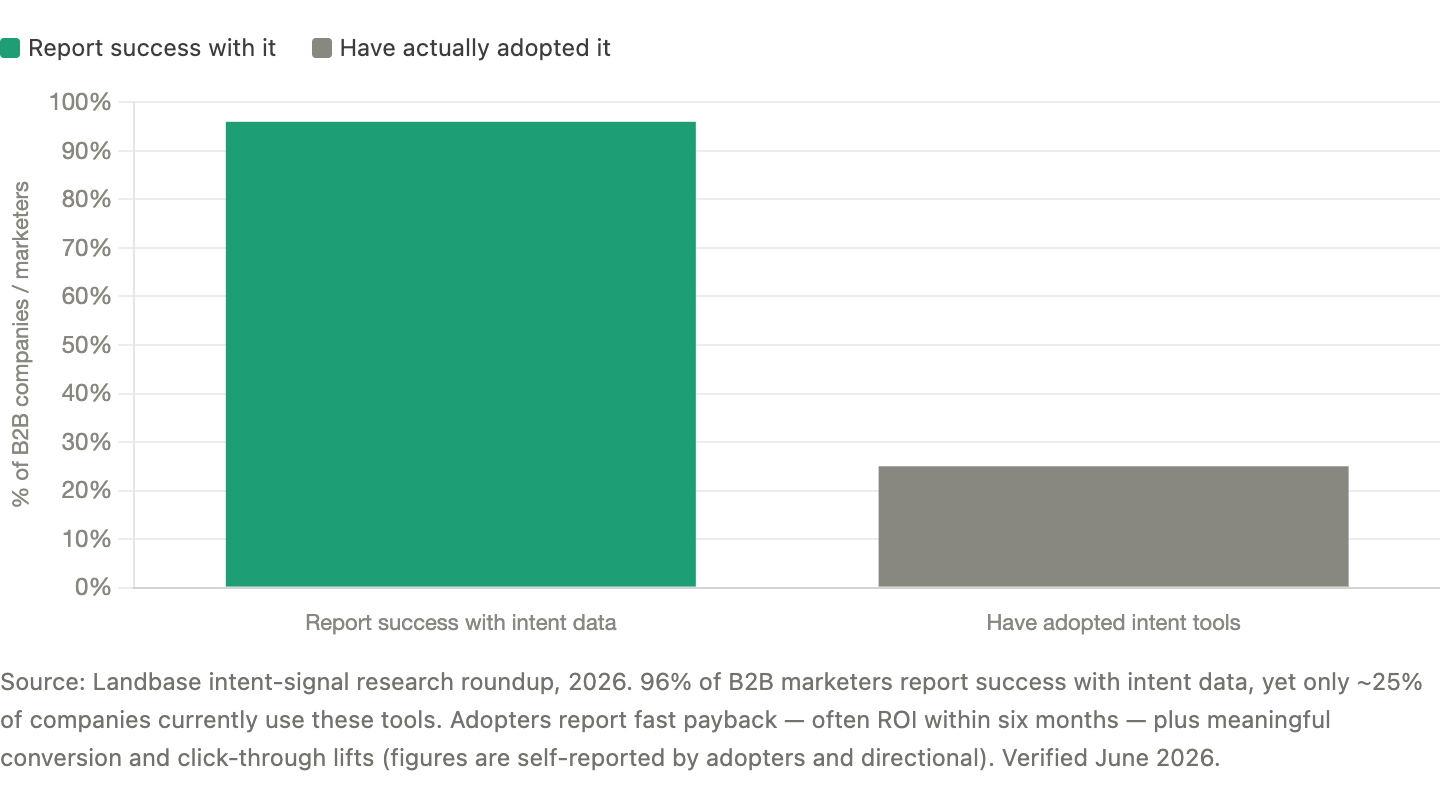
Intent data has moved from a niche tactic to a core part of the modern go-to-market stack, in large part because so much of the buying journey is now invisible. Buyers complete most of their research before ever contacting a vendor, reviewing roughly an average of 11 pieces of content before reaching out to suppliers. Yet there's a striking gap between how well intent data works and how widely it's used: 96% of B2B marketers report success with intent data, yet only 25% of companies currently leverage these tools. For the teams that adopt it early, that gap is the opportunity intent data has matured into a reliable account-prioritization signal, and the companies using it are engaging accounts while competitors remain invisible.
How intent data works, step by step
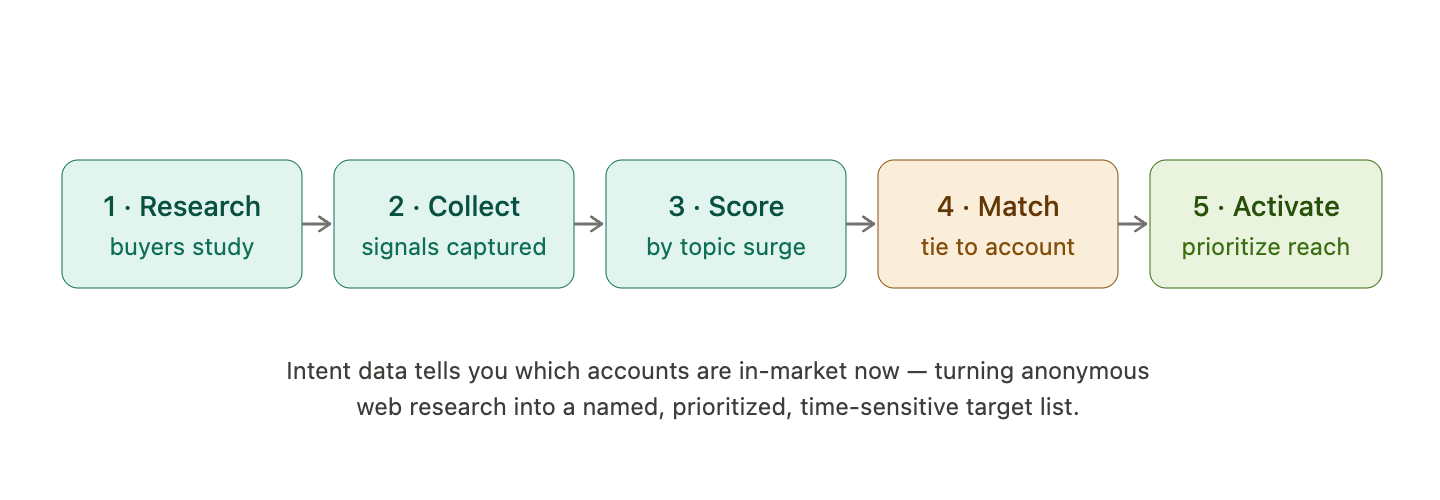
Intent data moves through a pipeline from raw behavior out on the web to a prioritized account sitting in front of a rep. Understanding the five stages makes it clear what the data can and can't tell you.
First, buyers research. Across the open web, prospects read articles, download guides, compare vendors on review sites, and attend webinars leaving a trail of behavioral signals. Second, providers collect those signals through publisher co-ops, bidstream data, and review platforms, capturing activity at enormous scale (signal volume varies dramatically by provider some capture fewer than 20 million signals monthly while others process over a trillion signals, which is why provider choice matters). Third, the signals are scored by topic to detect a meaningful surge an account reading about your category far more than its baseline. Fourth, that activity is matched to a specific company, turning anonymous research into a named account. Finally, the result is activated surfaced to your sales and marketing teams so they can prioritize the accounts showing genuine, current interest.
First-party vs. third-party intent data
Intent data divides into first-party data collected directly from company properties like website visits and email engagement, and third-party data obtained from external sources like review sites and industry publications. The two answer different questions: HubSpot
The strongest programs combine them: third-party intent surfaces accounts you didn't know were looking, and first-party intent confirms which of those have started paying attention to you specifically. Pairing the two is also what separates leaders from laggards on results.
The main sources of intent data
Most intent data comes from a handful of source types. Review-site activity (G2, Capterra, TrustRadius) is among the highest-intent, because buyers comparing vendors there are usually close to a decision. Publisher co-ops and content networks track research across thousands of B2B sites. Bidstream data infers interest from advertising signals. Technographic signals reveal what tools a company already runs. And your own first-party behavior site visits, demo requests, content downloads is often the most reliable signal of all. Each source has different precision and coverage, which is why mature programs blend several rather than relying on one.
How to use intent data effectively
Intent data only creates value when it changes prioritization. A practical motion: define your ideal customer profile, layer intent on top to find which of those accounts are showing a research surge, route the highest-combined-fit-and-intent accounts to sales first, and personalize outreach to the topic the account is actually researching. The payoff is timing and efficiency teams pairing intent-driven engagement with good targeting report meaningfully shorter sales cycles and higher conversion, because they're reaching buyers during the research window instead of interrupting accounts with no active need.
This is the core of what Backchannels does. It combines a buyer database with buying signals so you can define your ICP, find the companies that fit, and see which of them are showing intent right now bringing first-party and third-party signals together into one prioritized view, so your team spends its time on the accounts most likely to buy.
Frequently asked questions
What is intent data in simple terms?
It's data about what potential buyers are researching online, used to figure out which companies are actively looking for a solution like yours right now so you can reach them at the right moment.
What's the difference between first-party and third-party intent data?
First-party intent is behavior on your own properties (your site, email, product), telling you who's engaging with you. Third-party intent is research behavior across the wider web, telling you who's in-market for your category even if they've never visited you.
Is intent data the same as a buying signal?
Intent data is one type of buying signal specifically the behavioral, research-based kind. "Buying signal" is broader and also includes organizational changes like funding or hiring.
How accurate is intent data?
Accuracy varies by provider and source. Signal volume ranges from under 20 million to over a trillion signals per month between providers, so coverage and precision differ widely which is why blending multiple sources and pairing intent with fit data produces the most reliable results.
How do companies use intent data?
To prioritize. It tells sales and marketing which accounts to focus on first, when to reach out, and what topic to lead with concentrating effort on accounts showing genuine, current interest.
TRY BACKCHANNELS FREE
Your next customers are already in the database.
Backchannels gives you 225,000 verified software decision-makers. Filter to your exact ICP, preview matches for free, and push them straight into Salesforce or HubSpot. Pay per contact. No subscription, no contract.
Browse contacts freeNo credit card. Preview before you spend a credit.
No items found.
Final Thoughts
Published
September 14, 2026
Writer
Joe Backchannels
Share


Most Wanted