.png)
The Backchannel
What is account-based marketing (ABM)?
Featured Blog


Account-based marketing (ABM) is a B2B go-to-market strategy that concentrates sales and marketing effort on a defined set of high-value target accounts, treating each account (or a tight cluster of similar accounts) as a "market of one." Instead of casting a wide net to capture as many leads as possible, ABM inverts the approach: identify your highest-value target accounts first, then build personalized campaigns designed to engage the specific people who make buying decisions at those companies. Pavilion
That inversion is the whole idea. Traditional demand generation optimizes for lead volume and works down a funnel; ABM starts at the account level and coordinates sales and marketing around winning specific companies. It exists because most of the market isn't buying at any given moment only an estimated 5% of B2B accounts are actively looking to buy at any given time so concentrating resources on the right accounts beats spraying everyone.
ABM vs. traditional demand generation
The two approaches aren't opposites you must choose between, but they optimize for different things:
The headline reason teams adopt ABM is efficiency of return: across study after study, 87% of marketers say that ABM delivers a higher ROI than other marketing strategies, and ABM-sourced deals tend to be larger Forrester's data puts deal sizes 11-50% larger than non-ABM, with ABM-sourced deals closing around a third bigger on average.
The three types of ABM
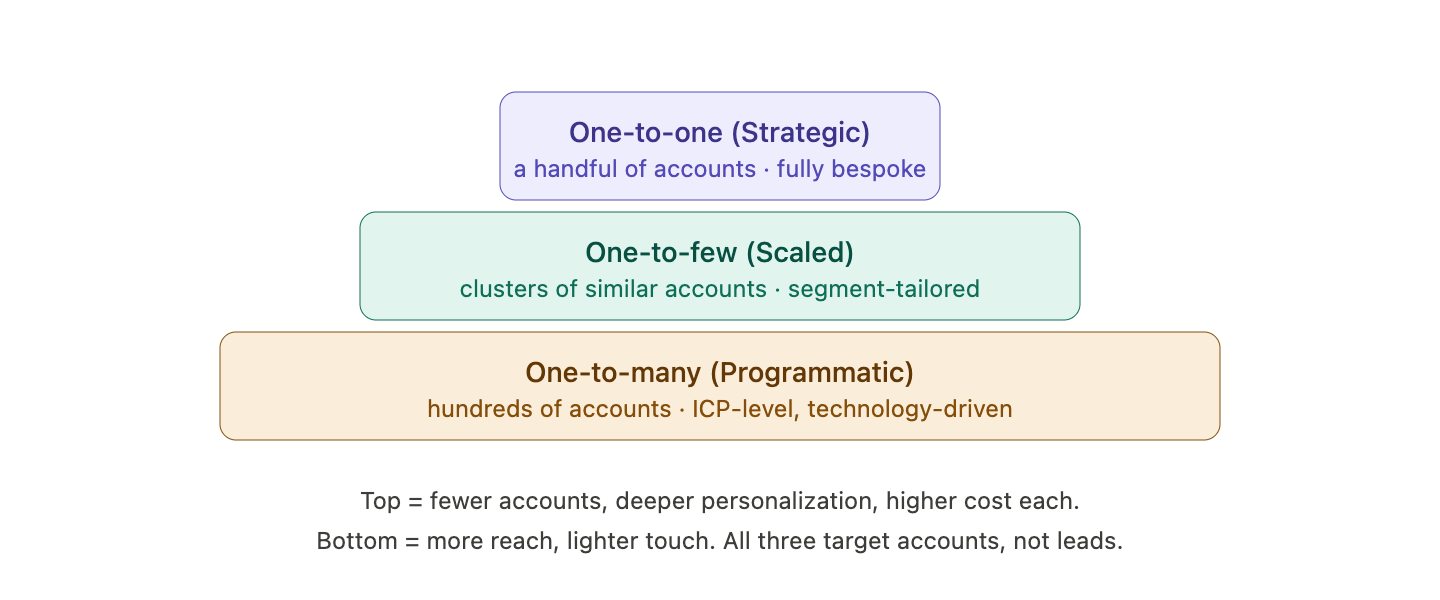
ABM isn't one-size-fits-all. It runs on a spectrum of three tiers that trade reach for depth of personalization.
Does ABM work? What the data shows
ABM's effectiveness scales with how precisely it's executed and the clearest evidence is in win rates by personalization depth. Generic, lightly targeted ABM performs only modestly better than broad demand gen, but deeply personalized, account-specific programs convert at a dramatically higher rate.
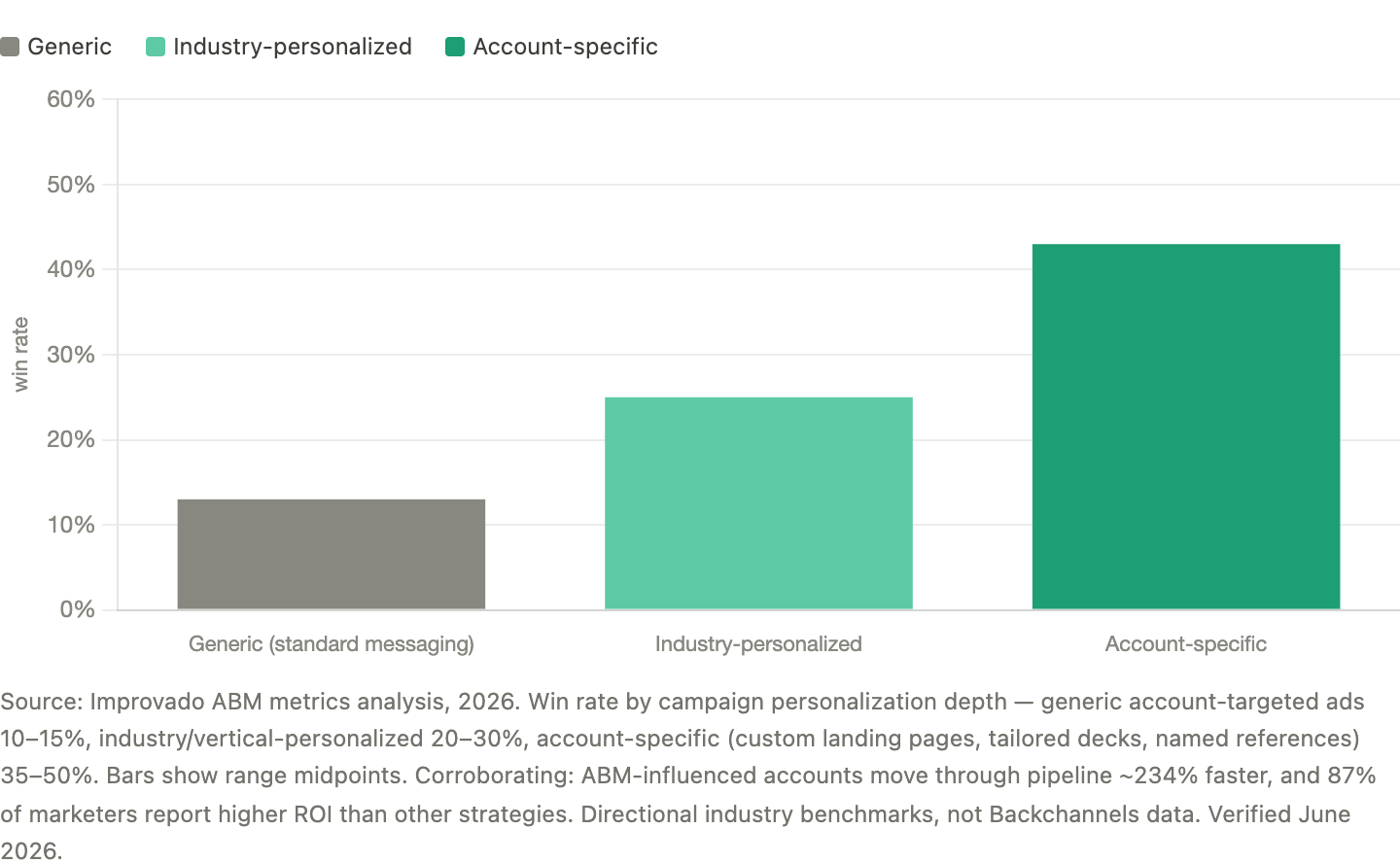
The lift shows up beyond win rates, too: Ad-influenced accounts progress through the sales pipeline 234% faster than those not influenced by targeted advertising, and mature programs report the strongest returns of all. The catch is execution discipline there's a wide gap between claiming ABM and doing it well. 80% of organizations say they're running ABM. Only 29% measure it with ABM-aligned metrics, and that measurement gap is where most programs quietly underperform.
How to run an ABM program
A practical ABM motion follows a clear sequence. Start by defining your ideal customer profile, then build the target account list from it. Map the buying committee at each account the multiple stakeholders who'll shape the decision. Coordinate sales and marketing on personalized plays for those accounts and contacts, choosing the right tier (one-to-one, one-to-few, or one-to-many) based on each account's value. Finally, measure at the account level engagement, pipeline, velocity, and deal size not by raw lead counts.
The most important shift in 2026 is that the best programs are signal-based rather than calendar-based: they use real-time intelligence to trigger plays rather than relying on static account lists and quarterly campaign calendars. Reaching an account during an active buying window, with a message informed by what's actually happening there, is what separates ABM that compounds from ABM that stalls.
This is where Backchannels fits the ABM motion. ABM lives or dies on the quality of the target account list and the timing of outreach and that's exactly what a buyer database with buying signals provides: define your ICP, build a precise target list of accounts that genuinely fit, and see which of them are showing in-market signals right now, so your account plays land during the window when they can actually move a deal.
Frequently asked questions
What is account-based marketing in simple terms?
It's a B2B strategy where sales and marketing focus their effort on a specific list of high-value target companies, personalizing outreach to the decision-makers at those accounts instead of chasing a broad pool of leads.
What's the difference between ABM and demand generation?
Demand generation attracts a wide audience and optimizes for lead volume. ABM starts with specific target accounts and optimizes for engagement and revenue within them. Demand gen works down a funnel; ABM inverts it.
What are the three types of ABM?
One-to-one (strategic) targets a handful of accounts with fully bespoke campaigns; one-to-few (scaled) targets clusters of similar accounts with segment-tailored campaigns; one-to-many (programmatic) targets hundreds of accounts at the ICP level using technology.
Does ABM actually work?
The data is consistent: most marketers report higher ROI from ABM than other strategies, deals run larger, and pipeline moves faster but the gains scale with personalization depth and disciplined, account-level measurement.
How do you measure ABM?
With account-level metrics: account engagement, target-account pipeline, pipeline velocity, account win rate, deal size, and ROI by tier rather than lead volume or cost per lead.
TRY BACKCHANNELS FREE
Your next customers are already in the database.
Backchannels gives you 225,000 verified software decision-makers. Filter to your exact ICP, preview matches for free, and push them straight into Salesforce or HubSpot. Pay per contact. No subscription, no contract.
Browse contacts freeNo credit card. Preview before you spend a credit.
No items found.
Final Thoughts
Published
September 16, 2026
Writer
Joe Backchannels
Share


Most Wanted