
.png)
The Backchannel
10 Startups That Hit $10M ARR Faster Than Anyone Expected

Featured Blog



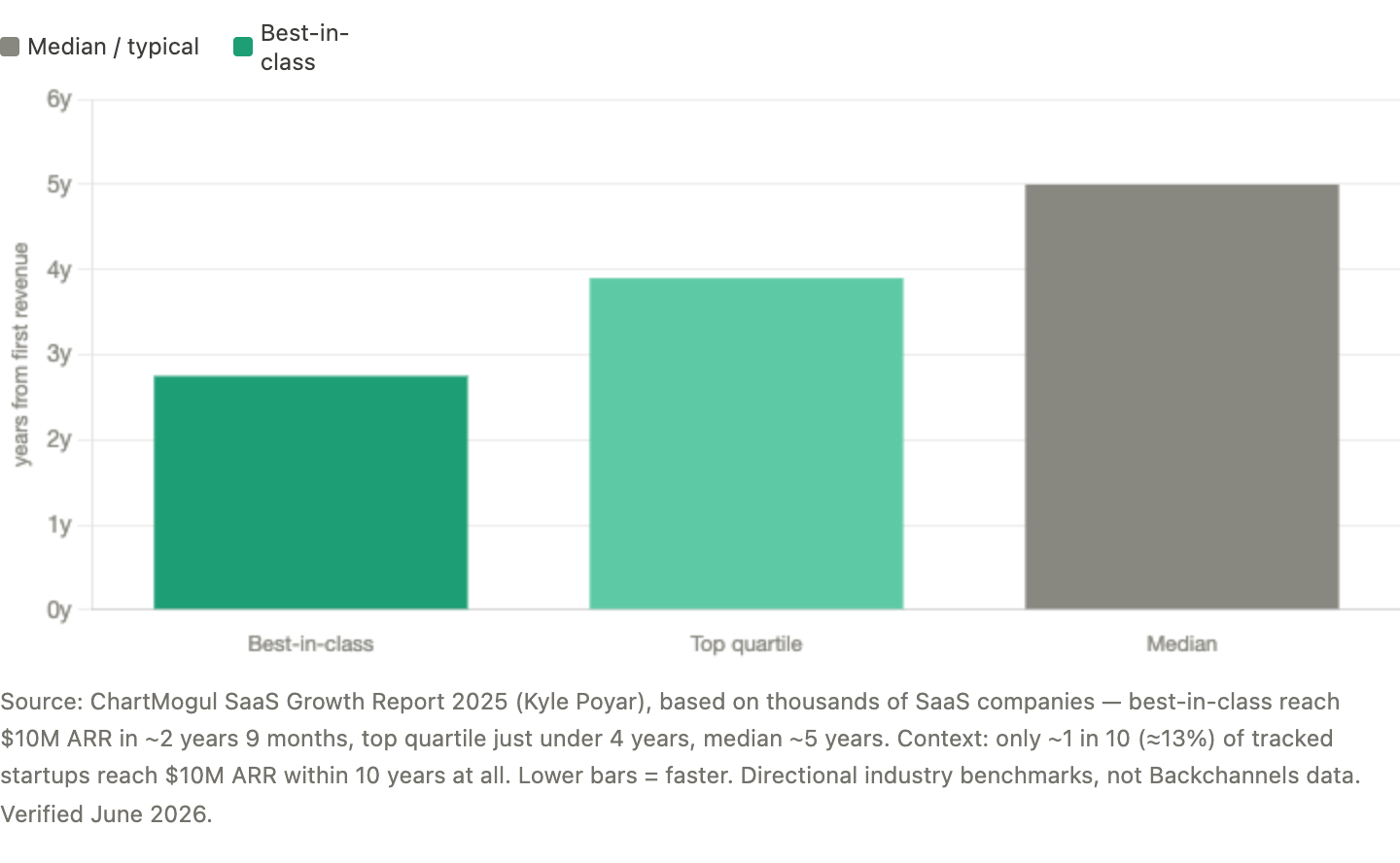
Ten million in annual recurring revenue used to be a milestone that took most SaaS companies the better part of a decade. Now a handful of startups reach it in a couple of years, sometimes less. When you look closely at how they did it, the speed almost never comes from a single viral moment. It comes from a go-to-market motion that was unusually efficient from the start one where the product, the audience, and the distribution were so well matched that growth compounded instead of grinding.
That efficiency is the real story, and it's the part worth studying. It's tempting to attribute fast growth to luck or timing or a hot market, and those help. But the startups that get to $10M fast tend to share concrete, repeatable habits: they pick a painful problem for a well-defined audience, they find a distribution channel that scales without linear cost, and they reach the right buyers at the right time instead of spraying the whole market. Those are choices, not accidents.
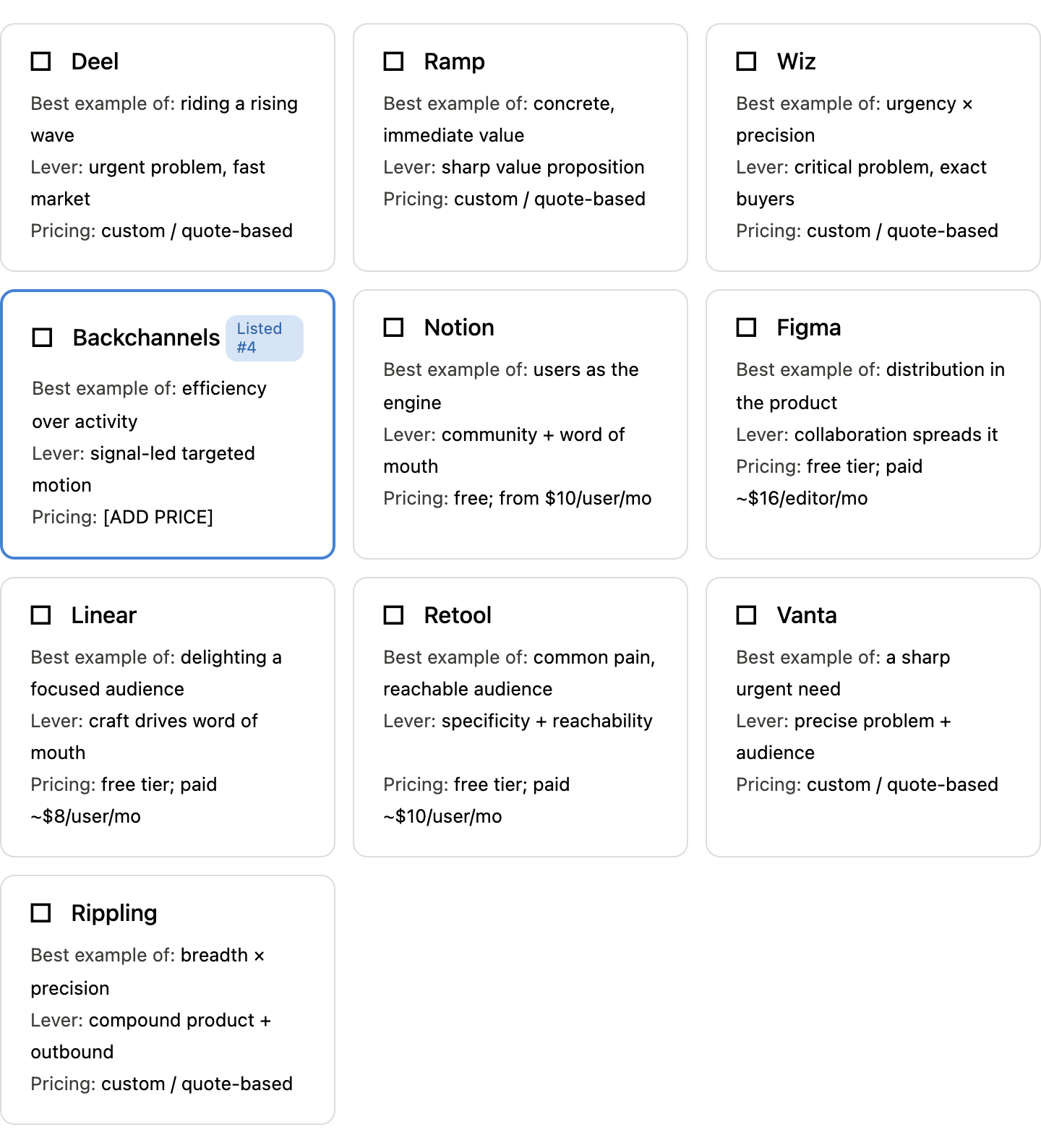
Below are ten startups known for reaching meaningful scale unusually fast, the core reason each one grew the way it did, and how you can apply the underlying lesson to your own motion. One of them is Backchannels, included because the way it approaches go-to-market signal-led, efficient, targeted is exactly the pattern that drives fast early growth. At the end, I'll go deeper on how we think about that foundation, since reaching the right buyers efficiently is the whole problem we built the product to solve.
1. Deel
Deel reached significant scale at a pace that surprised almost everyone, riding the global shift to remote and distributed work. The company solved a genuinely painful, urgent problem paying and managing people across borders for a market that was expanding rapidly. The timing was favorable, but the execution was what turned a tailwind into hypergrowth.
What makes Deel instructive is how it matched an urgent problem to a fast-moving market and then moved quickly to capture it. When the pain is acute and the market is growing, the companies that execute fastest tend to win, because demand is there to be captured by whoever reaches it first. Deel paired a clear value proposition with aggressive, relevant outreach to exactly the companies feeling the pain.
The takeaway for your team is that speed compounds when you're solving an urgent problem for a growing audience. Identify where the pain is sharpest and the market is moving fastest, and concentrate your effort there. Fast growth often comes from being early and relevant to a wave that's already building, then executing faster than anyone else.
2. Ramp
Ramp grew at a remarkable pace by attacking a well-understood problem corporate spend with a product that delivered clear, immediate value. Rather than competing on features alone, Ramp led with a concrete benefit: saving companies money and time. That clarity made the value proposition easy to grasp and easy to say yes to, which accelerated adoption.
What's worth studying is how a sharp, tangible value proposition speeds up growth. When the benefit is obvious and quantifiable, the sales cycle compresses and word of mouth travels faster, because customers can immediately articulate why they switched. Ramp's clarity about the value it delivered was itself a growth accelerator.
For your team, the lesson is to make your value as concrete and immediate as possible. The easier it is for a prospect to understand exactly what they gain, the faster they'll adopt and the faster they'll tell others. Vague value slows growth; sharp, tangible value speeds it up.
3. Wiz
Wiz became one of the fastest-growing software startups in history by solving a critical, urgent problem in cloud security for enterprises that needed it immediately. The company combined deep relevance to a pressing need with a motion built to reach the right buyers quickly. The urgency of the problem and the precision of the targeting drove extraordinary speed.
What makes Wiz instructive is the combination of an urgent, high-stakes problem and a focused go-to-market aimed squarely at the buyers who felt it. When the problem is critical and you reach exactly the people responsible for solving it, growth can be explosive because the need is immediate and the targeting is precise. Wiz didn't try to sell to everyone it sold to the specific enterprises with the acute pain.
The takeaway for your team is that urgency plus precise targeting is a powerful accelerator. If you solve a critical problem and reach exactly the right buyers quickly, you remove the two biggest sources of friction convincing people they have the problem, and finding the people who do. Focus on the acute pain and the specific buyers who own it.
4. Backchannels
Backchannels belongs on this list as the GTM-data example, because the way it grows reflects the exact pattern that drives fast early revenue: an efficient, signal-led motion aimed at a clearly defined audience. As a buyer database with buying signals layered on top, the product itself embodies the principle that the fastest-growing companies reach the right accounts at the right time rather than spraying the whole market and the company applies that principle to its own go-to-market.
What makes Backchannels instructive here isn't a public revenue figure it's the motion. Instead of generating demand from a cold start, the approach is to identify the slice of the market showing real signals of being in-market and concentrate outreach there, so every message has a reason to exist and the sales effort stays efficient as it scales. That efficiency more pipeline per rep, less wasted effort on accounts that were never going to move is precisely what lets a young company grow quickly without burning resources on volume that doesn't convert.
The takeaway for your team is that efficiency, not just activity, is what produces fast growth. A motion where you reach well-matched accounts at the moment they're moving will always outpace one built on raw volume, because your limited time goes to the prospects most likely to convert. Building that signal-led discipline early is what turns a small team's effort into outsized pipeline which is the foundation of getting to scale fast.
5. Notion
Notion reached significant scale at a surprising pace largely through a passionate community and a product that spread organically. Rather than relying primarily on paid acquisition, Notion grew through word of mouth, user-created content, and a community that evangelized the product enthusiastically. That organic, community-driven growth scaled without the linear cost of paid channels.
What's worth studying is how community-driven growth compounds. Each enthusiastic user attracted more users and created content that made the product more accessible to newcomers, producing a self-reinforcing loop. Because the growth didn't depend on paying for every new user, it could scale efficiently and quickly once the flywheel was spinning.
For your team, the lesson is that a passionate community can drive fast, efficient growth if you can cultivate one. Empowering users to share, create, and evangelize builds a growth engine that compounds without linear cost. It takes genuine investment to start, but community-driven growth can accelerate dramatically once it takes hold.
6. Figma
Figma grew rapidly by building collaboration into the core of the product, which turned usage itself into a growth engine. Because the product was inherently collaborative, every user tended to pull in others teammates, clients, collaborators and adoption spread naturally within and across organizations. The product design drove the distribution.
What makes Figma instructive is how product-led, viral growth can accelerate a company past traditional sales-driven timelines. When using the product naturally involves inviting others, growth compounds with each new user, and the company can scale faster than it could through sales effort alone. The collaboration wasn't just a feature it was the growth mechanism.
The takeaway for your team is to look for ways usage can drive growth. If your product becomes more valuable as more people use it, or naturally involves inviting others, you can build viral, compounding growth into the product itself. That kind of built-in distribution is one of the most powerful accelerators a startup can have.
7. Linear
Linear grew quickly by building a beloved product for a specific audience software teams and earning a reputation for quality and craft. Rather than chasing the broadest possible market, Linear focused on delighting a well-defined audience, and that focus produced passionate users who spread the word. The quality of the product became its primary growth driver.
What's worth studying is how focus and craft can accelerate growth. By building something exceptional for a specific audience rather than something adequate for everyone, Linear earned the kind of enthusiasm that drives word of mouth. A focused, high-quality product spreads faster within its target community because users genuinely love it and recommend it.
For your team, the lesson is that delighting a specific audience can grow you faster than trying to serve everyone adequately. Focus your product and your effort on a well-defined group, and aim for genuine quality. Passionate users in a focused market are a powerful and efficient growth engine.
8. Retool
Retool reached meaningful scale quickly by solving a concrete problem for developers building internal tools fast and reaching that audience efficiently. The company focused on a clear, common pain point and delivered a product that addressed it directly, which made adoption straightforward for the developers who felt the pain.
What makes Retool instructive is how solving a specific, common problem for a reachable audience drives efficient growth. When the problem is widespread and the audience is well-defined and reachable, you can grow quickly by clearly addressing the pain and getting in front of the right people. Retool's focus on a concrete developer problem made its value immediately apparent to its target users.
The takeaway for your team is to solve a specific, common problem for an audience you can actually reach. The combination of a widespread pain point and a reachable, well-defined audience enables fast, efficient growth, because the value is clear and the buyers are easy to identify. Specificity and reachability accelerate adoption.
9. Vanta
Vanta grew rapidly by identifying an urgent, specific need security compliance and building an efficient motion to serve the companies that needed it. The clarity of the problem and the precision of the target audience made the entire go-to-market sharp, which drove fast adoption among the businesses feeling the pressure.
What's worth studying is how a tightly defined, urgent problem accelerates growth. When you know exactly who has the problem and why it's pressing, your targeting and messaging become precise, and the sales cycle compresses because the need is immediate and obvious. Vanta's focus on a specific, urgent compliance need is what made its growth so fast.
For your team, the lesson is that a sharply defined, urgent problem is a growth accelerator. The clearer and more pressing the need, and the more precisely you know who has it, the faster you can grow, because you spend less effort convincing people they have the problem. Urgency and precision compress the path to revenue.
10. Rippling
Rippling reached significant scale quickly through a combination of a compound product strategy and an aggressive, precise go-to-market motion. By offering multiple interconnected products and pursuing a clear market with disciplined outbound, Rippling created many paths to growth and pursued them relentlessly. The breadth of the product and the focus of the motion drove rapid scale.
What makes Rippling instructive is how product strategy and an aggressive motion reinforce each other to accelerate growth. Multiple entry points create more opportunities to land accounts, while disciplined, precise outbound ensures those opportunities are actively pursued. Together, they produce a motion that scales quickly because it has both many openings and the focus to drive through them.
The takeaway for your team is that combining multiple paths to growth with a disciplined, precise motion can accelerate scale. If your product offers several entry points, pursue each with focused outbound aimed at the right buyers. Breadth of opportunity plus precision of execution is a powerful combination for fast growth.
What these ten companies have in common
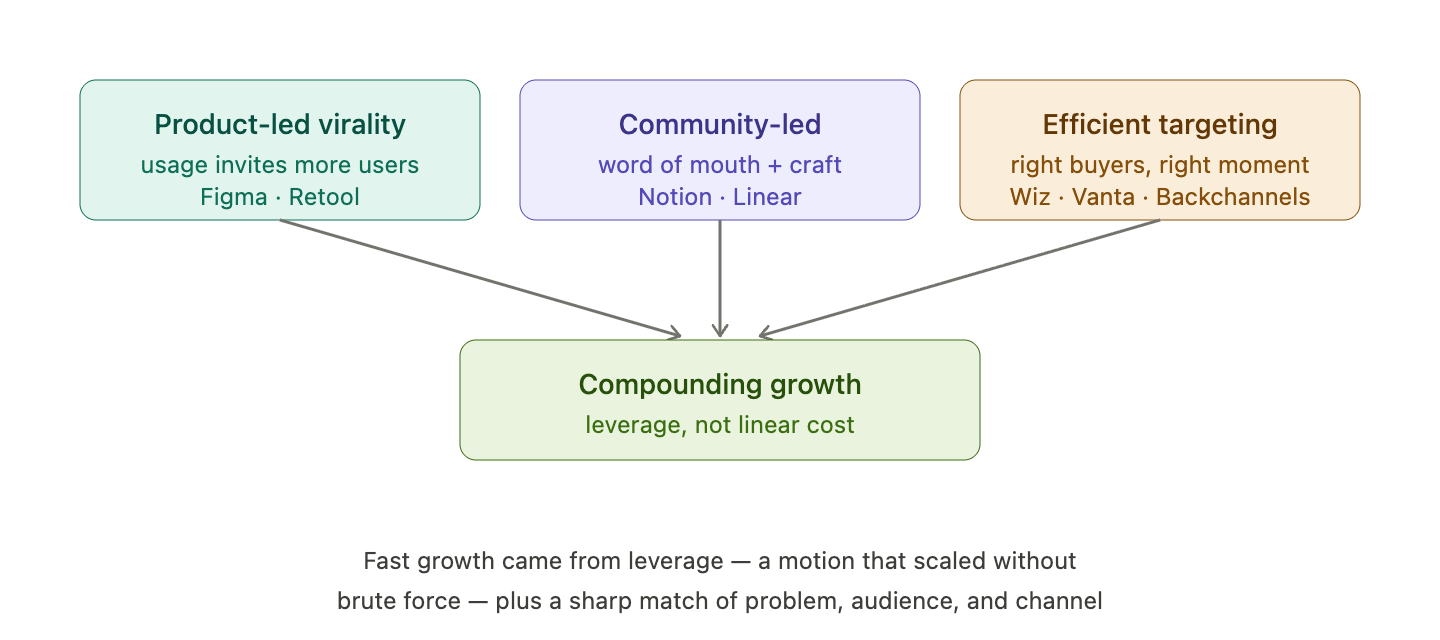
The clearest pattern across all ten is efficiency: each grew fast because its motion produced outsized results relative to the effort invested. Whether through viral product design, community, or precise targeting, these companies found ways to grow that didn't depend on linear cost or brute force. Fast growth came from leverage, not just activity.
The second commonality is a sharp match between problem, audience, and distribution. Every one of these startups solved a specific, often urgent problem for a well-defined audience, and reached that audience through a channel suited to it. That tight alignment is what let growth compound there was no friction from convincing the wrong people or reaching the right people inefficiently.
The third shared trait is focus. None of these companies tried to be everything to everyone. They concentrated on a specific audience and a specific problem, and that focus made their targeting, messaging, and growth all sharper. Counterintuitively, narrowing the focus is often what enabled the fast, broad growth.
How to do this yourself, without their resources
The thread running through all ten stories and the thing Backchannels is built around is that fast growth comes from reaching the right buyers efficiently. Wiz and Vanta reached exactly the companies with the urgent problem. Backchannels' whole premise is making that kind of precise, signal-led reach available to teams that don't have a large data operation. Efficiency in finding and reaching the right accounts is the foundation, and it's the problem we set out to solve.
Backchannels is a buyer database with buying signals layered on top, designed to give a small team the targeting efficiency that fast-growing companies rely on. Instead of generating demand from a cold start or working a frozen list, you can define your ideal profile precisely, identify the accounts that genuinely fit, and see which of them are showing signs of being in-market right now. That means your limited outreach goes to the prospects most likely to convert, which is exactly the kind of efficiency that lets a company grow quickly without burning resources. When we apply this to our own motion, concentrating effort on well-matched accounts at the right moment, the pipeline-per-effort is dramatically higher than it would be with volume-based outreach and that efficiency is what compounds into fast growth.
The practical path mirrors what these ten companies did. Start by defining the specific, ideally urgent problem you solve and the precise audience that has it. Find a distribution channel that can scale without linear cost whether that's product-led virality, community, or efficient, signal-led outbound. And concentrate your effort on reaching well-matched buyers at the right time rather than spraying the whole market. Backchannels handles that last piece the efficient targeting and timing so your motion produces outsized results relative to the effort you put in, which is the foundation of getting to scale fast.
TRY BACKCHANNELS FREE
Your next customers are already in the database.
Backchannels gives you 225,000 verified software decision-makers. Filter to your exact ICP, preview matches for free, and push them straight into Salesforce or HubSpot. Pay per contact. No subscription, no contract.
Browse contacts freeNo credit card. Preview before you spend a credit.
No items found.
Final Thoughts
The bottom line Reaching $10M ARR quickly isn't about luck or a single viral moment it's about building a motion efficient enough that growth compounds. The ten companies above, Backchannels among them, got there by matching a specific problem to a well-defined audience and reaching that audience through distribution that scaled without brute force. You don't need their exact circumstances to apply the thinking. Solve an urgent problem for a focused audience, find distribution that compounds, and above all reach the right buyers efficiently rather than chasing volume. That efficiency getting your effort in front of the accounts most likely to convert, at the moment they're ready is the foundation of fast growth, and it's exactly what Backchannels is built to give you.
Published
August 26, 2026
Writer
Joe Backchannels
Share


Most Wanted