
.png)
The Backchannel
10 SaaS Companies With the Smartest Go-to-Market Strategies in 2026

Featured Blog



Go-to-market is where good products either find their market or quietly die. You can build something genuinely useful and still lose, because the hard part was never the product it was figuring out who it's for, how to reach them, how to price it, and how to turn early traction into a repeatable engine. The companies that get this right don't just grow; they grow efficiently, which in 2026's tighter capital environment matters more than it has in years.
What makes a go-to-market strategy "smart" isn't a single clever tactic. It's coherence the product, the pricing, the channel, and the sales motion all reinforcing each other instead of pulling in different directions. The companies below have that coherence. Each one made a defining strategic choice about how to reach its market, and each choice is worth understanding because the underlying principle transfers even if the specifics don't.
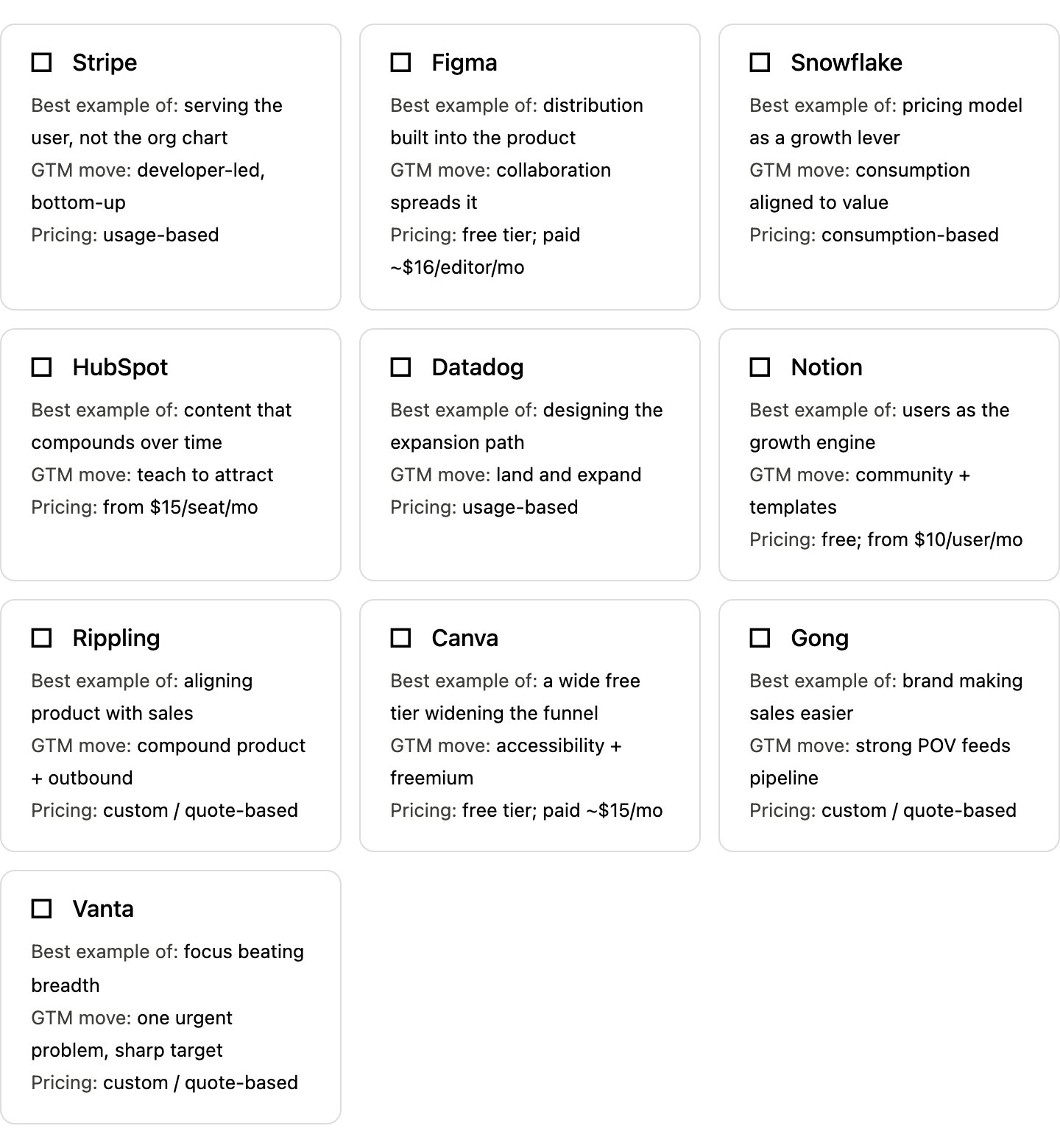
Below are ten SaaS companies whose go-to-market approaches are worth studying in 2026, the core strategic idea behind each, and how you can apply that thinking to your own motion. At the end, I'll cover the part that underpins almost every smart GTM strategy knowing exactly who your market is and reaching them at the right time and how we think about that at Backchannels.
1. Stripe
Stripe's go-to-market genius was choosing a channel almost no one was serving well: developers. Rather than selling to executives through traditional enterprise sales, Stripe made its product so easy for developers to adopt that adoption happened bottom-up, often before any purchasing decision was formally made. The documentation, the clean API, and the low-friction onboarding were the go-to-market strategy.
What makes Stripe instructive is the insight that the buyer and the user aren't always the same person, and serving the user brilliantly can be the most powerful path to the buyer. By winning developers, Stripe earned its way into companies through the people who actually had to live with the product, building loyalty that top-down sales rarely achieves.
The takeaway for your own motion is to identify who actually adopts and champions your product, and serve them so well that they pull you into the organization. Sometimes the smartest go-to-market move is to win the end user's heart rather than chase the org chart especially if your product touches people who'll advocate for it internally.
2. Figma
Figma's strategy combined a genuinely collaborative product with a bottom-up motion that turned every user into a potential evangelist. Because the product was built around collaboration, adoption naturally spread one designer brought in another, who brought in a developer, who brought in a product manager. The product's core design made organic, viral expansion almost inevitable.
What's worth studying is how Figma aligned its product design with its growth model. Collaboration wasn't just a feature; it was the engine of distribution. Every new user made the product more valuable to existing users and pulled more people in, which meant growth compounded inside accounts without requiring a salesperson for every seat.
The lesson for your team is to look for ways your product can spread through use. If collaboration, sharing, or network effects can be built into how the product works, growth becomes partly self-propelling. Designing distribution into the product itself is one of the smartest go-to-market moves available though it requires the product to genuinely get better as more people use it.
3. Snowflake
Snowflake's go-to-market intelligence shows up in its consumption-based pricing and its enterprise focus. Rather than locking customers into large seat-based contracts, Snowflake tied revenue to actual usage, which lowered the barrier to starting and let accounts grow naturally as they consumed more. The pricing model itself aligned the company's success with the customer's.
What makes Snowflake instructive is how pricing became a growth strategy. Consumption pricing meant customers could start small and scale spending as they saw value, reducing the risk of adoption and creating a natural expansion path. The company grew as its customers grew, which is a far healthier dynamic than betting everything on big upfront commitments.
For your team, the takeaway is to consider how your pricing model shapes your growth. A model that lets customers start small and expand as they see value can dramatically reduce friction and create built-in expansion. Pricing isn't just a finance decision it's one of the most underrated levers in go-to-market.
4. HubSpot
HubSpot built its go-to-market around content and education, essentially creating the inbound marketing playbook and then living it. By producing enormous amounts of genuinely useful content, HubSpot attracted its target audience, built trust, and generated demand that fed its sales motion. The content was the top of the funnel, and it ran at scale.
What's worth studying is the long-term compounding nature of this strategy. Content created years ago continues to attract and educate prospects, building an asset that appreciates over time rather than a cost that resets each quarter. HubSpot turned marketing into a durable engine rather than a series of campaigns, and that engine kept feeding the sales team qualified interest.
The lesson for your team is that educational content can be a powerful, compounding go-to-market channel. Teaching your audience builds trust and attracts the right people, and the asset keeps working long after it's published. It's slow to start, but few channels compound as reliably over time.
5. Datadog
Datadog's go-to-market strength lies in its land-and-expand motion. Customers adopt one product to solve a specific problem, then expand to additional products as they discover more value, with usage spreading across teams. The strategy is built on getting a foothold and then growing systematically within the account.
What makes Datadog instructive is the discipline of designing for expansion from the start. The product portfolio is structured so that solving one problem naturally surfaces adjacent ones the company can also solve, turning a single entry point into a growing footprint. Each new product becomes a reason for the customer to consolidate more of their spend with Datadog.
For your team, the takeaway is to think about how an initial adoption can expand over time. If you can land with one clear use case and then grow into adjacent ones, you build a motion where existing customers become a major source of growth. Designing the expansion path deliberately is far more efficient than constantly chasing new logos.
6. Notion
Notion's go-to-market combined a flexible, beloved product with a community-driven growth model. Rather than relying solely on traditional marketing, Notion cultivated a passionate community that created templates, shared workflows, and evangelized the product. The community became a distribution and education channel that the company couldn't have built through paid channels alone.
What's worth studying is how Notion turned its users into its marketing engine. By empowering people to build and share, the company created a self-reinforcing loop where users attracted more users and produced content that made the product more useful and accessible. The community did work that would otherwise require an enormous marketing budget.
The lesson for your team is that a passionate community can become one of your most powerful go-to-market assets. If you can empower your users to create, share, and evangelize, you build a growth engine that's hard for competitors to replicate. Community takes time and genuine investment, but it compounds in ways paid channels don't.
7. Rippling
Rippling's go-to-market intelligence shows up in its compound product strategy and its aggressive, precise outbound. By building a suite of interconnected products around a central system of record, Rippling created multiple entry points and expansion paths, then paired that with a disciplined outbound motion aimed at a clear market. The product strategy and the sales motion reinforced each other.
What makes Rippling instructive is the combination of product breadth and sales focus. The compound product gives the company many ways to land and expand, while the aggressive outbound ensures it's actively pursuing its market rather than waiting for demand. Together, they create a motion that's both efficient and hard to compete against.
For your team, the takeaway is that product strategy and go-to-market strategy should reinforce each other. If your product offers multiple entry points and expansion paths, an active outbound motion can pursue each one. The smartest strategies align what you build with how you sell it, so each makes the other stronger.
8. Canva
Canva's go-to-market combined radical accessibility with a freemium model that drove massive top-of-funnel adoption. By making design approachable for non-designers and offering a genuinely useful free tier, Canva attracted an enormous user base, then converted a portion to paid as their needs grew. The accessibility was the growth strategy.
What's worth studying is how Canva used a free tier to build scale and then monetized through expanding needs. The free product wasn't a loss leader so much as the top of a very wide funnel, bringing in millions of users from which paid conversions naturally emerged. The breadth of adoption created a huge base to monetize over time.
The lesson for your team is that a well-designed free tier can be a powerful engine for building scale, provided there's a natural path from free to paid as users' needs grow. Accessibility widens the funnel dramatically, but it only works as go-to-market if the upgrade path is real and the free tier doesn't cannibalize what people would otherwise pay for.
9. Gong
Gong's go-to-market strength combines a strong, data-driven brand with disciplined sales execution. The company built a distinctive market presence around insights and a clear point of view, which generated demand, then backed it with a sales motion known for precise targeting and sharp messaging. The brand and the sales motion worked together to punch above the company's weight.
What makes Gong instructive is how it used thought leadership and a strong brand to support its sales efforts. By becoming a recognized voice with a clear perspective, Gong made its outbound more effective prospects already knew and trusted the brand before a rep reached out. The demand generation and the sales execution reinforced each other.
For your team, the takeaway is that building a strong brand and point of view makes every other part of your go-to-market easier. When prospects recognize and trust you before you reach out, your sales motion works better. Brand isn't separate from sales it's what makes sales more efficient, especially in crowded markets.
10. Vanta
Vanta's go-to-market intelligence lies in identifying an urgent, specific need and building a motion around solving it efficiently. By focusing on a clear, pressing problem for a well-defined audience, Vanta created a strategy where the value proposition was immediate and the target market was obvious. The clarity of the problem made the entire go-to-market sharper.
What's worth studying is how a tightly defined problem and audience make go-to-market more efficient. When you know exactly who has the problem and why it's urgent, your targeting, messaging, and sales motion all become clearer and more effective. Focus beats breadth, especially early, because every part of the motion can be aimed at a specific, well-understood need.
The lesson for your team is that a sharply defined problem and audience is a go-to-market advantage. The clearer and more urgent the need you solve, and the more precisely you know who has it, the more efficient your entire motion becomes. Resist the urge to be everything to everyone focus is what makes early go-to-market work.
What these ten companies have in common
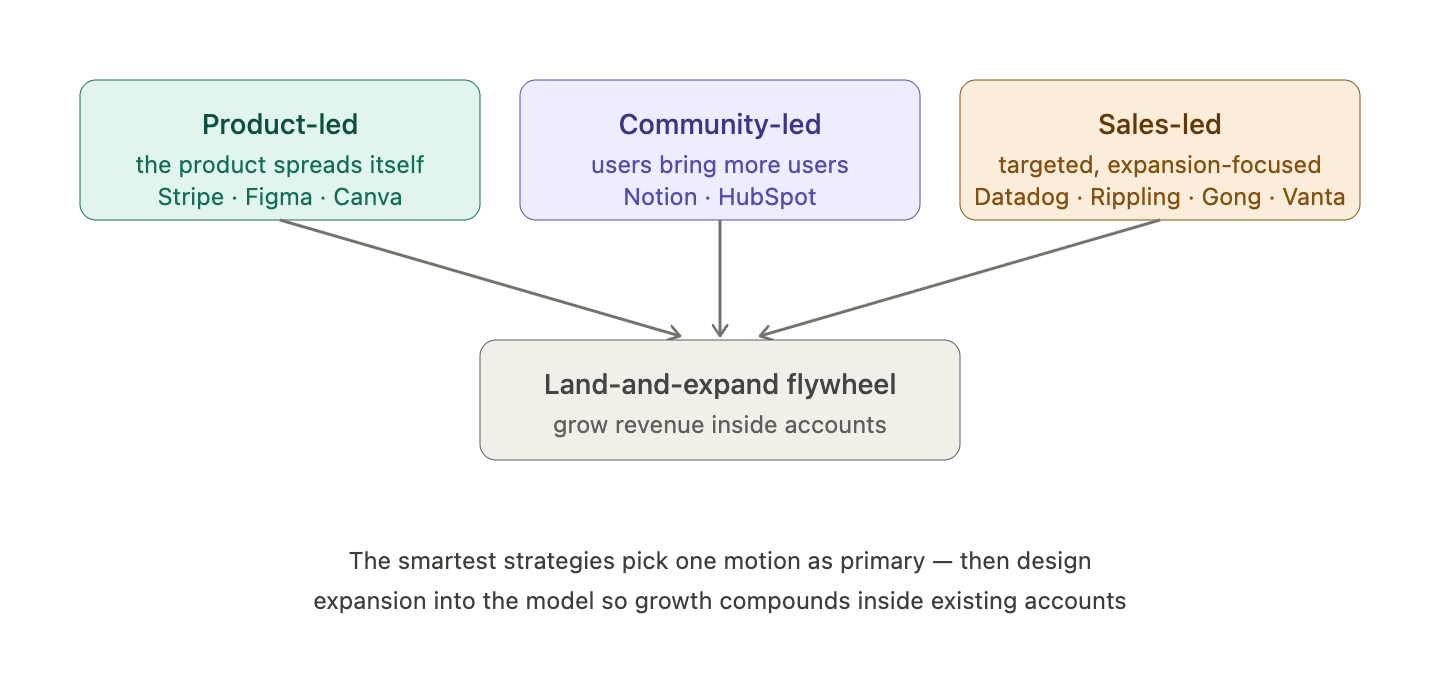
Look across all ten and the defining trait is coherence: the product, pricing, channel, and sales motion all reinforce each other. Stripe's developer focus, Snowflake's consumption pricing, Figma's collaborative product in each case the pieces fit together into a strategy where every element strengthens the others. Smart go-to-market isn't a collection of tactics; it's a system where the parts align.
The second pattern is clarity about the market. Every one of these companies knew precisely who it was for and what problem it solved. Vanta's urgent, specific need, Stripe's developers, Snowflake's enterprises the sharpness of that definition is what made everything downstream work. Vague targeting produces vague go-to-market; precise targeting produces precise execution.
The third commonality is that the smartest strategies often build distribution or expansion into the model itself. Figma's viral collaboration, Datadog's land-and-expand, Canva's freemium funnel, Notion's community these companies didn't just bolt a sales team onto a product. They designed growth into how the product and business worked, so the motion partly propelled itself.
How to do this yourself, without their resources
Here's the foundation underneath nearly every strategy above, and the part most teams underinvest in: knowing exactly who your market is and reaching them at the right moment. Stripe knew it was developers. Vanta knew exactly who had the urgent problem. That clarity about the target and the ability to act on it is the bedrock of smart go-to-market, and it's precisely what we built Backchannels to support.
Backchannels is a buyer database with buying signals layered on top, designed to give you the market clarity that the best go-to-market strategies are built on. Instead of guessing who your product is for, you can define your ideal profile precisely and see the accounts that genuinely match then identify which of them are showing signs of being in-market right now. The companies above succeeded because they understood their market deeply and reached it efficiently; Backchannels is what makes that level of precision achievable when you don't have years of data and a large team. When we apply this to our own go-to-market, the clarity about who to reach and when is what makes every other decision messaging, channel, timing sharper.
The practical path is to start with the same clarity these companies had. Define your target market as precisely as you can the specific profile of company and person who has the problem you solve, and why it's urgent for them. Build your understanding of that market around real data rather than assumptions. Layer in timing by identifying which accounts are showing signals of being ready now. And make sure the rest of your motion your pricing, your channel, your messaging reinforces that focus rather than diluting it. Backchannels handles the market-intelligence foundation, the part that makes a coherent go-to-market strategy possible, so you can build the kind of focused, efficient motion these ten companies are known for.
TRY BACKCHANNELS FREE
Your next customers are already in the database.
Backchannels gives you 225,000 verified software decision-makers. Filter to your exact ICP, preview matches for free, and push them straight into Salesforce or HubSpot. Pay per contact. No subscription, no contract.
Browse contacts freeNo credit card. Preview before you spend a credit.
No items found.
Final Thoughts
The bottom line The smartest go-to-market strategies of 2026 aren't the ones with the cleverest single tactic they're the ones where everything fits together around a clear understanding of the market. The ten companies above each made a defining strategic choice, from developer-led adoption to consumption pricing to community-driven growth, and built coherent motions around it. You don't need their scale to apply their thinking. Get crystal clear on who your market is and why they need you, build distribution or expansion into your model where you can, and make sure every part of your motion reinforces the rest. Start with the foundation deep clarity about your market and the ability to reach it at the right time and the rest of a smart go-to-market strategy has something solid to stand on. That foundation is exactly what Backchannels is built to give you.
Published
August 24, 2026
Writer
Joe Backchannels
Share


Most Wanted