12 min read

12 min read

June 2026
12 min read
12 min read
June 2026
12 min read
12 min read
June 2026
Lead qualification is how you decide whether a prospect is worth your time and how likely a deal is to close, based on fit, need, and ability to buy. It is the highest-leverage filter in sales, because reps spend only about 24% of their time actually selling and lose much of the rest chasing deals that were never going to close. BANT and MEDDIC are the two most widely used qualification frameworks, and the modern answer is not to pick one but to run both: BANT to qualify in fast, MEDDIC to win the deals that matter. Teams that implement BANT with discipline see conversion lift up to 59%, and MEDDIC delivers around a 25% win-rate improvement on complex deals. This guide gives you both frameworks, when to use each, and a copy-paste scorecard.
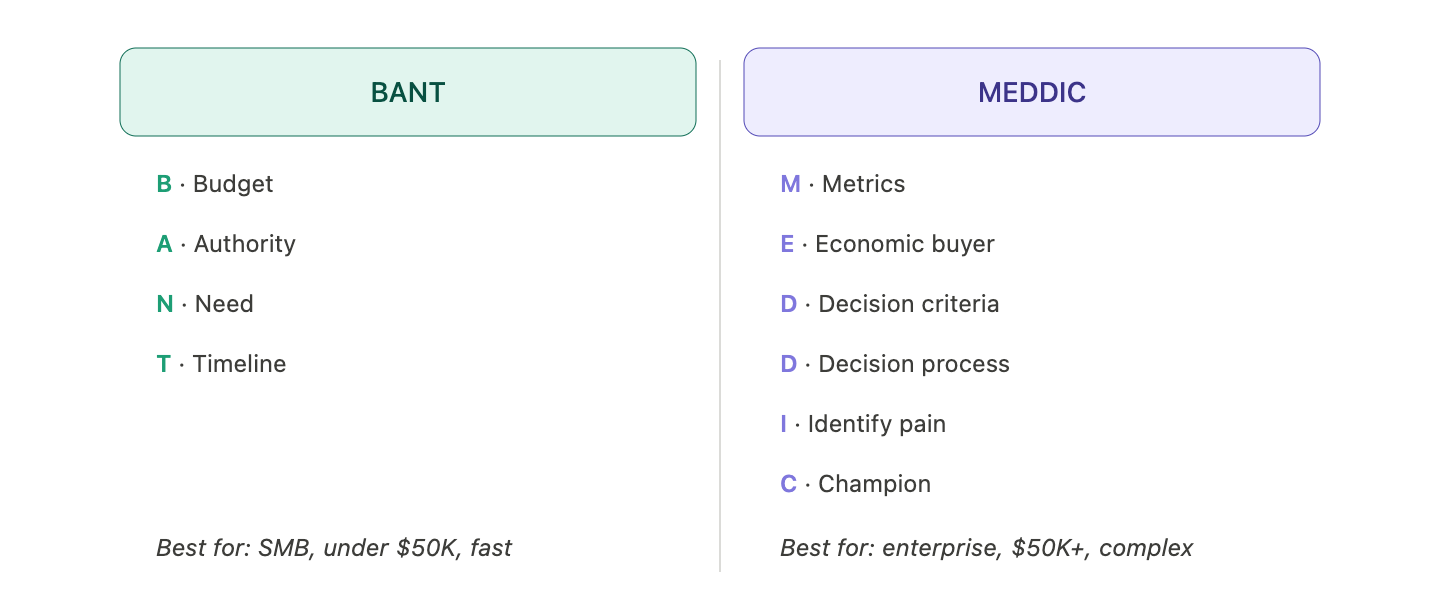
The short version: Use BANT (Budget, Authority, Need, Timeline) for fast, early qualification on smaller, faster deals, and MEDDIC (Metrics, Economic buyer, Decision criteria, Decision process, Identify pain, Champion) for complex enterprise deals. Most teams run them sequentially: an SDR runs BANT in 3 to 5 minutes to decide "should we pursue this," then an AE applies MEDDIC during discovery to figure out "how do we win this." Score each element rather than checking boxes, and never run either one as an interrogation script.
Here is how the two frameworks compare and where each fits:
One distinction before the frameworks: qualification is not lead scoring. Qualification frameworks like BANT and MEDDIC are rep-driven and conversation-based, and they work on day one with no data infrastructure. Lead scoring is system-driven and uses behavioral and firmographic signals to rank leads numerically (that is the next post in this series). Qualification answers "should this opportunity move forward at all," using structured questions a rep asks in a conversation.
Stop debating which framework is "better" and match it to the deal. The thresholds are clean: if your average deal is under $50K, closes in under 60 days, and has one or two decision-makers, use BANT, which answers "should we spend time here." If the deal is above $50K with 3 or more stakeholders and a cycle running 90 days or longer, use MEDDIC, which answers "how do we win this." For enterprise deals above $100K where legal, procurement, and competitive bake-offs are standard, extend to MEDDPICC, which adds Paper process and Competition. And remember the adoption principle that beats all of this: a simple framework used by 100% of the team beats a sophisticated one used by 30%.
BANT (Budget, Authority, Need, Timeline) was developed at IBM in the 1950s and remains the fastest way to triage, runnable in three to five minutes on a call. The trick is to run it as a research-and-validate conversation, not an interrogation. Do not ask "what's your budget?" point-blank, which is the fastest way to get a non-answer or a lie. Instead, surface each element naturally: ask how they have solved the problem so far and what it costs them (Need and the cost of inaction), who else would be affected by a change (Authority), and what happens if it is not solved by a certain date (Timeline). One modern caveat on Budget: in 2026 it often gets created after a business case, so a missing budget line is not a disqualifier, and "they told me there is budget" with nothing else confirmed is a red flag, not a green light.
MEDDIC (Metrics, Economic buyer, Decision criteria, Decision process, Identify pain, Champion) was created at PTC in 1996 to qualify $250K-plus deals across 10-to-16-stakeholder committees, and it goes exactly where BANT cannot. The three elements BANT lacks are usually what decide enterprise deals: the Economic Buyer (who actually signs), the Decision Process (how the organization really buys, including procurement), and the Champion, an internal advocate who sells for you when you are not in the room. Without a champion, deals stall. And unlike BANT, MEDDIC is not a one-time check; it enables ongoing qualification throughout the deal lifecycle, so you keep re-confirming as stakeholders shift and the deal evolves.
Both frameworks fail when reduced to binary yes/no fields. A weighted scorecard with a point threshold (say 70 out of 100) is far more reliable, because a prospect with strong Need, clear Authority, and a real Timeline but no formal budget yet often converts better than one who checks all four boxes weakly. The deeper danger is a CRM full of "Yes" answers that were never explicitly confirmed, which creates a pipeline illusion where the pipeline looks healthy but nothing closes. If a rep is forecasting a six-figure deal and the only qualification language they have is "they have budget," the forecast is fiction.
This is the single biggest gap in how most teams qualify. BANT treats Authority as a single decision-maker, but the 2026 reality is buying committees of 6 to 10 stakeholders. If you qualify only one contact, you risk missing the economic buyer, a key blocker, or a champion entirely, and the classic failure follows: a deal that looked solid stalls late when procurement, finance, or IT finally appear. Qualify the committee, not the individual, which is also why the SQL definition should incorporate MEDDIC-level criteria (confirmed pain, identified economic buyer, a clear next step) rather than one person's behavior.
A framework nobody reviews is decoration. MEDDIC only improves forecast accuracy if managers inspect the data during pipeline reviews and hold reps accountable for real answers, not placeholder text, otherwise reps rightly call it busywork. Build the scorecard into your CRM, raise the qualification bar as the cost of the interaction rises (a quick BANT-lite at the SDR cold call, full MEDDIC at the AE level), and review it weekly. One hard rule on sequencing: do not try to run MEDDIC on a cold call, because reps who attempt it lose about 60% of the meetings they could have booked, since a stranger cannot meaningfully discuss Economic Buyer or Decision Process yet.
The qualification scorecard (copy and paste)
LEAD / OPPORTUNITY QUALIFICATION SCORECARD
Gate 1 (SDR, first touch): BANT   |   Gate 2 (AE, discovery): MEDDIC

GATE 1 — BANT  (score each 0-3; advance to discovery at 8/12 or higher)
   Budget      0 none / 1 unclear / 2 forming / 3 confirmed or createable
   Authority   0 unknown / 1 influencer / 2 access to buyer / 3 buyer engaged
   Need        0 none / 1 nice-to-have / 2 clear pain / 3 urgent + quantified
   Timeline    0 none / 1 vague / 2 this year / 3 specific event or date

GATE 2 — MEDDIC  (status each: Confirmed / Partial / Unknown; close gaps
                  before proposal)
   Metrics            The quantified outcome they want (in $ or hours)
   Economic buyer     Named, and ideally met
   Decision criteria  The factors they will judge vendors on
   Decision process   The real steps, who is involved, and procurement
   Identify pain      Confirmed pain tied to a business metric
   Champion           An internal advocate who sells when you are absent
   (+ MEDDPICC for $100K+: Paper process, Competition)

RED FLAGS (pause or de-qualify)
   - "They told me there is budget" with nothing else confirmed
   - Only one contact engaged on a 6-to-10-person committee
   - No named economic buyer late in the cycle
   - A "Yes" in the CRM that was never explicitly confirmed
The seven that quietly wreck pipelines: running either framework as an interrogation script, using binary yes/no instead of scoring, disqualifying a deal because budget is not yet formally allocated, qualifying only one contact on a multi-person committee, treating qualification as a one-time event rather than ongoing, filling CRM fields with unconfirmed "Yes" answers, and mandating a framework that leadership never actually inspects. And the sequencing mistake: attempting MEDDIC on a first cold call instead of a quick BANT.
Every qualification framework rests on one assumption that is easy to forget: that you are talking to the right person and can actually reach them. BANT's Authority, and MEDDIC's Economic Buyer and Champion, all fall apart if the contact data is wrong or the "Director of IT" in your CRM left six months ago. That is where Backchannels helps. As a buyer database with buying signals, it gives you verified contacts so your champion picks up and your economic buyer is reachable, it maps the full buying committee so you qualify the group rather than one person (the single biggest qualification gap), and it surfaces the buying signals that confirm Need and Timeline are real before a rep invests an hour. You cannot qualify someone you cannot reach.
What is the difference between BANT and MEDDIC?
BANT (Budget, Authority, Need, Timeline) is a fast, four-element filter that answers "should we pursue this deal." MEDDIC (Metrics, Economic buyer, Decision criteria, Decision process, Identify pain, Champion) is a six-element framework for complex deals that answers "how do we win this," adding a champion, the economic buyer, and the decision process that BANT misses.
When should you use BANT vs MEDDIC?
Use BANT for deals under about $50K with cycles under 60 days and one or two decision-makers, typically at the SDR first-touch stage. Use MEDDIC for deals above $50K with 3 or more stakeholders and cycles of 90 days or longer, applied by AEs during discovery. Above $100K with procurement, extend to MEDDPICC.
Can you use BANT and MEDDIC together?
Yes, and most experienced teams do. Run BANT first to qualify in or out quickly, then graduate promising deals into MEDDIC for deeper qualification as more stakeholders get involved. The scorecard is the handoff between the SDR gate and the AE gate.
Is BANT outdated?
Not for the right deals. BANT is too shallow for complex, multi-stakeholder enterprise deals, but it remains effective for high-velocity SMB and inbound triage, and about 52% of salespeople still find it reliable. The real problem is usually teams running it as an interrogation script rather than a research-and-validate workflow.
How do you score a lead with BANT or MEDDIC?
Use a weighted scorecard, not binary yes/no. Score each element (for example 0 to 3) and set a point threshold to advance, since a deal with strong need and a real timeline but no formal budget often beats one that weakly checks every box. For MEDDIC, status each element as Confirmed, Partial, or Unknown and close the gaps before proposing.
Backchannels gives you 225,000 verified software decision-makers. Filter to your exact ICP, preview matches for free, and push them straight into Salesforce or HubSpot. Pay per contact. No subscription, no contract.
Browse contacts freePublished
November 18, 2026
Writer
Joe Backchannels
Share


Most Wanted
12 min read
12 min read
June 2026
12 min read
12 min read
June 2026