12 min read

12 min read

June 2026
12 min read
12 min read
June 2026

12 min read
12 min read
June 2026
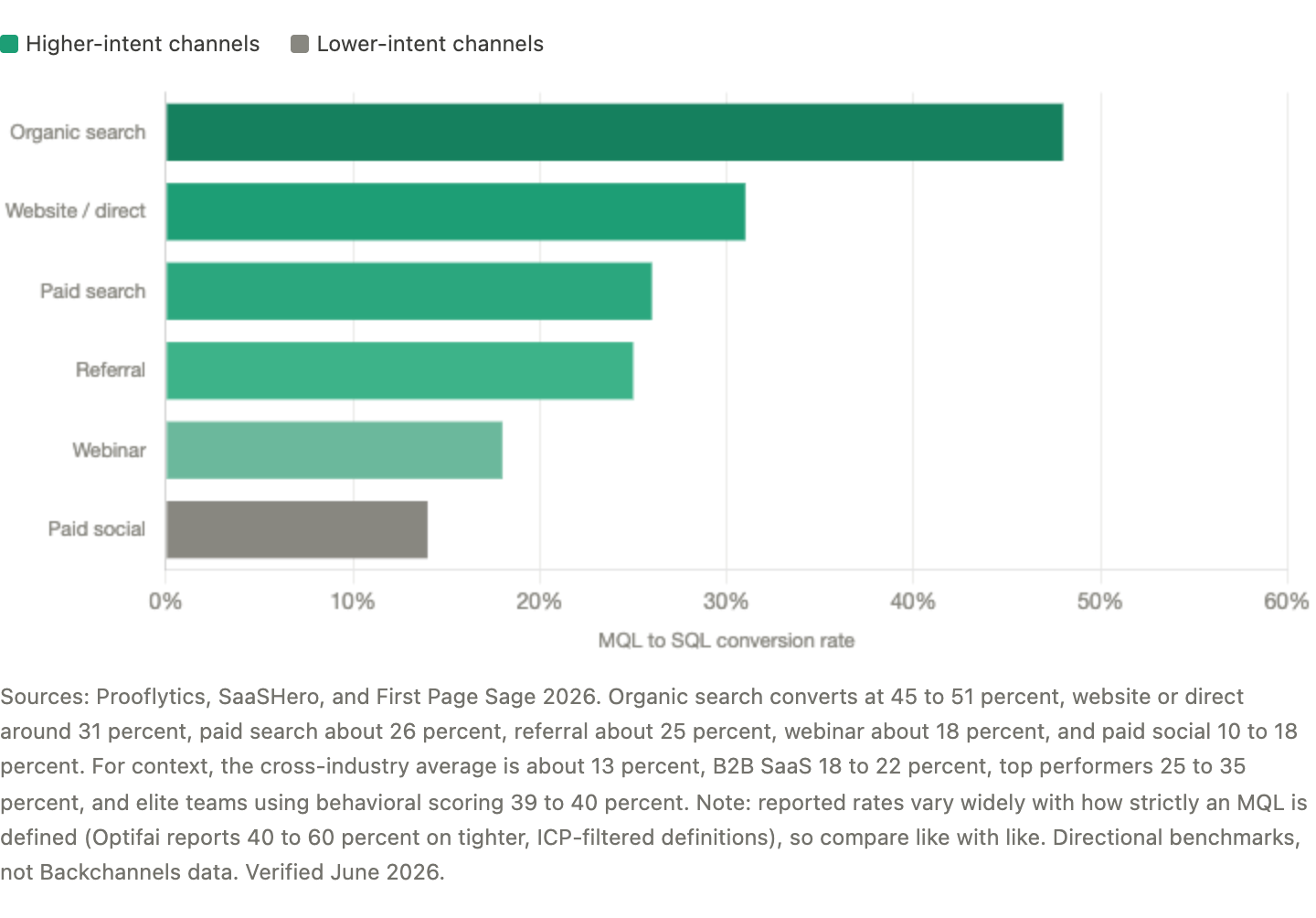
A good MQL-to-SQL conversion rate for B2B SaaS is 25 to 35 percent. The cross-industry average is about 13 percent, and most B2B SaaS teams land around 18 to 22 percent, so clearing 25 percent puts you ahead of the field. But this is the most definition-dependent metric in the funnel: a rate below 15 percent is almost always a lead-definition or scoring problem, not a sales-execution problem. And channel matters more than almost anything else, with organic search converting near 51 percent while paid social often sits at 10 to 18 percent.
That channel spread is the single biggest driver of the number, so a blended average hides what is actually happening:
Before comparing your number to anyone else's, understand why published rates swing from 13 percent to 60 percent. The biggest reason is how strictly a team defines an MQL. There are two common approaches: a broad-pool definition, where any engaged lead above a basic scoring threshold counts, and an ICP-filtered definition, where a lead must show purchase intent and fit your ideal profile before it qualifies. These produce completely different rates, which is why a single headline benchmark rarely helps on its own. If you see a 40 percent benchmark somewhere and panic about your 15 percent, check the MQL definition first, because you are probably comparing an ICP-filtered rate against your broad-pool funnel.
This is also why a rate below 15 percent is rarely a sales problem. As the 2026 benchmark reports put it, the cause is almost always that MQL scoring is too generous, qualifying leads who never matched the ICP, rather than reps failing to convert. Two measurement rules keep the number honest. Use time-lagged cohorts, not same-month snapshots: if your MQL-to-SQL cycle runs 60 days, compare SQLs created in month three against MQLs from month one, because same-month math distorts any cycle longer than 30 days. And always segment, since a blended rate masks massive variance, where your organic rate might be 50 percent while your paid rate is 15 percent.
Three fixes move this number faster than generating more leads. First, tighten the definition: the best-performing companies narrow their ICP aggressively, and a tighter ICP produces a higher SQL rate, because a category is not an ICP. Second, respond faster, which is the single highest-impact operational fix. Following up within the first hour produces a 53 percent conversion rate versus 17 percent for follow-ups after 24 hours, and responding within 5 minutes makes you roughly 100 times more likely to convert than waiting 30 minutes. Third, improve scoring: teams using behavioral scoring reach 39 to 40 percent, and AI-powered lead scoring achieves about 55 percent versus 35 percent with manual scoring. The payoff is real money, since a 5-point improvement in MQL-to-SQL rate lifts revenue by approximately 18 percent.
Notice the through-line: every lever is about lead quality and intent, not lead volume. That reflects the central 2026 shift, where MQL volume correlates weakly with revenue and an MQL is a marketing assumption, not a buying signal. The winners are not the teams generating the most leads, but the ones reaching the right buyers at the right time with enough intent to create real pipeline.
That is exactly the gap Backchannels closes. A low MQL-to-SQL rate is usually an upstream quality problem, so the highest-leverage fix is feeding the funnel with accounts that actually fit and are actually in-market. As a buyer database with buying signals, Backchannels supplies ICP-matched accounts, verified contact data so leads are reachable for that critical fast follow-up, and the buying signals that turn a "marketing assumption" into genuine intent. The result is MQLs that convert because they were real opportunities to begin with, which is the only durable way to move this rate.
What is a good MQL-to-SQL conversion rate?
For B2B SaaS, 25 to 35 percent is good and 18 to 22 percent is average. The cross-industry average is about 13 percent. Elite teams using behavioral scoring reach 39 to 40 percent. Anything below 15 percent usually signals a definition or scoring problem.
Why do MQL-to-SQL benchmarks vary so much between reports?
Because teams define "MQL" differently. A broad-pool definition counts any engaged lead, while an ICP-filtered definition requires fit and intent. Those approaches produce very different rates, so always compare like with like before drawing conclusions.
What is the average MQL-to-SQL rate by channel?
Organic search is highest at 45 to 51 percent, followed by website or direct around 31 percent, paid search about 26 percent, referral about 25 percent, webinar about 18 percent, and paid social at 10 to 18 percent. Channel mix drives most of the variance in a blended number.
My MQL-to-SQL rate is below 15 percent. What is wrong?
Usually one of three things, in order: an MQL definition that is too generous, slow follow-up, or bad contact data. Check those before assuming a sales-execution problem, since the handoff is far more often the cause than the closing.
How do I improve my MQL-to-SQL conversion rate?
Tighten your ICP and MQL definition, respond within minutes rather than hours, adopt behavioral or AI-based scoring, and feed the funnel with higher-intent, better-fit accounts. Improving lead quality beats increasing lead volume every time.
Backchannels gives you 225,000 verified software decision-makers. Filter to your exact ICP, preview matches for free, and push them straight into Salesforce or HubSpot. Pay per contact. No subscription, no contract.
Browse contacts freePublished
October 28, 2026
Writer
Joe Backchannels
Share


Most Wanted
12 min read
12 min read
June 2026
12 min read
12 min read
June 2026