12 min read

12 min read

June 2026
12 min read
12 min read
June 2026
12 min read
12 min read
June 2026
The average cold email reply rate is 3.43%, but the top 10% of senders clear 10.7%, and signal-based personalized campaigns reach 15 to 25%. That gap is not luck or volume. It comes down to a few repeatable choices about relevance, length, and what you ask for. This guide breaks down the anatomy of a cold email that gets replies, the rule behind each part, and five copy-paste templates you can adapt today.
The short version: A cold email that gets replies is short (under about 80 to 125 words), relevant (it opens with something about them, ideally a trigger or signal, not about you), and ends with one low-friction ask. The three mistakes that kill reply rates are pitching too hard (which can cut replies by up to 57%), asking for a meeting on the first touch (interest-based asks outperform meeting asks), and using more than one call to action. Get those right and you are most of the way there.
Here is the anatomy of a high-reply cold email, with the two parts that decide replies highlighted:
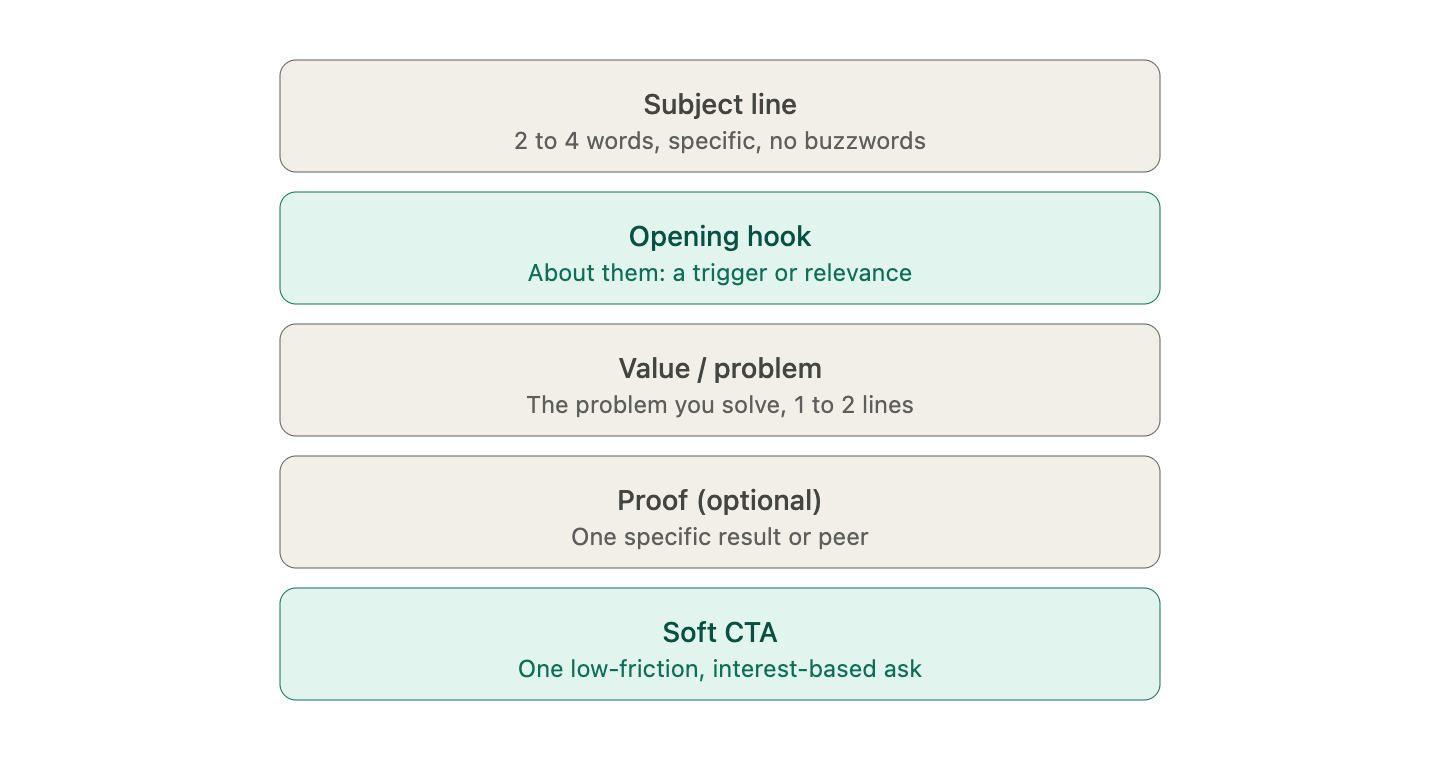
The best subject line looks like it came from a coworker, not a marketing campaign. Keep it to a few words, make it specific, and avoid buzzwords, ALL CAPS, and clickbait, which hurt both opens and deliverability. The highest-performing subject lines reference a specific situation: trigger-event subject lines reach a 54.7% open rate, a 42.4% lift over generic ones, and even a personalized subject line lifts response by about 30.5%. If a subject line could be sent to anyone, rewrite it.
Your first line should be about the prospect, ideally tied to a trigger or a relevant detail, before you say a single word about yourself. This is nearly as important as your CTA: timeline and trigger-based opening hooks average 10% reply rates versus 4.4% for generic ones. A useful self-check is the pronoun ratio, where you aim for roughly twice as many "you/your" references as "I/my" so the email feels like it is about their world, not your product.
Lead with the problem you solve, in one or two sentences, rather than describing your solution. Pitchy language is actively penalized: a study of 28 million cold emails found that buzzwords, ROI claims, and jargon drop reply rates by up to 57%. Name the specific challenge the prospect likely has, and let that do the selling. Every sentence should earn the next one; if a line does not add value, delete it.
If you have a credible, specific result or a recognizable peer, one line of proof builds trust. Keep it concrete and brief, like a specific outcome you produced for a similar company, not a vague claim. This part is optional, and on a very short email you can skip it entirely.
The last line decides more than any other. Use one interest-based ask, not a meeting request, because asking for someone's time triggers loss aversion. The data is consistent: soft, open-ended CTAs average a 4.2% reply rate versus 1.4% for hard "book a demo" asks, and single-CTA emails see up to 371% higher click-through than multi-ask emails. Lines like "Worth exploring?" or "Is this on your radar this quarter?" work because they cost the prospect nothing. And never put a calendar link in the first email, since it implies a meeting commitment before any value has landed; save it for the third touch or later.
Length and infrastructure round it out. Keep the email between about 50 and 125 words (elite senders stay under 80), since 68% of B2B opens happen on mobile and long emails get abandoned. Use plain text, a verified list, and proper authentication (SPF, DKIM, DMARC are mandatory now), because if your open rate is under 30% the problem is deliverability, not copy, and bounce rates should stay under 2%. Finally, plan to follow up: the first email captures about 58% of replies and follow-ups capture the other 42%, yet 70% of senders stop after one. Run a 4 to 7 touch sequence where each message adds new value rather than asking "did you see my last email," and re-engage on a fresh signal after the sequence ends.
5 proven cold email templates
Treat these as structures to adapt, not scripts to send as-is. The blanks marked with a trigger or problem are where the reply rate is won.
1. The trigger / signal email (best for a first touch right after a signal fires)
Subject: [trigger] + [one word]   e.g. "Series B + hiring"

Hi [First name],

Saw [specific trigger, e.g. you just closed your Series B and are
scaling the sales team].

When teams grow that fast, [the relevant problem, e.g. knowing which
accounts are actually in-market becomes the bottleneck].

We help [role/company type] [outcome] without [the pain].

Worth a look?

2. Problem-Agitate-Solve (PAS) (best for a well-understood pain in your ICP)
Subject: [the problem in 2 to 4 words]

Hi [First name],

Most [role]s I talk to are stuck with [specific problem].

The hidden cost is [consequence, e.g. reps lose the first weeks chasing
bad data], which [bigger impact].

We fix that by [how], so [outcome].

Is [problem] on your radar this quarter?

3. Before-After-Bridge (BAB) (best when you can paint a clear better state)
Subject: [desired outcome]

Hi [First name],

Right now, [current painful state].

Imagine [desired state, e.g. every rep starts the day with the 3 accounts
most likely to buy].

We get teams there by [the bridge / how].

Want me to share how [similar company] did it?

4. The short question email (best for busy senior buyers, ultra-low friction)
Subject: quick question

Hi [First name],

Quick one: how are you handling [specific thing] at [Company] today?

Asking because [one-line relevance].

[Your name]

5. The peer / social-proof email (best when you have a credible, similar result)
Subject: [peer company] + [outcome]

Hi [First name],

We recently helped [similar company] [specific result, e.g. cut prospecting
research from an hour to minutes].

Given [why it is relevant to them], thought it might be worth a look for
[Company].

Want to see how?
The five that sink reply rates: pitching with buzzwords and ROI claims (the 57% penalty), asking for a meeting or dropping a calendar link on the first touch, stacking more than one CTA, writing past ~125 words, and sending to an unverified list, where bounces mean your perfect CTA never reaches anyone. And the quiet one: sending a generic template at all, since only about 5% of senders personalize every email and those who do see 2 to 3 times the replies.
Look back at the five templates. Every one has a blank for a specific trigger or a relevant problem, and filling those blanks well is the entire difference between a 3% email and an 18% one. That is exactly where Backchannels helps. As a buyer database with buying signals, it gives you the trigger to put in your subject and opening hook (funding, hiring, leadership changes, category intent), the verified email address so the message actually lands (a bounce never reaches your CTA), and the account context that makes your problem line ring true. The hook is what gets replies, and the hook is a signal, which is what Backchannels surfaces.
What is the ideal length for a cold email?
Between about 50 and 125 words, with elite senders staying under 80. Under 25 words reads as lazy or unclear, and over 150 words sees sharp drops in replies, especially since most B2B emails are read on mobile.
What should the CTA be in a cold email?
A single, low-friction, interest-based ask, not a meeting request. Soft open-ended CTAs like "Worth exploring?" average roughly 4.2% reply rates versus 1.4% for hard "book a demo" asks. Do not include a calendar link in the first email.
How do you personalize a cold email?
Open with something about the prospect, ideally a trigger event (funding, a new hire, a launch) or a known challenge, before mentioning yourself. Trigger-based hooks more than double reply rates over generic openers, and personalization overall drives 2 to 3 times the replies.
How many follow-ups should a cold email sequence have?
Four to seven touches. The first email gets about 58% of replies and follow-ups get the rest, yet most senders stop after one. Each follow-up should add new value, not just ask whether the prospect saw the last message.
Why is my cold email not getting replies?
Usually one of three things, in order: deliverability (an open rate under 30% means you are not reaching the inbox), targeting and relevance (generic outreach to poor-fit accounts), or the ask (a hard meeting request instead of a soft interest CTA). Fix deliverability and list quality before rewriting copy.
Backchannels gives you 225,000 verified software decision-makers. Filter to your exact ICP, preview matches for free, and push them straight into Salesforce or HubSpot. Pay per contact. No subscription, no contract.
Browse contacts freePublished
November 10, 2026
Writer
Joe Backchannels
Share


Most Wanted
12 min read
12 min read
June 2026
12 min read
12 min read
June 2026