12 min read

12 min read

June 2026
12 min read
12 min read
June 2026
12 min read
12 min read
June 2026
Researching an account before you reach out is what separates a relevant first touch from generic outreach that gets ignored. It matters more than ever because buyers are self-informed: 96% research on their own and 88% already know your company and its competitors before the first call, so reps have to add insight, not introductions. But research is also the largest hidden time sink in sales, with reps spending 1 to 3 hours per account and only about 30% of their week actually selling. This framework shows you what to research, in what order, how to time-box it, and how to turn it all into a single relevant angle.
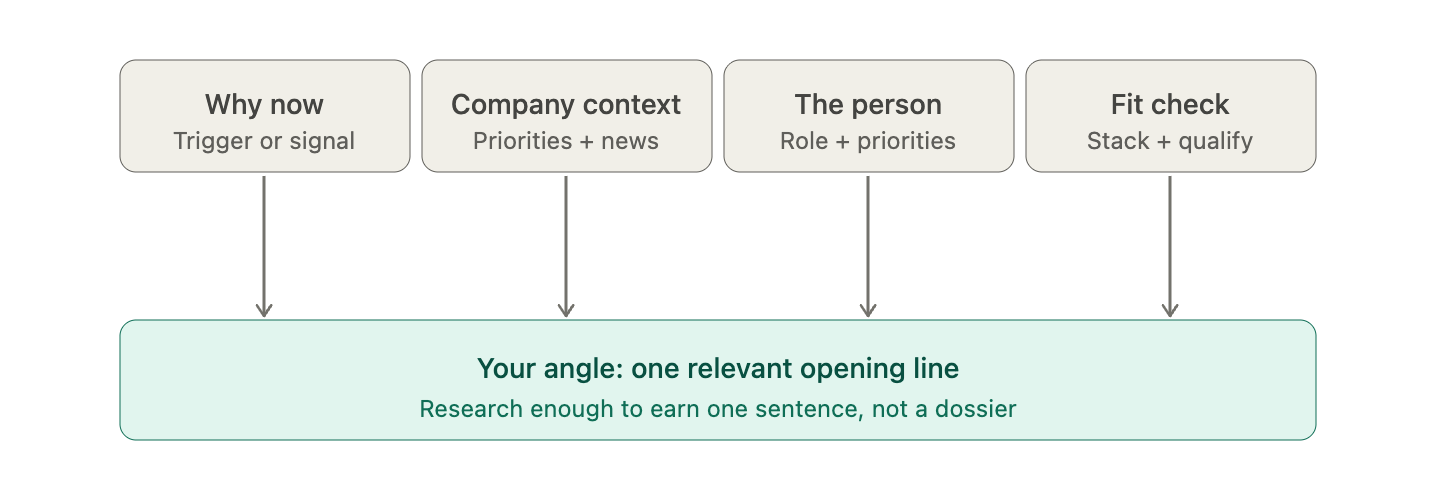
The short version: Before reaching out, answer three questions: why this account, why this person, and why now. Research four layers in priority order: (1) the trigger or signal that makes now the moment, (2) company context and priorities, (3) the person's role and what they care about, and (4) fit and data. Time-box it, around 5 minutes for most accounts and more for strategic ones, and stop when you can write one relevant opening line. The goal is a hook, not a dossier.
Everything you gather should converge on a single relevant sentence:
The highest-leverage thing you can find is a reason the conversation is relevant right now. A trigger or buying signal (a funding round, a leadership change, a relevant hiring spike, an acquisition, a product launch, a tech-stack change, or active research in your category) gives you a credible opening that generic outreach can never match. The discipline here is separating signal from noise, because most updates do not change anything: minor website copy edits, routine social posts, and non-executive job changes rarely create a real "why now." If you cannot tie the moment to something that actually shifts the buyer's priorities, do not force it.
Next, build just enough of a picture to connect your value to their situation: what the company does, its size and segment, recent news, and the strategic priority your product could support. Keep this light, because the goal is relevance, not a research report. Remember that buyers expect you to be informed, and generic messaging signals a lack of preparation and immediately reduces trust. For mid-market and enterprise accounts, go a layer deeper into strategic priorities, competitors, and expansion signals; for SMB, a couple of facts is usually enough.
Now shift from the account to the individual. Capture their role scope, decision-making power, tenure (someone new in the seat has likely inherited a problem you can speak to), and what they probably care about based on recent LinkedIn activity. This is the layer that enables real personalization instead of "fill-in-the-name" outreach that references an obvious detail without showing any understanding. And it is a two-way street: 82% of buyers look up the provider on LinkedIn before replying, so the relationship is being researched in both directions.
Before you spend the effort, confirm the account is actually worth it. Validate ICP fit (size, vertical, relevant stack), check for any disqualifiers, and verify the contact data is current. That last point is not a formality: bad data is the single most expensive hidden cost in prospecting, and there is nothing worse than spending two hours researching an account only to discover your champion left months ago. Confirm the email and direct dial are real before you build the rest.
Research expands to fill whatever time you give it, so cap it. The capacity problem is real: high-potential and low-urgency accounts often get the same depth of manual research because the workflow has no way to rank effort against revenue potential. Fix that by tiering your effort, for example around 15 minutes for a strategic Tier 1 account and about 5 for everything else. A simple test tells you when the process has gone wrong: if a rep has to open five tabs to answer "why this account, why this person, why now," research is consuming selling capacity instead of improving it.
Research only matters if it informs action. The deliverable is not a dossier; it is a single relevant point of view you can lead with. Translate your findings into one opening line that ties the "why now" to something the buyer cares about, then write a short message around it. Keep it tight, because emails under 100 words with three to four sentences get the highest reply rates, and pitching too heavily can cut reply rates by up to 57%. The payoff for getting this right is large: outreach with genuine, insight-led personalization sees reply rates roughly 2 to 3 times higher than generic templates, landing near 18% in some analyses versus about 5% for generic.
PRE-OUTREACH RESEARCH — [Account] / [Contact]
Time budget:  Tier 1 ~15 min   |   Tier 2 and 3 ~5 min

WHY NOW (the trigger)
[ ] Recent signal? (funding / leadership change / hiring / M&A /
    launch / tech-stack change / category intent)
[ ] Is it real, recent, and relevant? (skip minor posts, copy
    edits, and non-executive moves)

COMPANY CONTEXT
[ ] What they do + size + segment
[ ] Recent news or strategic priority
[ ] Growth stage

THE PERSON
[ ] Role scope + decision power
[ ] Tenure (new in seat = inherited problems)
[ ] What they likely care about / recent LinkedIn activity

FIT & DATA CHECK
[ ] ICP fit confirmed (size, vertical, stack)
[ ] Any disqualifiers?
[ ] Contact verified (email + direct dial are current)

OUTPUT (the only thing that matters)
   Why this account: ____
   Why this person:  ____
   Why now:          ____
   -> One relevant opening line: ______________________________
The five that waste the most time: over-researching into a dossier when you needed a hook, researching every account to the same depth regardless of tier, mistaking background noise for a real signal, leading with company facts the buyer already knows (they are 96% self-informed) instead of insight, and skipping the data check so you prep an account whose champion has already moved on.
This framework is essential, and it is also the reason reps sell less than a third of their week. The fix is not to research less; it is to make the research come to the rep instead of sending them hunting across five tabs. That is what Backchannels is built for. As a buyer database with buying signals, it does the highest-leverage layers automatically: it surfaces the "why now" signal (funding, hiring, leadership changes, category intent) and separates it from noise, supplies the company context, and provides verified contact data for the right person, so the rep opens an account already holding the angle rather than assembling it by hand. Research that took an hour becomes a few minutes, and every first touch leads with a credible reason it is landing now.
What should you research before reaching out to a prospect?
Four things, in priority order: the trigger or signal that makes now the right moment, the company's context and priorities, the person's role and what they care about, and a fit-and-data check. The aim is to answer "why this account, why this person, why now."
How long should you spend researching an account before outreach?
Time-box it by tier: roughly 15 minutes for a strategic Tier 1 account and about 5 minutes for everything else. Reps commonly spend 1 to 3 hours per account, which is far more than the payoff justifies for most accounts. Stop when you can write one relevant opening line.
What is the difference between account research and prospect research?
Account research covers the company: strategic priorities, competitors, and expansion signals. Prospect research covers the individual: their role scope, decision-making power, and likely goals. You need both, but lead with the account-level "why now."
Does pre-outreach research actually improve reply rates?
Yes. Insight-led, genuinely personalized outreach sees reply rates roughly 2 to 3 times higher than generic templates, reaching around 18% in some analyses versus about 5% generic, and most buyers respond better to outreach tailored to their situation.
How do you research an account efficiently?
Lead with signals over background noise, scale effort to the account's tier, verify contact data before investing time, and translate everything into a single opening line rather than a long brief. If answering "why now" takes five browser tabs, the process is too slow and a signal source should be doing that work for you.
Backchannels gives you 225,000 verified software decision-makers. Filter to your exact ICP, preview matches for free, and push them straight into Salesforce or HubSpot. Pay per contact. No subscription, no contract.
Browse contacts freePublished
November 5, 2026
Writer
Joe Backchannels
Share


Most Wanted
12 min read
12 min read
June 2026
12 min read
12 min read
June 2026