12 min read

12 min read

June 2026
12 min read
12 min read
June 2026
12 min read
12 min read
June 2026
An ideal customer profile (ICP) is a detailed description of the company most likely to buy your product, get full value from it, retain, and expand. Building one is the highest-leverage targeting decision a go-to-market team can make: companies with a clearly defined ICP report up to 68% higher win rates, and ICP-aligned opportunities close 2 to 3 times more often than poor-fit deals. Yet most B2B companies have not formally documented theirs, which is the single most common root cause of wasted pipeline. This guide gives you a five-step process, a copy-paste template, and a filled example.
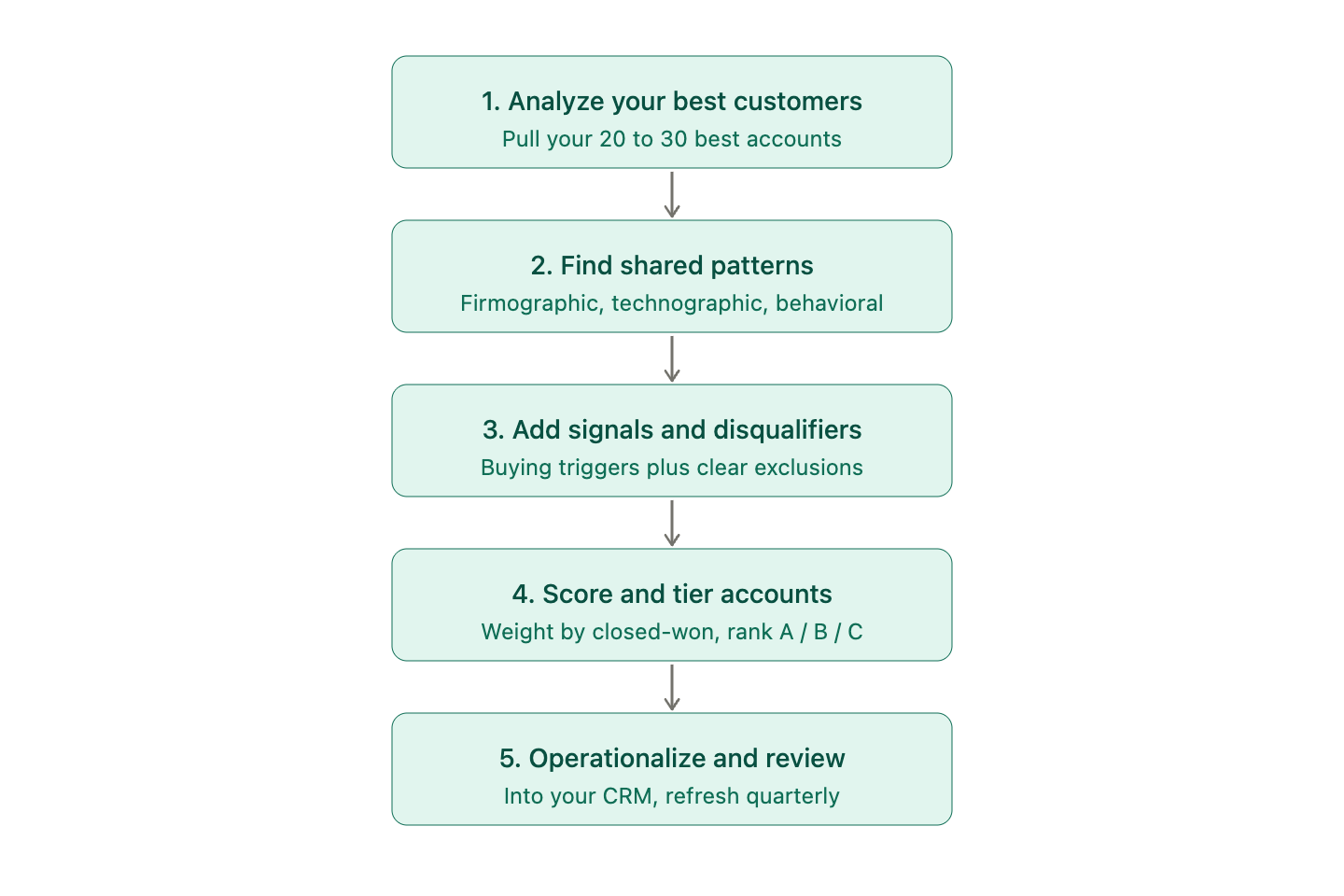
The short version: Build an ICP in five steps. (1) Analyze your 20 to 30 best customers. (2) Find the firmographic, technographic, and behavioral patterns they share. (3) Add buying signals and define your disqualifiers. (4) Turn it into a scorecard and tier accounts A, B, and C. (5) Put it in your CRM and review it quarterly. The goal is a one-page profile specific enough to filter a database, build a target list, and write messaging that resonates.
Here is the process at a glance:
Skip the brainstorming and start with data. Pull a list of your 20 to 30 best customers, and define "best" by outcomes rather than logo size: highest net revenue retention, fastest close, lowest support burden, most expansions. You need at least 20 to find real patterns, because fewer than that and you are finding coincidences. Bring in the people closest to the deals while you are at it. Sales can tell you which deals felt easy and which dragged, and customer success can tell you who adopted fast and became an advocate. A profile built by marketing alone tends to miss both.
Now look for what your best accounts have in common across three layers. Firmographics are the company basics: industry, employee count, revenue or ARR, geography, and funding stage. Be specific, because "technology" is too broad while "B2B SaaS, Series B to D, 100 to 2,000 employees" is actionable. Technographics are their tech stack, and this is where targeting gets sharp: knowing a prospect runs Salesforce and Outreach tells you more about buying readiness than knowing they are a 200-person SaaS company. Behavioral indicators are growth-stage clues like hiring patterns and expansion. If your profile only lists industry, size, and geography, you have done maybe 40% of the work.
Two additions separate an ICP that works from one that gathers dust. First, buying signals, which tell you when to reach out, not just who: a 300-person SaaS company actively researching your category is a far better prospect than an identical company that is not, and without signals the two look the same. Second, disqualifiers, the explicit list of who to exclude (wrong verticals, companies below a size floor, no relevant tech in place, direct competitors). Negative criteria keep reps from burning hours on accounts that were never going to close.
Having a profile is step one; scoring accounts against it is what makes it operational. Turn your criteria into a simple rubric with mandatory attributes and weighted nice-to-haves, then score every account and sort into tiers. A common cut is Tier A (white-glove, personalized sequences and custom demos), Tier B (structured cadences), and Tier C (automate or deprioritize). The payoff is concrete: Tier A accounts close at 1.5 to 2 times the rate of Tier B with sales cycles 15 to 20% shorter, so on a 100-deal pipeline that prioritization is worth dozens of additional closed deals a year.
An ICP that lives only in a slide deck is worth nothing. It has to live inside your systems as a CRM filter, a scoring model, and a rule that changes how reps prioritize accounts. Keep it to one page so people actually use it. And treat it as a living model, not a one-time exercise, because ICP drift (a gradual slide toward broader, less urgent accounts) quietly lengthens cycles and lowers win rates. A quarterly review owned by RevOps, validated against your latest closed-won data, keeps it sharp.
IDEAL CUSTOMER PROFILE — [Your Company]
Last reviewed: [date]  |  Owner: [RevOps / Marketing]

1. FIRMOGRAPHICS (the company)
   - Industry / vertical:
   - Company size (employees):
   - Revenue / ARR range:
   - Geography:
   - Funding stage (if applicable):

2. TECHNOGRAPHICS (their stack)
   - Must-have tools:
   - Complementary tools:
   - Integrations that matter:

3. BEHAVIORAL & BUYING SIGNALS (when to reach out)
   - Growth signals (hiring, funding, expansion):
   - Intent signals (researching your category):
   - Trigger events (new exec, tool change, M&A):

4. PAIN & FIT (why they buy)
   - Primary problem we solve:
   - Trigger that makes it urgent:
   - Outcome / value they get:

5. BUYING COMMITTEE (who to convince)
   - Economic buyer:
   - Champion / primary user:
   - Technical evaluator:

6. DISQUALIFIERS (who to exclude)
   - Hard exclusions:
   - Yellow flags:

7. SCORING & TIERS
   - Mandatory criteria (must have all):
   - Scoring weights:
   - Tier A = [score]  |  Tier B = [score]  |  Tier C = [score]
Here is what a filled, specific profile looks like, so you can gauge whether yours is sharp enough: Series B and later B2B SaaS companies, 200 to 500 employees, $20M to $100M ARR, headquartered in North America, running Salesforce plus a marketing automation platform, currently hiring for RevOps or Sales Ops, whose primary challenge is forecasting accuracy and pipeline visibility; economic buyer is the VP of RevOps or CRO; disqualifiers are companies under 100 employees, non-SaaS business models, and no CRM in place. That is specific enough to filter a database, build a target account list, and write messaging that resonates. If your profile cannot do all three, it is too vague.
The four that hurt most: defining the ICP so broadly that everyone is a fit, relying only on firmographics while ignoring signals and intent, building it once and never updating it, and never validating against closed-won data. One more worth naming: do not confuse your ICP with your buyer personas. The profile defines the account; personas define the handful of people you need to convince inside it. ICP comes first, because if you target the wrong accounts, no persona strategy will save your conversion rate.
The hardest part of an ICP is not writing it; it is operationalizing it against the whole market. A one-page profile only creates pipeline once you find every company that matches it and reach them at the right moment. That is exactly what Backchannels does. As a buyer database with buying signals, it lets you take the firmographic, technographic, and behavioral criteria from your template and pull a scored, ICP-matched list of accounts with verified contacts, then surfaces the buying signals (funding, hiring, leadership changes, category intent) that tell you which of those accounts to work first. It turns the document into a live, prioritized target list, which is where the 68% win-rate advantage actually comes from.
What is an ideal customer profile (ICP)?
An ICP is a data-backed description of the company most likely to buy, get value, retain, and expand. It combines firmographics, technographics, behavioral and buying signals, pain and fit, and explicit disqualifiers, and it defines which accounts to pursue before you decide who to contact.
What is the difference between an ICP and a buyer persona?
An ICP describes the company; a buyer persona describes an individual inside it. ICP comes first and defines which accounts to target, while personas help you tailor messaging to each stakeholder on the buying committee once you are in the account.
How many customers do I need to analyze to build an ICP?
At least 20 to 30 of your best accounts. Fewer than 20 and you are likely seeing coincidences rather than patterns. Define "best" by retention, close speed, support burden, and expansion, not by logo size.
How often should I update my ICP?
Review it quarterly and rebuild it fully after major product, pricing, or market shifts. ICPs drift toward broader, less urgent accounts over time, which lengthens cycles and lowers win rates, so a RevOps-owned quarterly review keeps it accurate.
What makes an ICP actually useful?
Specificity and operationalization. It should be specific enough to filter a database, build a target list, and write messaging, and it should live in your CRM as a filter and scoring model, not in a document. If it cannot do those things, it is too vague to drive results.
Backchannels gives you 225,000 verified software decision-makers. Filter to your exact ICP, preview matches for free, and push them straight into Salesforce or HubSpot. Pay per contact. No subscription, no contract.
Browse contacts freePublished
November 3, 2026
Writer
Joe Backchannels
Share


Most Wanted
12 min read
12 min read
June 2026
12 min read
12 min read
June 2026