12 min read

12 min read

June 2026

12 min read
12 min read
June 2026
12 min read
12 min read
June 2026
A target account list (TAL) is the curated, scored, and tiered set of companies you have deliberately chosen to pursue because they match your ICP and represent real revenue potential. It is the opposite of waiting for inbound leads to self-select: you pick the companies first, then build engagement around them. Getting it right is the highest-stakes step in account-based selling, yet 39% of B2B marketers say deciding which accounts to target is one of their biggest challenges, and about 60% struggle with account selection. This guide gives you a six-step process, capacity-based sizing, and a copy-paste template.
The short version: Build a TAL in six steps. (1) Start from your ICP. (2) Size it to your team's real capacity. (3) Source accounts from at least three places (CRM mining, lookalikes, and intent data). (4) Enrich and verify contacts for the buying committee. (5) Score and tier into Tier 1, 2, and 3. (6) Assign owners and review quarterly. The rule that governs all of it: 50 accounts your reps can actually work will beat 5,000 they cannot.
The job is to narrow the whole market down to a prioritized, tiered list:
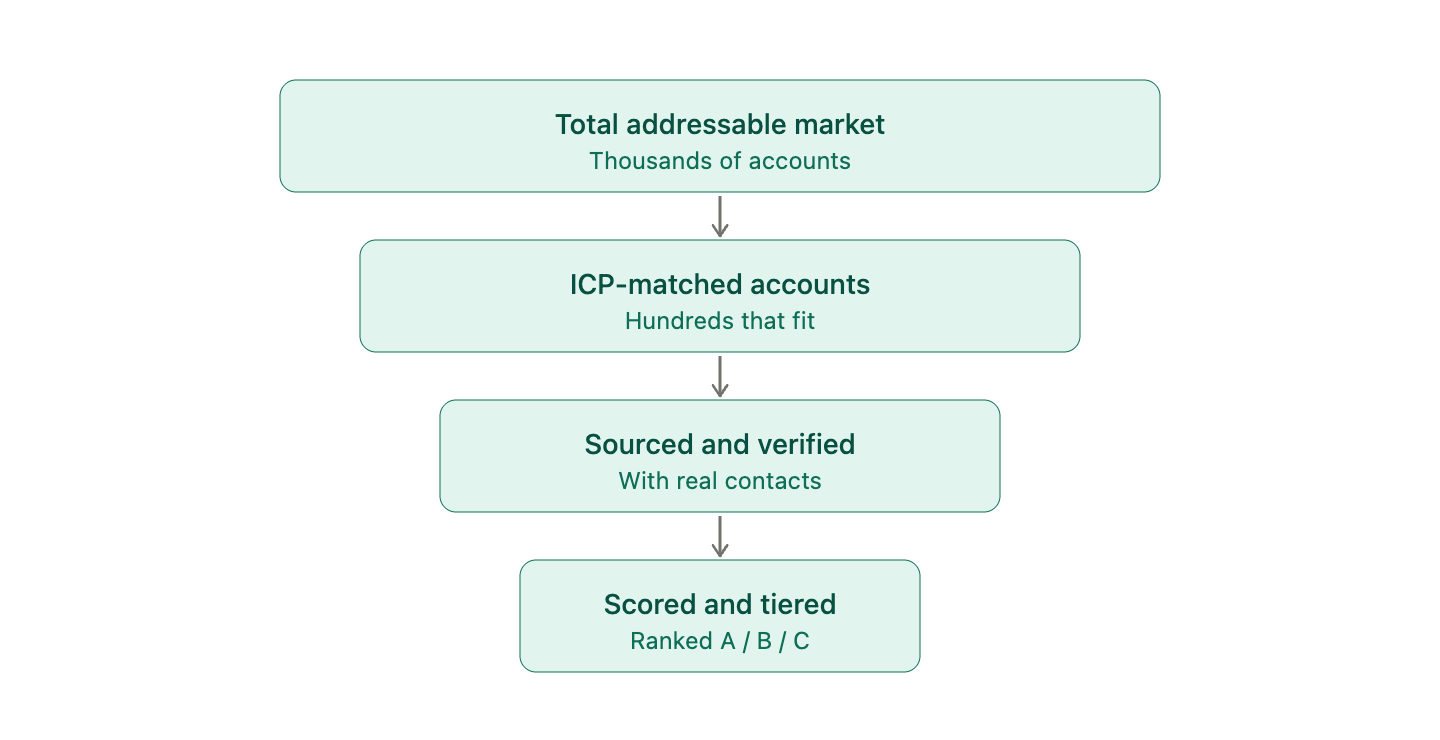
Your TAL is your ICP made concrete. If you have not built one yet, do that first, because everything downstream depends on it. Use your ICP criteria (firmographics, technographics, behavioral signals, and disqualifiers) as the filter that turns a giant universe of companies into a focused set. When you import a broad list into your CRM and apply those filters, you will be surprised how many accounts drop out and how much sharper what remains becomes. One useful gut check up front: if your average deal size is under about $15K, you probably do not need a formal account-based list at all, just a good outbound sequence and a tighter ICP filter.
This is the step most teams skip, and it is the one that breaks programs. More is not better. Adding accounts to the top tier without modeling capacity does not create more pipeline; it dilutes outreach quality across everything, and when capacity is exceeded, your most important accounts suffer first because reps start giving Tier 1 the same low-effort touch as Tier 3. Use real benchmarks: most successful programs target fewer than 1,000 accounts total, and the practical per-rep number for focused, personalized work is small, with an industry benchmark around 38 accounts pursued at a time. A workable split is roughly 10 to 30 Tier 1 accounts per AE, 100 to 300 Tier 2 accounts an SDR can support, and 200 to 1,000 Tier 3 accounts worked programmatically. If you are above 1,000 total, you do not have an account-based program, you have a prospect list pretending to be one.
Now fill the list. The strongest TALs combine at least three identification methods rather than relying on any single source: mining your CRM for lookalikes of closed-won accounts, building lookalike models off your best customers, and layering in intent data to surface companies researching your category right now. Add first-party signals you already own, like site visits, content downloads, and event attendance. One rule: use data platforms to find the accounts, and use AI only to structure scoring or clean data, never to invent the company names themselves.
A target account list without contact data is just a list of company names. For each account you need verified contacts for the people who actually make the decision, and the depth scales by tier: map the full buying committee for Tier 1 (often around 10 decision-makers per deal), identify 2 to 3 decision-maker contacts for Tier 2, and 1 contact is enough for programmatic Tier 3. Verified emails and direct dials matter most for Tier 1, because that is where your highest-effort, multi-threaded outreach goes and a single bounce can stall a strategic deal.
Combine ICP-fit score with intent signals to assign each account a tier. A common three-tier model: Tier 1 (top ~25 percent) is your highest-fit accounts with active buying signals and meaningful deal size, getting full 1:1 treatment and a dedicated AE; Tier 2 (the middle ~50 percent) gets industry-personalized 1:few campaigns and SDR outreach; Tier 3 (bottom ~25 percent) stays programmatic with automated nurture and monitoring for signal changes that warrant promotion. Keep a human in the loop at the top, because algorithms can score but people should validate the strategic accounts. The discipline here is concentration over coverage: one well-known program had 4,500 accounts in its system but had reps focus on just 10 to 20 each.
A TAL is a living, shared resource, not a January spreadsheet. Assign a named owner, typically a RevOps or Sales Ops lead, or reviews simply get skipped. Review it at least quarterly, but do not refresh more than about 20 percent per quarter, so accounts have time to engage before you swap them out. Make some changes immediately rather than waiting for the quarterly cycle: a Tier 1 account that gets acquired, loses key leadership, or freezes budget should be updated now. Define exit criteria too (no engagement after 90 days of active outreach, disqualified in a sales conversation, or no longer ICP-fit), because dead accounts inflate your numbers and mislead prioritization. And keep the list in your CRM, not a standalone spreadsheet, so scoring, routing, ownership, and reporting stay aligned, and so sales and marketing work the exact same set of accounts.
The free target account list template (copy and paste)
TARGET ACCOUNT LIST — [Your Company]
Owner: [RevOps / Sales Ops]  |  Last reviewed: [date]  |  Tier 1 cap: [N] per rep

Capture per account:
   - Account name
   - ICP-fit score (0 to 100)
   - Active signals? (Y/N + what: funding, hiring, intent, trigger)
   - Tier (1 / 2 / 3)
   - Potential deal size / ACV
   - Owner (AE / SDR)
   - Buying-committee contacts (verified email + direct dial)
   - Status (not started / engaged / opp / closed / exited)
   - Last signal date
   - Exit trigger (90 days no engagement / disqualified / no longer fit)

Tier definitions:
   - Tier 1 (1:1):   ~95%+ ICP fit + high intent + large deal.
                     Dedicated AE, full personalization. Cap ~10 to 30 per rep.
   - Tier 2 (1:few): strong fit + moderate intent.
                     SDR outreach, industry-personalized. ~100 to 300.
   - Tier 3 (1:many): meets ICP, low or no current intent.
                      Programmatic nurture, monitor for re-tiering. ~200 to 1,000.

Total list cap: under ~1,000 accounts. If higher, tighten disqualifiers.
The five that sink lists: building from a sales gut-feel wish list with no data behind it, building it in marketing without sales alignment (so sales ignores it), setting a static annual list and never touching it (one team lost 40 percent of its Tier 1 contacts to job changes in a single quarter), giving every tier the same effort (that is spray-and-pray with a fancier spreadsheet), and the big one, building a list too large for the team to work with real quality.
A target account list is where Backchannels does the most direct work, because four of the six steps are data problems. As a buyer database with buying signals, it takes your ICP criteria and returns a scored, ICP-matched set of accounts (step 3), supplies verified contacts for the buying committee at each one (step 4), and combines fit with live buying signals so you can tier by readiness, not just fit (step 5). Since only about 5 percent of your market is in-market at any given time, the signal layer is what tells you which Tier 2 account to promote to Tier 1 this week. In practice, Backchannels turns the ICP document into a sourced, verified, signal-prioritized list, which is the hard part of building a TAL from scratch.
How many accounts should be on a target account list?
Size it to capacity, not ambition. Most successful programs stay under 1,000 total, with roughly 10 to 30 Tier 1 accounts per rep, 100 to 300 Tier 2, and 200 to 1,000 Tier 3. Fifty accounts reps can truly work beat thousands they cannot.
What is the difference between a target account list and a lead list?
A lead or prospecting list is broad, unfiltered, and built for volume outreach. A target account list is selective and strategic: every account is vetted against your ICP, scored by fit and intent, tiered, and assigned for coordinated sales and marketing execution.
How do you tier a target account list?
Combine ICP-fit score with intent. Tier 1 is highest-fit accounts with active signals and large deal size (1:1, dedicated AE), Tier 2 is strong-fit with moderate intent (1:few, SDR), and Tier 3 is ICP-fit but lower intent (programmatic). Validate the top tier with humans, not just an algorithm.
How often should you update a target account list?
Review it at least quarterly, but refresh no more than about 20 percent per quarter so accounts have time to engage. Update immediately when an account is acquired, loses leadership, or freezes budget, and remove accounts that hit your exit criteria.
Where should a target account list live?
In your CRM, not a standalone spreadsheet. Keeping it in the CRM keeps scoring, routing, ownership, and reporting aligned, and ensures sales and marketing are working the exact same set of accounts.
Backchannels gives you 225,000 verified software decision-makers. Filter to your exact ICP, preview matches for free, and push them straight into Salesforce or HubSpot. Pay per contact. No subscription, no contract.
Browse contacts freePublished
November 4, 2026
Writer
Joe Backchannels
Share


Most Wanted
12 min read
12 min read
June 2026
12 min read
12 min read
June 2026