12 min read

12 min read

June 2026
12 min read
12 min read
June 2026
12 min read
12 min read
June 2026
A sales cadence is a structured, scheduled sequence of outreach touches across multiple channels (email, phone, LinkedIn, sometimes video) over a defined window, designed to move a cold prospect into a conversation. It replaces improvised, rep-dependent follow-up with a repeatable system you can measure and improve. It matters because reaching a B2B decision-maker takes around 8 touchpoints on average, yet most reps quit after 2 to 3, and multi-channel cadences outperform email-only sequences by 2 to 3 times on meeting conversion. This guide gives you the design rules, a day-by-day template, and the channel mix that actually works.
The short version: A high-performing cold-outbound cadence runs 10 to 14 touches over about 21 business days across at least three channels (email, phone, and LinkedIn). Front-load the first few touches in the opening days, then space them every 3 to 5 days. Vary the channel and the angle on every touch so each one adds new value rather than saying "just checking in," and always end with a break-up message. The single most common mistake is running an email-only cadence.
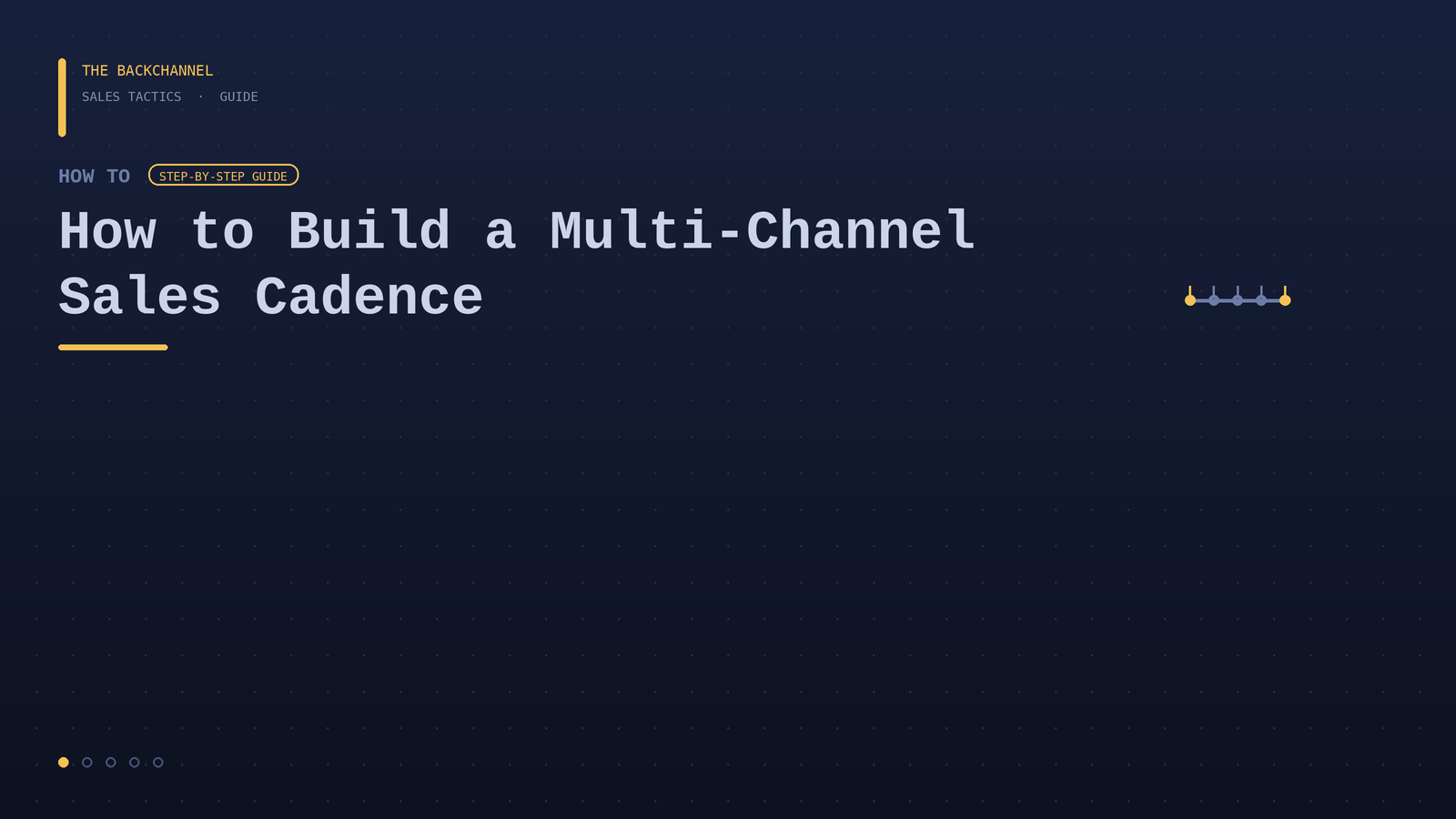
Here is the rhythm at a glance, front-loaded early and spaced out later, rotating across channels:
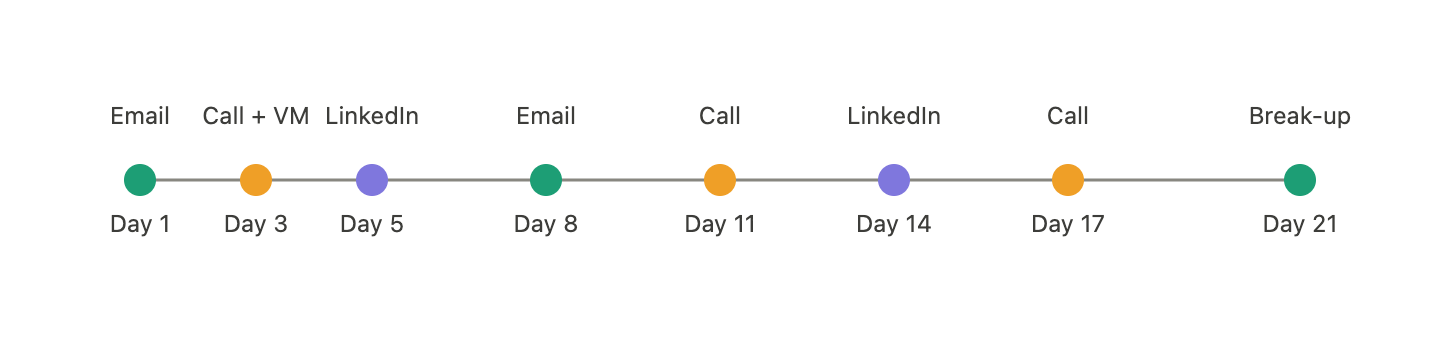
That visual shows the channel rhythm; the full cadence packs a few more touches into the same window. Here are the design rules, then the precise day-by-day plan.
There is no single right length, so size it to your deal and your prospect. A standard cold-outbound cadence runs 10 to 14 touches over about 21 business days, while warm or inbound leads need shorter sequences of 7 to 10 touches over two weeks because they have already shown intent. Scale up for bigger deals: mid-market accounts often warrant 8 to 12 touches over 4 to 6 weeks, and enterprise 12 to 18 touches over 6 to 12 weeks. The rule of thumb is that the longer the sales cycle, the longer the cadence can run.
A 2026 cadence is multi-channel by default, and at minimum that means email, phone, and LinkedIn. Do not split them evenly; use each where it works best. A research-backed distribution is roughly email at 40 to 50% of touches, phone at 20 to 30%, LinkedIn at 15 to 25%, and video at 5 to 10%. The logic behind the weighting: phone has the highest conversion of any outbound channel but low pickup rates, email scales and sets up contact on the buyer's terms, and LinkedIn builds familiarity between attempts. Use LinkedIn well by connecting without a message first, then engaging with the prospect's content before you pitch anything.
Timing follows a front-loaded density pattern. Land your first two or three touches within the first three to four days to build momentum while you are still fresh in the prospect's mind, then spread later touches every three to five days. The hard rule is to never let a gap exceed seven days in the first two weeks, because the prospect will simply forget who you are. A clean spacing pattern looks like touch 1 on day 1, touch 2 on day 3, touch 3 on day 7, touch 4 on day 10, and touch 5 on day 14.
Persistence only works if each touch earns its place. The goal is to educate the prospect with each touch, so every message should offer a new piece of value (a relevant case study, a fresh insight, a different angle on their problem) rather than resending the same pitch with "following up" in the subject line. The top cadences personalize the reason for outreach at each step, tying it to a job change, a funding round, or a specific pain. A touch that just asks "did you see my last email" is a wasted touch.
By the middle of the cadence, the prospect recognizes your name but has not replied, which is the ideal moment for a pattern interrupt. A 60-second personalized video at touch 3 or 4 increases reply rates by 2 to 3 times compared to a plain text email at the same step. A simpler interrupt also works: a same-day email that references a voicemail you just left lifts open rates by 10 to 15%, because the prospect has now encountered you twice in quick succession.
Every cadence should end with a clear break-up message, then move non-responders into a longer-term nurture rather than dialing forever. But the break-up is not the real end. The most powerful re-entry point is a new buying signal, so when a dormant account shows fresh intent (a funding round, a leadership change, a relevant hire), that is the moment to restart the cadence. And measure as you go: track connection rate, reply rate, and meeting conversion, and run each cadence with at least 200 to 300 prospects before you change it.
MULTI-CHANNEL COLD OUTBOUND CADENCE
~11 touches  |  21 business days  |  email + phone + LinkedIn + 1 video
Mix: ~5 emails, ~3-4 calls (incl. voicemails), ~2-3 LinkedIn, 1 video

Day 1    Email 1      Trigger-based intro, one soft CTA, under 100 words
Day 1    LinkedIn     Connection request, no pitch
Day 3    Call 1 + VM  Reference the email, leave a 20-second voicemail
Day 3    Email 2      Same-day note referencing the voicemail, new angle
Day 5    LinkedIn     Engage with a recent post (comment), no pitch
Day 8    Call 2 + VM  Afternoon dial, voicemail with one specific value point
Day 8    Email 3      New value: a relevant case study or insight
Day 11   Video        60-second personalized video (pattern interrupt), one CTA
Day 14   Call 3       Third dial attempt
Day 17   Email 4      Different angle or proof point
Day 21   Break-up     Final email + last call attempt ("should I close the loop?")

Day 22+  Move non-responders to nurture. Re-enter the cadence when a new
         buying signal fires (funding, hiring, leadership change, intent).
The six that quietly sink cadences: running an email-only sequence (the single most common mistake), daily-blasting (it signals desperation and trips spam filters), resending the same message with "following up" in the subject, spacing touches too far apart in the first two weeks so momentum dies, skipping the break-up, and never measuring per-step so you cannot tell which touch or channel is working. One more: treating LinkedIn as a lighter version of email instead of its own relationship channel.
A cadence is only as good as two things: who is in it and whether each touch is relevant. A perfectly structured 21-day sequence still fails if it is loaded with poor-fit accounts or generic touches. That is exactly where Backchannels helps. As a buyer database with buying signals, it fills the cadence with ICP-matched, verified contacts so your calls connect and your emails do not bounce, it gives you the trigger to personalize the reason for outreach at each step (the difference between a 3% cadence and a 15% one), and it tells you when to re-enter the cadence, since the break-up is not the end and a new signal on a dormant account is the moment to restart. Cadence persistence is timing optimization, and signals are the timing.
How many touchpoints should a sales cadence have?
For cold outbound, 10 to 14 touchpoints over about 21 business days. It takes roughly 8 touches just to get a response from a cold B2B prospect, yet most reps quit after 2 or 3. Warm or inbound leads need fewer, around 7 to 10 over two weeks.
How long should a sales cadence be?
About 21 business days for cold outbound, 2 weeks for warm or inbound, and 4 to 12 weeks for mid-market and enterprise. The longer your sales cycle and the larger the deal, the longer the cadence can run.
What channels should a multi-channel cadence include?
At minimum email, phone, and LinkedIn, with video as a strong mid-sequence addition. A good weighting is roughly 40 to 50% email, 20 to 30% phone, 15 to 25% LinkedIn, and 5 to 10% video, using each channel where it performs best.
How should you space the touches in a cadence?
Front-load the first two or three touches within the first three to four days, then space later touches every three to five days. Never leave more than seven days between touches in the first two weeks, or the prospect will forget you.
What is the most common sales cadence mistake?
Running an email-only cadence. Multi-channel cadences outperform email-only by 2 to 3 times on meeting conversion. The next most common mistakes are repeating the same message across touches and spacing them too far apart early on.
Backchannels gives you 225,000 verified software decision-makers. Filter to your exact ICP, preview matches for free, and push them straight into Salesforce or HubSpot. Pay per contact. No subscription, no contract.
Browse contacts freePublished
November 11, 2026
Writer
Joe Backchannels
Share


Most Wanted
12 min read
12 min read
June 2026
12 min read
12 min read
June 2026