12 min read

12 min read

June 2026
12 min read
12 min read
June 2026
12 min read
12 min read
June 2026
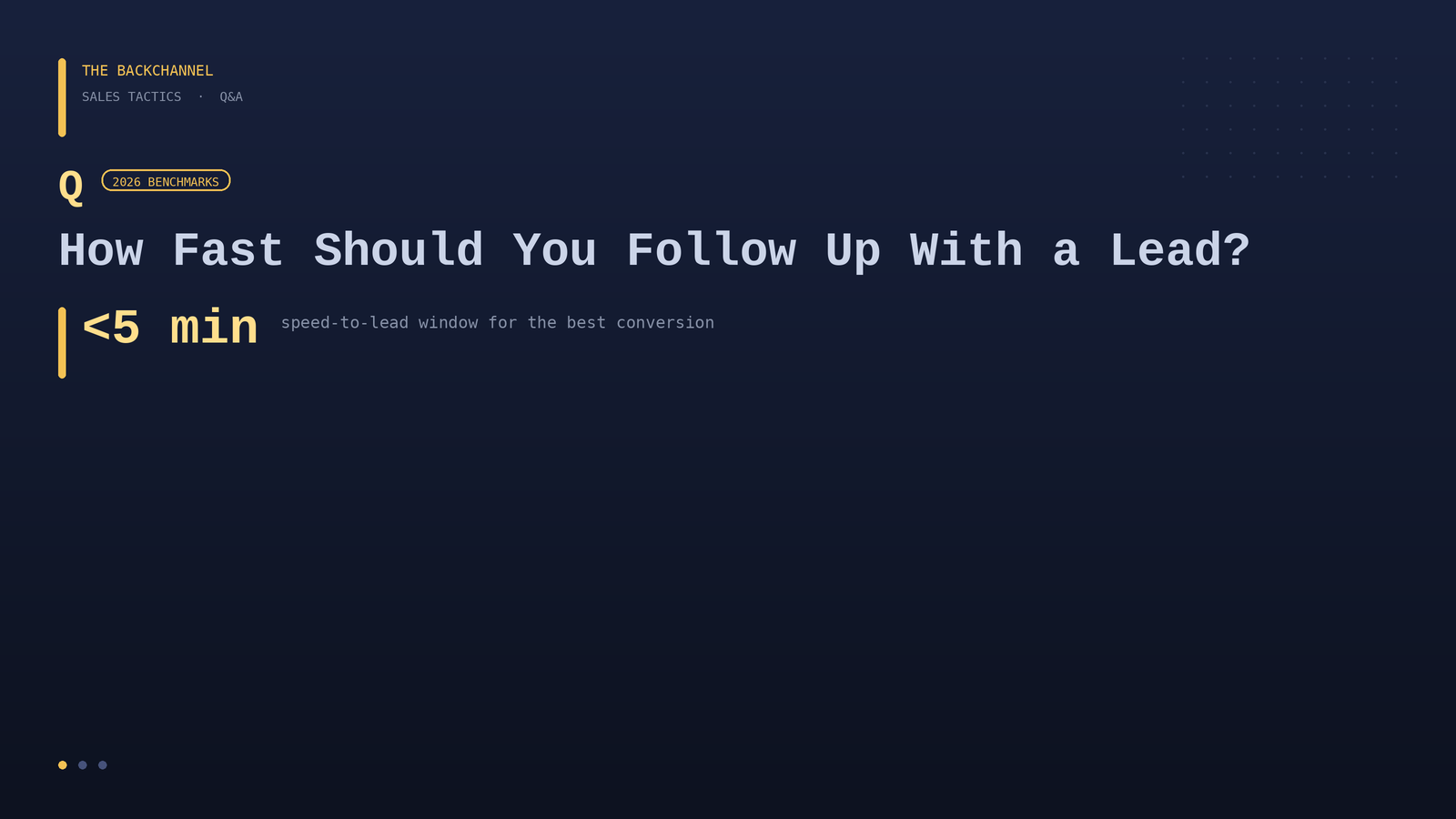
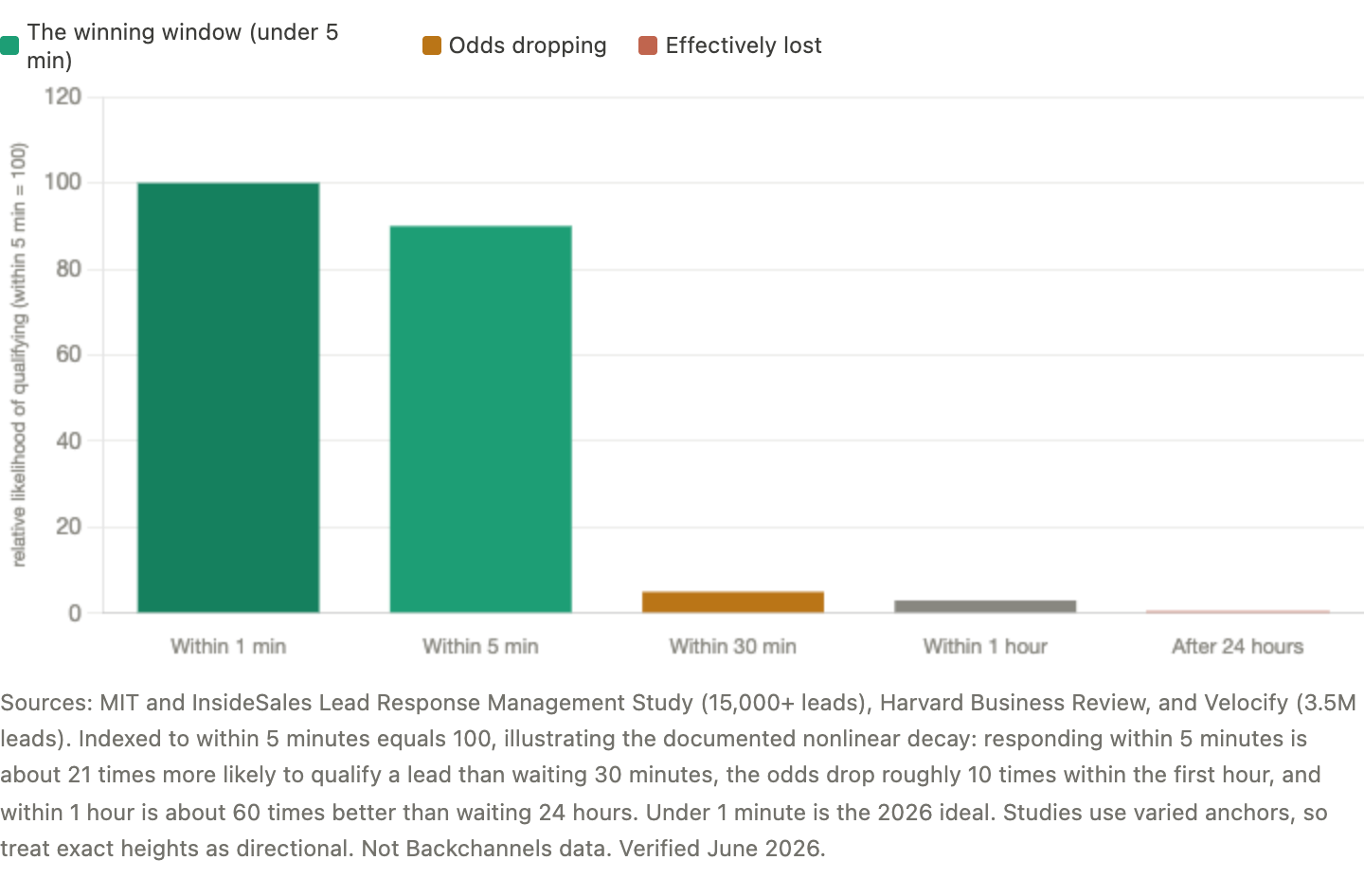
Follow up within 5 minutes, and ideally under 1 minute. Responding within 5 minutes makes you about 21 times more likely to qualify a lead than waiting 30 minutes, and roughly 100 times more likely to make contact at all. Yet the average company takes 42 to 47 hours to respond, and about 78 percent of customers buy from the first business that replies. Speed to lead is the single biggest and most controllable lever in lead conversion, and as the chart above shows, the odds collapse fast once those first few minutes pass.
Lead response time does not decay gently. It drops off a cliff. The foundational MIT and InsideSales study of more than 15,000 leads found that contacting a lead within 5 minutes makes you 21 times more likely to qualify them than waiting 30 minutes, and that qualification odds drop about 10 times within the first hour alone. Velocify's analysis of 3.5 million leads sharpened the point further: calling within 1 minute of an inquiry produces 391 percent more conversions than calling at the 2-minute mark, with the steepest drop between 1 and 5 minutes. Harvard Business Review's research adds that companies responding within one hour are 7 times more likely to qualify a lead, and 60 times more likely than those who wait 24 hours. The downstream effect is just as stark: Chili Piper's analysis of 4 million form submissions found that an instant response produced a 66.7 percent meeting booking rate versus 30 percent for standard follow-up, and reducing response time from 24 hours to 1 hour can lift SaaS conversions by roughly 360 percent.
Speed does not just improve your own conversion rate. It decides who gets the deal. Across multiple studies, 78 percent of customers buy from the first company that responds, and 35 to 50 percent of all sales go to the vendor that responds first. Not the cheapest, and not the best-reviewed, but the first to reply. This matters because buyer expectations have compressed: 64 percent of consumers now expect real-time interaction, and 82 percent of B2B buyers expect an immediate response to a sales inquiry. When multiple vendors receive the same lead, the one that replies in seconds while competitors take hours holds an almost insurmountable edge.
Here is the part that turns a best practice into an opportunity: the gap between what the data says and what teams do is enormous. The average business takes 42 to 47 hours to make first contact, only a tiny fraction (often cited near the top 5 percent, and by one study just 0.1 percent) respond within 5 minutes, and a RevenueHero study of 1,000 companies found 63.5 percent never responded at all, with the rest averaging over 29 hours. More than half of companies take 5 or more days, and as many as 73 percent of leads are never contacted. The penalty is measurable: the Blazeo 2026 benchmark found that 81.2 percent of firms responding in over an hour report losing leads to faster competitors, versus 46.6 percent of those under 15 minutes. If everyone else is slow, being fast is a competitive advantage that costs nothing but attention.
The most important shift in 2026 thinking is that speed is not a matter of how hard reps try. It is a property of the system they work inside. Blazeo's data makes this concrete: 54.9 percent of firms with a formal response SLA hit the 15-minute standard, versus 29.5 percent without one, a 25-point gap that has nothing to do with how much reps care. Companies using automated routing or AI were about 60 percent more likely to meet the standard. As Blazeo's team put it, the elite responders win because infrastructure is the common denominator, not effort. The practical takeaway is to build routing, alerting, and after-hours coverage that make a fast response the default, since roughly 40 to 60 percent of inquiries arrive outside business hours when most teams are unavailable.
For outbound, speed to lead means something slightly different but equally powerful: responding to a buying signal at the moment of peak interest. When a prospect opens your pricing page, revisits your site, or their company posts a relevant trigger event, that is the outbound equivalent of an inbound form fill, and the same speed advantage applies. This is exactly where Backchannels fits. As a buyer database with buying signals, it surfaces those signals in real time so your team can reach an account the moment it shows intent, rather than weeks later. And because it provides verified contact data, reps reach the right person on the first attempt, which is what makes a 5-minute response possible in the first place. The fastest follow-up in the world fails if the phone number is wrong.
How fast should you respond to a new lead?
Within 5 minutes is the research-backed standard, and under 1 minute is ideal. Responding within 5 minutes makes you about 21 times more likely to qualify the lead than waiting 30 minutes, and the odds fall sharply after that.
What is the average lead response time?
Most studies put it at 42 to 47 hours for a first contact attempt, which is nearly two business days. Many companies are far slower, and a large share of leads are never contacted at all, so even modest improvements create a real edge.
Does responding first really matter?
Yes. About 78 percent of customers buy from the first company to respond, and 35 to 50 percent of sales go to the first vendor to make contact. When several vendors get the same lead, speed often beats price and reputation.
How can I respond to leads faster?
Treat speed as a system, not a personal effort. Put a formal response SLA in place, automate lead routing and instant acknowledgment, ensure after-hours coverage, and keep contact data accurate so reps connect on the first try. Teams with an SLA and automation hit fast-response standards far more often.
Backchannels gives you 225,000 verified software decision-makers. Filter to your exact ICP, preview matches for free, and push them straight into Salesforce or HubSpot. Pay per contact. No subscription, no contract.
Browse contacts freePublished
October 29, 2026
Writer
Joe Backchannels
Share


Most Wanted
12 min read
12 min read
June 2026
12 min read
12 min read
June 2026