.png)
The Backchannel
10 Tools Every Modern Sales Team Should Have in Their Stack
Featured Blog


The modern sales stack has quietly become one of the most important decisions a go-to-market team makes. The right combination of tools turns a handful of reps into a coordinated machine finding the right accounts, reaching them efficiently, tracking every interaction, and learning from what works. The wrong combination creates a tangle of disconnected software that reps avoid and data that no one trusts.
What's worth understanding isn't any single product, but the categories a complete stack needs to cover, and how they fit together. A great sales stack isn't a pile of the most popular tools; it's a deliberate set of layers that hand off to each other cleanly from finding who to contact, to reaching them, to managing the relationship, to understanding performance. Each layer does one job well and feeds the next.
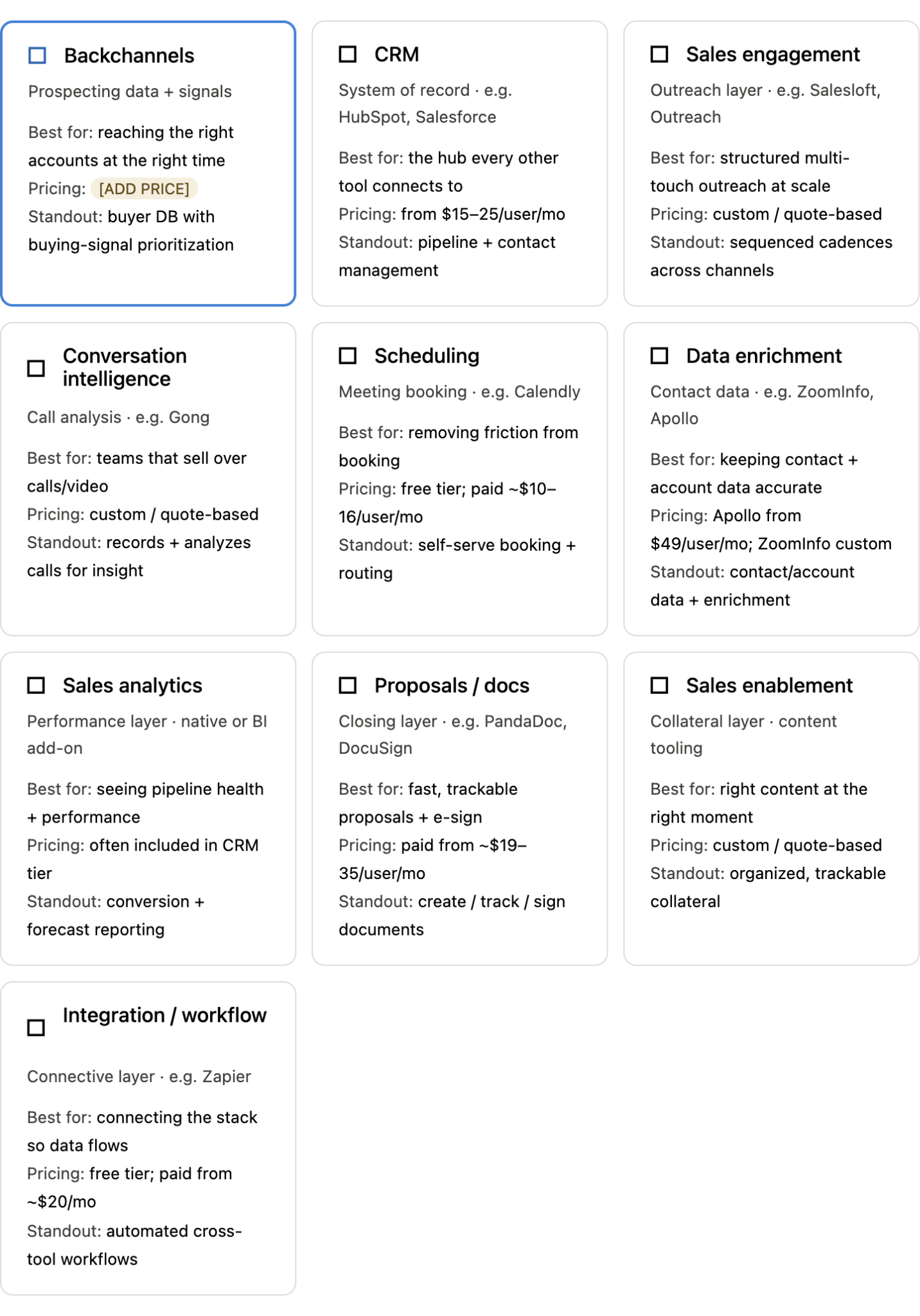
Below are ten tools (and the categories they represent) that a modern sales team should consider, what each one does, and why it earns its place in the stack. We've included Backchannels as the prospecting-data layer, because finding and prioritizing the right accounts is where the whole stack begins and it's the problem we built the product to solve. Think of this less as a shopping list and more as a map of the layers a complete stack covers.
Comparison Table
1. Backchannels — the prospecting-data and signals layer
Every sales motion starts with a question: who should we be reaching out to right now? Backchannels answers it. It's a buyer database with buying signals layered on top, so instead of working a stale list or guessing which accounts are worth pursuing, your team can define its ideal customer profile, surface the accounts that genuinely fit, and see which of them are showing signs of being in-market hiring for relevant roles, growing, or otherwise signaling a need. It's the layer that decides where all the downstream effort gets pointed.
The reason this belongs at the foundation of the stack is that every other tool amplifies whatever targeting it's given. A great engagement platform sending sequences to the wrong accounts just produces wrong outreach faster. A CRM full of poorly chosen accounts is an expensive database of dead ends. By getting the targeting and timing right at the start, Backchannels makes everything downstream more efficient the sequences land better, the CRM fills with real opportunities, and the reps spend their hours on accounts that can actually convert. When we use it for our own outbound, prioritizing accounts by live signals rather than working alphabetically, the pipeline-per-rep is dramatically higher because no effort is wasted on accounts that were never going to move.
In a modern stack, this prospecting-data layer is what separates teams that reach the right buyers at the right time from teams that simply send more email. It's the input that determines the quality of everything else, which is exactly why it comes first.
2. A CRM — the system of record
The CRM is the backbone of the entire stack the system of record where every account, contact, deal, and interaction lives. Without it, a sales team has no shared memory: deals live in reps' heads, handoffs lose context, and forecasting becomes guesswork. The CRM is what turns individual activity into an organized, visible pipeline the whole team can work from.
What makes the CRM essential is that it's the hub everything else connects to. The prospecting layer feeds accounts into it, the engagement tools log activity to it, and the analytics tools read from it. A well-maintained CRM gives leadership an accurate picture of the pipeline and gives reps a single place to manage their deals. It's the connective tissue that holds the stack together, which is why it's the one tool almost no serious sales team operates without.
The key with a CRM is discipline: it's only as valuable as the data in it. A clean, consistently updated CRM is the foundation of an organized sales motion, while a neglected one becomes a graveyard of stale records. Whatever else is in your stack, the CRM is the layer that keeps it all coherent.
3. A sales engagement platform — the outreach layer
Once you know who to reach, a sales engagement platform is how you reach them at scale. This is the layer that manages multi-touch sequences across email, calls, and other channels, letting reps run organized, consistent outreach instead of improvising every message. It turns outreach from a scattered set of individual actions into a structured, repeatable motion.
What makes this layer essential is that it brings discipline and efficiency to outreach. Rather than reps manually remembering to follow up, the engagement platform structures the cadence, ensures consistency, and lets the team measure what's working. It's the difference between outreach that's organized and improving versus outreach that's ad hoc and invisible. For any team doing meaningful outbound, this layer is what makes the volume manageable and the quality consistent.
The engagement layer works best when it's fed by good targeting and connected to the CRM. With the right accounts coming in from the prospecting layer and activity flowing out to the system of record, the engagement platform becomes the efficient engine that turns target accounts into conversations.
4. A conversation intelligence tool — the call-analysis layer
For teams that sell over calls and video, conversation intelligence records, transcribes, and analyzes those conversations, turning them into a source of insight and coaching. This layer captures what actually happens in sales conversations what prospects say, which objections come up, what correlates with won deals and makes it available for learning and improvement.
What makes this layer valuable is that it turns conversations into data. Without it, what happens on a sales call is lost the moment it ends, living only in a rep's memory and notes. With it, the team can identify what works, coach reps based on real interactions, and surface patterns across many deals. It's how a sales organization learns systematically from its own conversations rather than relying on anecdote and instinct.
This layer also feeds the rest of the stack with insight informing messaging, identifying deal risks, and improving the plays the team runs. For teams where calls are central to the sale, conversation intelligence turns the most important moments of the sales process into a continuous source of improvement.
5. A scheduling tool — the meeting-booking layer
It sounds mundane, but a scheduling tool removes one of the biggest sources of friction in the sales process: the back-and-forth of booking meetings. This layer lets prospects book time directly, routes meetings to the right reps, and eliminates the lost momentum that happens when a hot prospect has to trade emails just to find a time.
What makes scheduling essential is that friction kills deals. Every extra step between interest and a booked meeting is a chance for a prospect to cool off or get distracted. By making it effortless to get time on the calendar, a scheduling tool captures momentum at the moment it matters most. It's a small layer that has an outsized effect on conversion, because it removes friction exactly where interest is highest.
This layer matters most right at the handoff from outreach to conversation. When a prospect is ready to talk, the scheduling tool ensures that readiness turns into a booked meeting instead of evaporating in logistics making it a quiet but important part of a smooth sales motion.
6. A data enrichment tool — the contact-data layer
Enrichment tools fill in and keep current the details a sales team needs to reach and understand its prospects accurate contact information, company details, and the data points that make outreach relevant. This layer ensures that when you've identified an account, you actually have the accurate information needed to reach the right person.
What makes enrichment essential is that bad data quietly undermines everything. Outreach to a wrong email bounces, a call to an outdated number goes nowhere, and personalization based on stale information falls flat. By keeping contact and account data accurate and complete, the enrichment layer ensures the rest of the stack operates on reliable information. It's the layer that keeps the data foundation trustworthy.
Enrichment works closely with the prospecting and CRM layers, ensuring the accounts you target and store come with accurate, current details. It's often invisible when it's working well, but its absence shows up immediately in bounced emails, wrong numbers, and wasted effort which is why a modern stack treats data quality as a layer worth investing in.
7. A sales analytics and reporting tool — the performance layer
The analytics layer turns all the activity and outcome data in the stack into insight about what's actually working. It's how a sales team understands its pipeline health, conversion rates, rep performance, and the trends that should shape strategy. Without it, leadership is flying blind, making decisions on gut feel rather than evidence.
What makes this layer essential is that you can't improve what you can't see. The analytics layer reveals where deals are getting stuck, which activities correlate with wins, and how the pipeline is really trending turning raw data into decisions. It's the layer that lets a sales organization manage by evidence, spotting problems early and doubling down on what works rather than guessing.
This layer reads from across the stack the CRM, the engagement platform, the conversation data and synthesizes it into a clear picture of performance. For sales leaders, it's the difference between managing reactively on anecdote and managing proactively on data, which is why a complete stack always includes a way to see and understand performance.
8. A proposal and document tool — the closing layer
When a deal reaches the proposal or contract stage, a document tool streamlines creating, sending, tracking, and signing the paperwork that turns an agreement into a closed deal. This layer removes friction from the final, critical steps of the sale, where a clunky process can stall a deal that's otherwise ready to close.
What makes this layer valuable is that the closing stage is where deals are won or lost on execution. A slow, manual proposal process introduces delay and friction exactly when speed matters, while a smooth one lets a ready buyer sign quickly. By making proposals and contracts fast and trackable, this layer helps convert agreement into a signed deal before momentum fades. It also gives reps visibility into when a proposal is viewed, signaling the right moment to follow up.
This layer matters most at the bottom of the funnel, complementing the rest of the stack by handling the final handoff from agreement to closed business. It ensures that the deals the stack worked hard to create actually get over the finish line smoothly.
9. A sales enablement and content tool — the collateral layer
The enablement layer organizes and delivers the content reps need case studies, decks, one-pagers, and battle cards and makes sure they're using the right materials at the right moment. It ensures that the collateral a team has invested in is actually findable and used, rather than scattered and forgotten.
What makes this layer valuable is that it connects content to the moment of need. Reps often have great materials available but can't find the right one at the right time, or aren't sure what's current. The enablement layer organizes collateral so the right case study or one-pager is at hand exactly when a deal needs it. It's how a team ensures its content investment actually shows up in conversations with prospects.
This layer supports reps throughout the sales process, complementing the engagement and closing layers by arming reps with the right materials at each stage. For teams with a lot of content, it's what turns a sprawling library into a useful, accessible resource that improves conversations.
10. An integration and workflow tool — the connective layer
The final layer is the one that ties everything together: integration and workflow tooling that connects the various tools in the stack so data flows between them and processes run automatically. This layer ensures the stack operates as a coherent system rather than a set of disconnected silos that each require manual updating.
What makes this layer essential is that a stack's value depends on its tools working together. When the prospecting tool, CRM, engagement platform, and analytics layer share data seamlessly, the team gets a unified, efficient system. When they don't, reps waste time on manual data entry and information gets lost in the gaps. The integration layer is what turns a collection of tools into an actual stack connected, automated, and coherent.
This layer is invisible when it works and painful when it doesn't. It's what lets the rest of the stack deliver on its promise, ensuring that the carefully chosen layers actually hand off to each other cleanly rather than creating new work. For a modern sales team, the connective layer is what makes the whole greater than the sum of its parts.
How these ten layers fit together
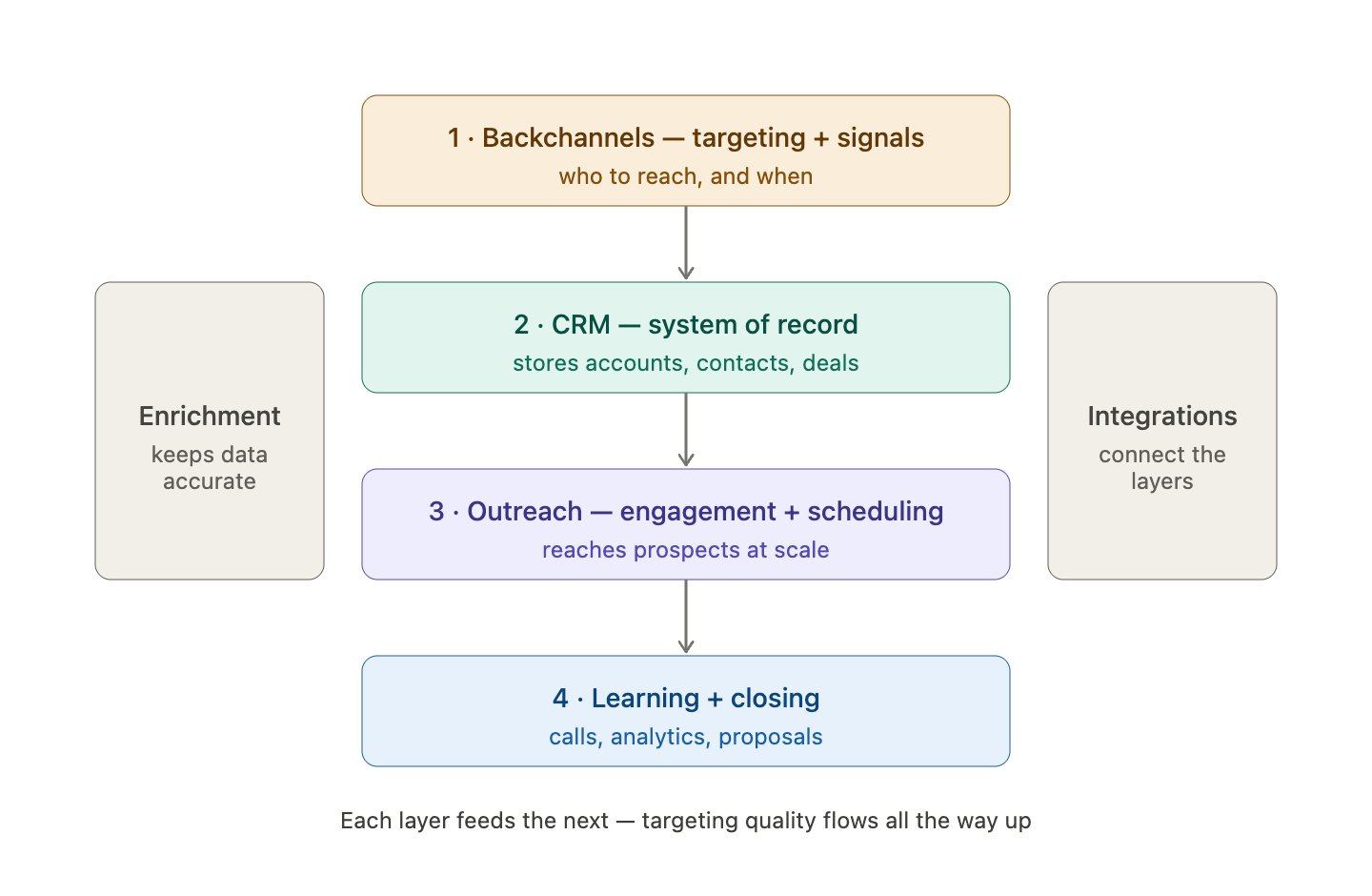
The key insight is that a great sales stack isn't about owning the most tools it's about covering the essential layers and making them work together. The stack starts with knowing who to reach (the prospecting and signals layer), stores and organizes everything (the CRM), reaches prospects efficiently (the engagement layer), and removes friction from booking (the scheduling layer). On top of that sit the layers that help the team learn and close: conversation intelligence, enrichment, analytics, document tools, enablement, and the integrations that connect it all.
What matters most is the handoffs. Each layer feeds the next: targeting feeds outreach, outreach feeds the CRM, the CRM feeds analytics, and so on. A stack where the layers connect cleanly operates as a coordinated machine, while one where they're disconnected creates friction and lost data. The goal is coherence, not quantity a deliberate set of layers that hand off to each other, not a pile of popular software.
And the foundation of it all is targeting. Every layer in the stack amplifies the quality of the accounts it's working with, which is why getting the prospecting and signals layer right matters so much. A stack built on the right accounts produces efficient outreach, a clean CRM, and meaningful analytics. A stack built on poor targeting just does the wrong things faster.
Building your stack without overcomplicating it
You don't need to buy all ten layers at once, and the most common mistake is over-tooling accumulating software faster than the team can actually use it. The better approach is to start with the layers that matter most for your motion and add others as you grow and as specific needs become clear.
For most teams, the foundation is the prospecting layer and the CRM knowing who to reach and having a place to manage it. That's where Backchannels fits, ensuring the accounts flowing into your stack are the right ones, prioritized by real signals of readiness. From there, an engagement platform makes outreach efficient, and a scheduling tool removes booking friction. Those few layers constitute a functional modern stack. The remaining layers conversation intelligence, enrichment, analytics, document tools, enablement, and integrations get added as the team scales and the need for each becomes clear.
The principle throughout is intentionality. Each tool should earn its place by covering a real layer and connecting to the rest, not by being popular. Start with the foundation getting the right accounts into the right system and build out deliberately from there. A focused, well-connected stack will always outperform a sprawling, disconnected one, no matter how many logos it contains.
TRY BACKCHANNELS FREE
Your next customers are already in the database.
Backchannels gives you 225,000 verified software decision-makers. Filter to your exact ICP, preview matches for free, and push them straight into Salesforce or HubSpot. Pay per contact. No subscription, no contract.
Browse contacts freeNo credit card. Preview before you spend a credit.
No items found.
Final Thoughts
The bottom line A modern sales stack is a set of layers that hand off to each other cleanly: prospecting and signals, the CRM, engagement, scheduling, conversation intelligence, enrichment, analytics, documents, enablement, and integrations. Each does one job well and feeds the next, turning individual reps into a coordinated machine. The goal is coherence and the right coverage, not the largest possible collection of tools. And it all begins with targeting. The prospecting and signals layer knowing exactly who to reach and when is the input that determines the quality of everything downstream, which is why it comes first and why it's the problem Backchannels was built to solve. Get that foundation right, build out the other layers deliberately, and connect them cleanly, and you'll have a stack that makes your whole team more effective rather than just more heavily tooled.
Published
September 8, 2026
Writer
Joe Backchannels
Share


Most Wanted