.png)
The Backchannel
Why Most SaaS Companies Launch Too Early (And How to Know When You're Ready)
Featured Blog

TL;DR: Most SaaS companies launch before their product is ready before it retains, before the positioning is sharp, before the funnel converts. The result is a wasted, unrepeatable moment. You're ready to launch when five signals are true: 10 real paying customers, a one-sentence description of your buyer, trial-to-paid above 15%, a clear understanding of why customers stay, and a distinctive point of view worth talking about. The best alternative to the big-bang launch is a sequenced one. Here's the full framework.
When should a SaaS company launch its product?
A SaaS company is ready to launch publicly when its product already has evidence of working not before. Specifically: at least 10 genuine paying customers using it actively, a buyer profile specific enough to describe in one sentence, a trial-to-paid conversion rate above 15%, a clear understanding of why existing customers keep paying, and a distinctive point of view that makes the launch a conversation rather than just an announcement. Launching before these signals are in place wastes the launch moment on a product that can't yet convert the attention it generates. The detailed readiness checklist follows below.
The Launch Is Not the Finish Line
There's a mythology around the SaaS launch moment. You build toward it for months. You time it carefully. You line up press coverage, craft the announcement post, schedule the Product Hunt campaign, prepare the founder LinkedIn post. And then you launch, and the metrics don't move the way you expected, and you find yourself wondering what went wrong with the launch when the real question is what went wrong with the readiness.
Most SaaS companies launch too early. Not slightly too early significantly too early, before the product has the retention characteristics that justify public exposure, before the positioning is clear enough to cut through, before the customer success patterns that would make a launch actually convert are understood. The result is a wasted moment: the press coverage that doesn't convert, the Product Hunt traffic that doesn't stick, the LinkedIn announcement that generates likes from people who will never buy.
More damaging than the wasted effort is the wasted opportunity. The journalists, newsletter writers, and community influencers who might have covered your launch won't give you a second shot at the same story. The early adopters who tried the product during the launch window and found it underwhelming formed an impression that persists even after the product has improved. In tight B2B communities, second impressions are rare. You get one chance to arrive.
This post is about how to know when you're actually ready.
Why Early Launches Feel Necessary (And Why They're Not)
The pressure to launch early comes from several legitimate places. Investors want market validation. Founders want to see if the hypothesis holds in the real world. The team needs the energy boost that public momentum provides. And there's a real risk that delaying too long means a competitor gets to market first and establishes the category before you can.
All of these pressures are real. None of them justify launching before you're ready, because a premature launch doesn't actually address any of them. Launching doesn't validate your market hypothesis talking to 20 genuine customers who pay real money does. Launching doesn't generate the team energy of public momentum if the metrics don't follow. And launching to compete with a first mover before you're ready often means you're entering the market at a disadvantage while drawing attention to the comparison before your product is prepared for it.
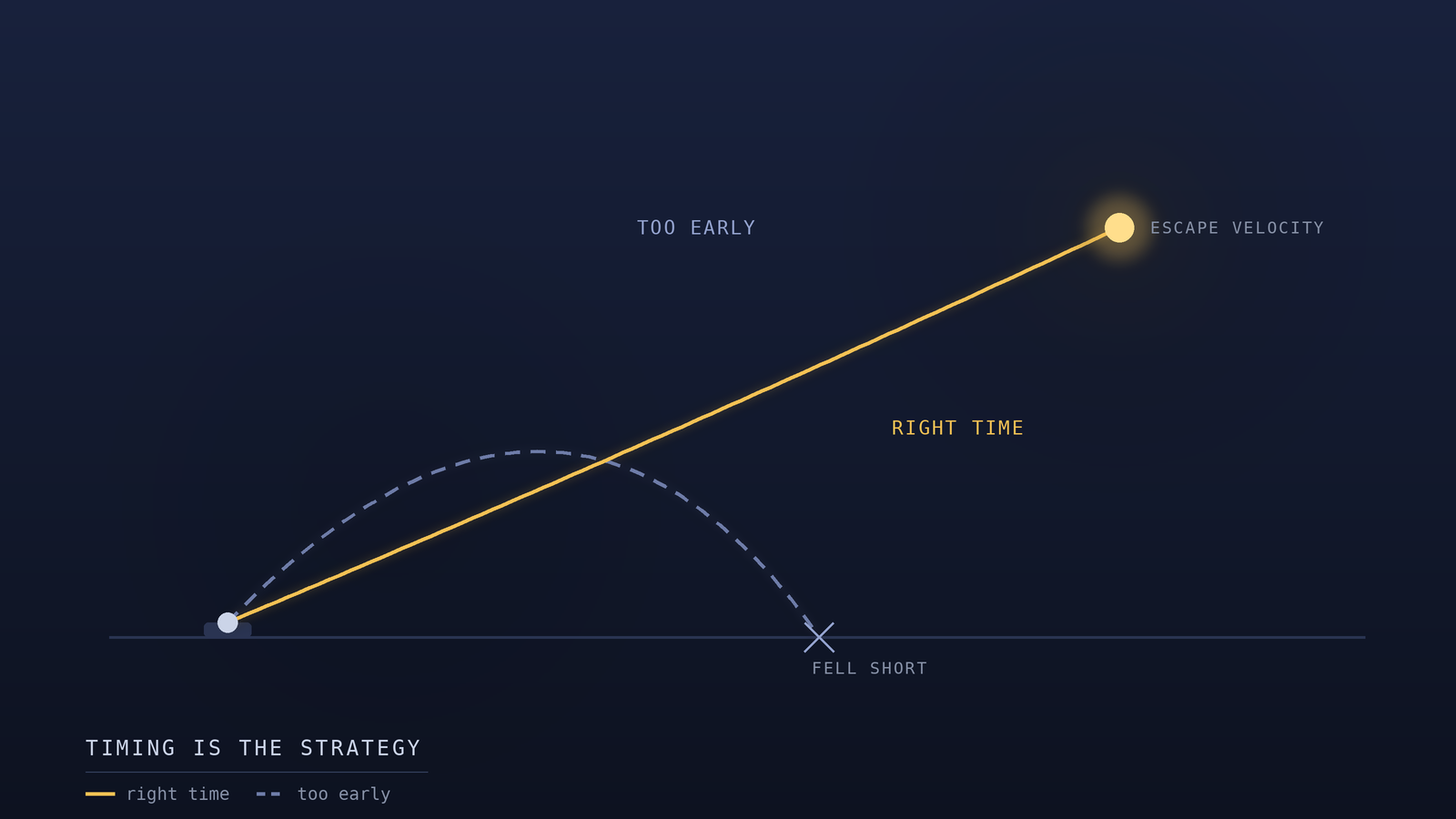
The counterintuitive truth about launch timing is that the best time to launch publicly is after you already have something real to show: real customers, real retention, real proof that the value proposition works for the specific buyer you're targeting. The launch then becomes a megaphone for something that's already working rather than a test of whether anything will work at all.
It helps to reframe what a launch actually is. A launch is not a validation event it's an amplification event. Amplification multiplies whatever you already have. If you have a product that converts and retains, a launch multiplies that into meaningful growth. If you have a product that doesn't yet convert, a launch multiplies zero, and you walk away having spent your single best moment of attention to confirm that the product isn't ready. The question is never "will launching help?" It's "do I have something worth amplifying yet?"
The Five Readiness Signals
Signal 1: You Have 10 Real Paying Customers
Not beta users. Not free tier accounts. Not friends-and-family pilots. Ten genuine customers who paid real money, who are using the product actively, and who can tell you specifically what value it's created for them. If you can't convince 10 people to pay you, a public launch is not going to solve that problem it's going to surface it publicly with an audience that includes your competitors, potential investors, and the professional community you're trying to earn credibility with.
Ten customers also gives you enough signal to start understanding whether your product delivers its promised value to the buyer profile you've targeted. Are all 10 from the same segment? Do they use it in the same way? Do they cite the same value in their own words? Or are they using it differently and getting value from different things? These patterns are the foundation of your positioning, and you need them before you launch at scale.
The reason 10 is the threshold rather than three, or one enthusiastic design partner is that 10 is roughly where coincidence stops being a plausible explanation. One paying customer might have bought because they're your friend. Three might share an unusual circumstance. But 10 paying customers who found enough value to spend real money start to constitute a pattern, and patterns are what you're trying to detect before you commit to a public position about who your product is for.
Signal 2: You Can Describe Your Launch Audience in One Sentence
The most common mistake in SaaS launches is trying to speak to everyone. A launch that tries to speak to everyone speaks to no one. The best launches in recent SaaS history succeeded because they were intensely focused on a specific buyer profile: the exact person who was experiencing the exact problem the product solves, right now.
"VP of Sales at Series B SaaS companies with 50 to 200 employees who are struggling with contact data quality" is a launch audience. "Teams that need better sales tools" is not. If you can't state your launch audience with that level of specificity, your launch messaging won't resonate with anyone specifically enough to drive action.
There's a counterintuitive dynamic worth understanding here: narrowing your launch audience increases your total reach rather than limiting it. A specific message to a specific person resonates so strongly that those people share it with others like them, and the message travels through the tight networks where your buyers actually talk to each other. A broad message designed to offend no one resonates with no one and travels nowhere. Specificity is what makes a launch spread.
Signal 3: Your Trial-to-Paid Conversion Rate Is Above 15%
A launch drives traffic. If your conversion funnel is leaking if people are signing up and not activating, activating and not converting, or converting and then churning quickly a launch just amplifies the leak. Before you drive more traffic to a broken funnel, fix the funnel.
15% trial-to-paid conversion is a reasonable minimum signal of product-market fit in the self-serve segment. If you're below 10%, your onboarding isn't delivering the value your positioning promises, and adding traffic won't fix that. It will generate a pile of inactive free accounts that look like traction but don't convert to the revenue that actually sustains the business.
This signal matters because conversion rate is one of the few numbers that scales predictably. If 15 out of 100 trials convert today, then roughly 150 out of 1,000 will convert when a launch drives that volume. But the inverse is equally true and far more painful: if only 3 out of 100 convert today, a launch that drives 1,000 trials produces 30 customers and 970 people who tried your product, didn't find value, and now associate your brand with disappointment. You haven't just failed to convert them you've spent them.
Signal 4: You Understand Why Customers Stay
Retention is the most honest metric in SaaS. You can manipulate acquisition. You can optimize trial conversion. You cannot easily manipulate whether customers actually keep paying for your product month over month. If your first customers are churning within 90 days, you have a product problem that a launch cannot solve and will only accelerate.
Before you launch, you should be able to answer this question confidently: why do your retained customers keep paying? Not in the abstract in their specific language, citing the specific value that makes the product worth the ongoing cost. If you don't know the answer with that level of specificity, you're not ready to promise that value to the broader market.
The deeper reason this matters is that everything you say in a launch is a promise, and retention is the evidence that you can keep it. When you launch, you're telling a wide audience "this product will deliver X." If your existing customers are churning, you don't actually know that the product delivers X you're making a promise you can't yet keep, to an audience large enough that breaking it does lasting reputational damage. Knowing exactly why customers stay means knowing exactly what promise you can make and keep at scale.
Signal 5: You Have a Point of View Worth Talking About
The launches that generate genuine organic momentum in B2B aren't product announcements they're narrative moments. They advance a point of view about how the world works or how a problem should be solved that's genuinely different from the existing consensus. The launch isn't "here's our product" but "here's what we believe about X, here's why the existing solutions are wrong, and here's what we built as a result."
If you can't articulate a distinctive point of view in one or two sentences, you're not ready to launch. A launch without a distinctive point of view generates attention but not conversation, and attention without conversation doesn't compound in the ways that matter for early-stage growth.
The mechanism here is that products are easy to ignore and beliefs are hard to ignore. "We built a tool that does X" invites a shrug from everyone not actively shopping for X. "Everyone in this category is solving the problem the wrong way, and here's why" invites a reaction agreement or disagreement, both of which generate conversation, and conversation is what carries a launch through the networks where your buyers live. A point of view gives people something to argue about, and arguing is sharing.
The Alternative to the Big Launch
The big launch moment is seductive because it feels decisive. One moment, one announcement, one day of concentrated attention. But it's a model optimized for press coverage in an era when press coverage doesn't convert to customers the way it once did.
The alternative is a sequenced approach that most people find less exciting but that consistently produces better results. Start by launching to a small, tight community: the specific practitioners in your target segment who you've already identified as early adopters. Get real usage data and real testimonials. Improve the product based on what you observe. Then launch to a slightly wider audience with proof points and social proof in hand. Then iterate again.
This approach builds the momentum that makes a broader public launch land differently than a cold announcement does. You're not asking the market to take a chance on an unproven product. You're sharing something that already has a track record, with real evidence, from real customers who look like the people you're speaking to.
The best launches feel anticlimactic to the founders who execute them. By the time the public announcement goes out, the product is working, the customers are happy, the retention is solid, and the story is proven. The launch is just the moment you tell a wider audience about something you already know is real.
How to Use This Checklist
Treat the five signals as gates, not goals to optimize individually. Before you commit to a public launch date, walk through each one honestly: Do you have 10 real paying customers, or are you counting pilots and friends? Can you state your buyer in one sentence, or does your description still hedge? Is trial-to-paid genuinely above 15%, or are you hoping it improves with volume? Do you know why customers stay in their words, or are you guessing? Do you have a real point of view, or just a product description? If any gate is still open, the highest-leverage work is closing it not planning the launch. The launch will be there when you're ready, and it will work far better for the wait.
Frequently Asked Questions
How many customers should a SaaS have before launching?
At least 10 genuine paying customers who use the product actively and can articulate the specific value it delivers. Ten is the rough threshold where coincidence stops explaining your traction and a real pattern emerges. Beta users, free accounts, and friends-and-family pilots don't count only customers who paid real money and stuck around.
What is a good trial-to-paid conversion rate for SaaS?
Above 15% is a reasonable minimum signal of product-market fit in the self-serve segment. Below 10% usually indicates an onboarding or positioning problem that more traffic won't fix. Because conversion scales predictably, launching with a low rate simply multiplies a leaky funnel driving many trials that fail to convert.
Why do most SaaS product launches fail?
Most fail because the product wasn't ready, not because the launch was poorly executed. A launch amplifies whatever you already have: if the product doesn't yet convert and retain, the launch multiplies zero and burns an unrepeatable moment of attention. The fix is launching after you have evidence the product works, not before.
Is it better to do a big launch or a sequenced launch?
For most early-stage SaaS, a sequenced launch produces better results. Launching first to a small community of target-segment early adopters generates real usage data, testimonials, and product improvements. A later, broader launch then lands with proof in hand, rather than asking the market to take a chance on an unproven product.
How do I know if my SaaS is ready to launch?
Check five readiness signals: 10+ real paying customers, a buyer profile specific enough to state in one sentence, trial-to-paid conversion above 15%, a clear understanding of why customers stay (in their own words), and a distinctive point of view worth talking about. If any of these is missing, closing that gap matters more than planning the launch.
TRY BACKCHANNELS FREE
Your next customers are already in the database.
Backchannels gives you 225,000 verified software decision-makers. Filter to your exact ICP, preview matches for free, and push them straight into Salesforce or HubSpot. Pay per contact. No subscription, no contract.
Browse contacts freeNo credit card. Preview before you spend a credit.
No items found.
Final Thoughts
A premature launch burns your best shot at creating a first impression. Know the five readiness signals before you go public. The best launches feel anticlimactic to the founders who execute them because the groundwork was already done.
Published
August 14, 2026
Writer
Joe Backchannels
Share


Most Wanted

12 min read

12 min read

June 2026