.png)
The Backchannel
What is the buying committee in B2B (and how to sell to one)?
Featured Blog

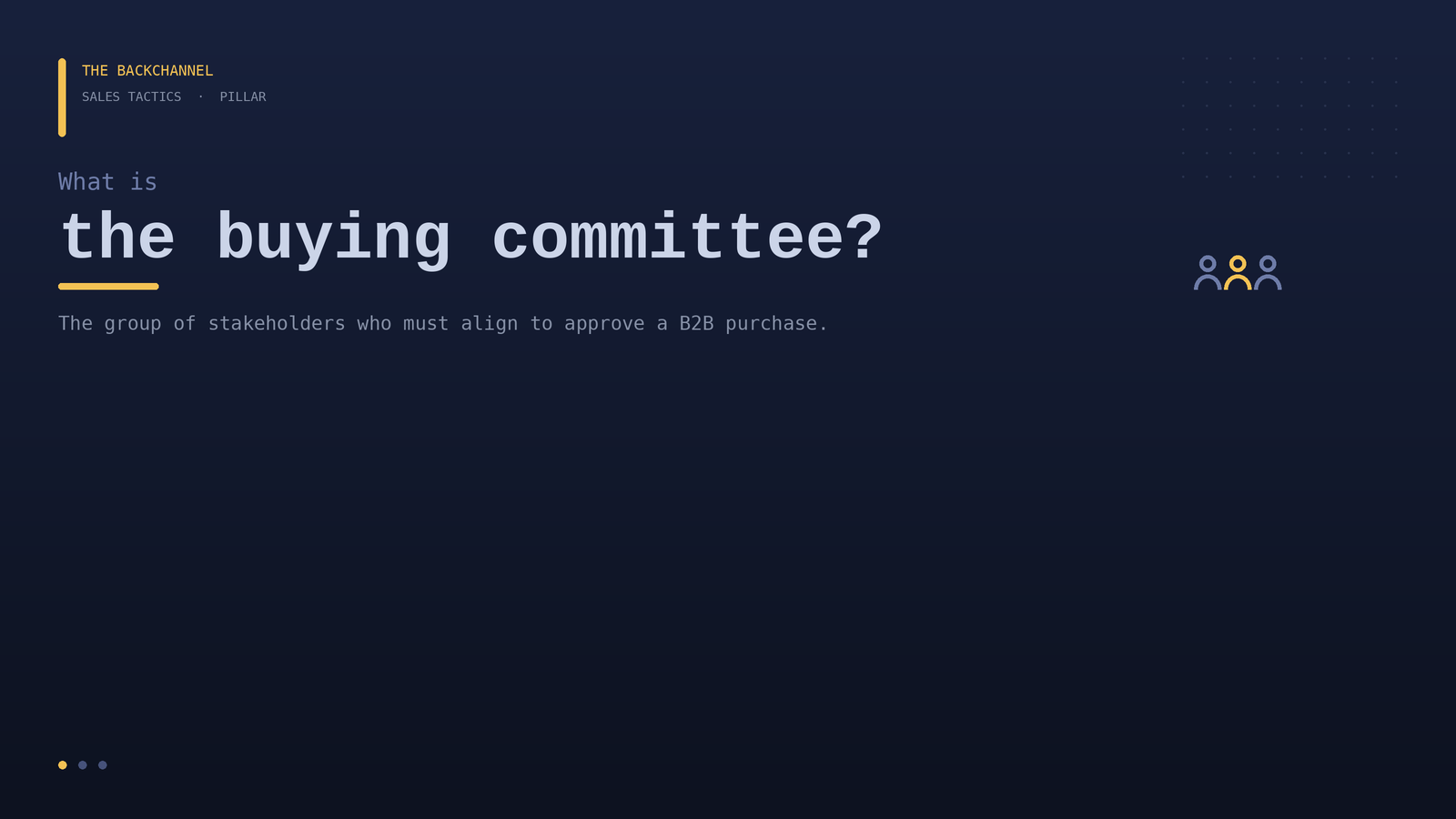
A buying committee (also called a buying group) is the group of people inside a company who collectively research, evaluate, and approve a B2B purchase. Rather than a single decision-maker, a modern committee typically spans 6 to 10 stakeholders end users, an internal champion, technical evaluators from IT, a finance or economic buyer, procurement, legal, and one or more executive sponsors each evaluating the purchase through their own lens and each able to slow or block the deal.
The practical implication is profound: B2B selling is no longer about winning over one person. It's about helping a group of people with different priorities reach consensus. Gartner's most-cited research puts the average enterprise buying committee at 6 to 10 people, each performing five separate information-gathering tasks which means a single deal generates dozens of independent research threads you have to influence, mostly without being in the room.
Why the buying committee matters more every year
The committee has been growing steadily, and that growth is the single biggest structural change in B2B sales. A decade ago the average buying group was about 5.4 people; today the median for larger deals sits well into double digits.
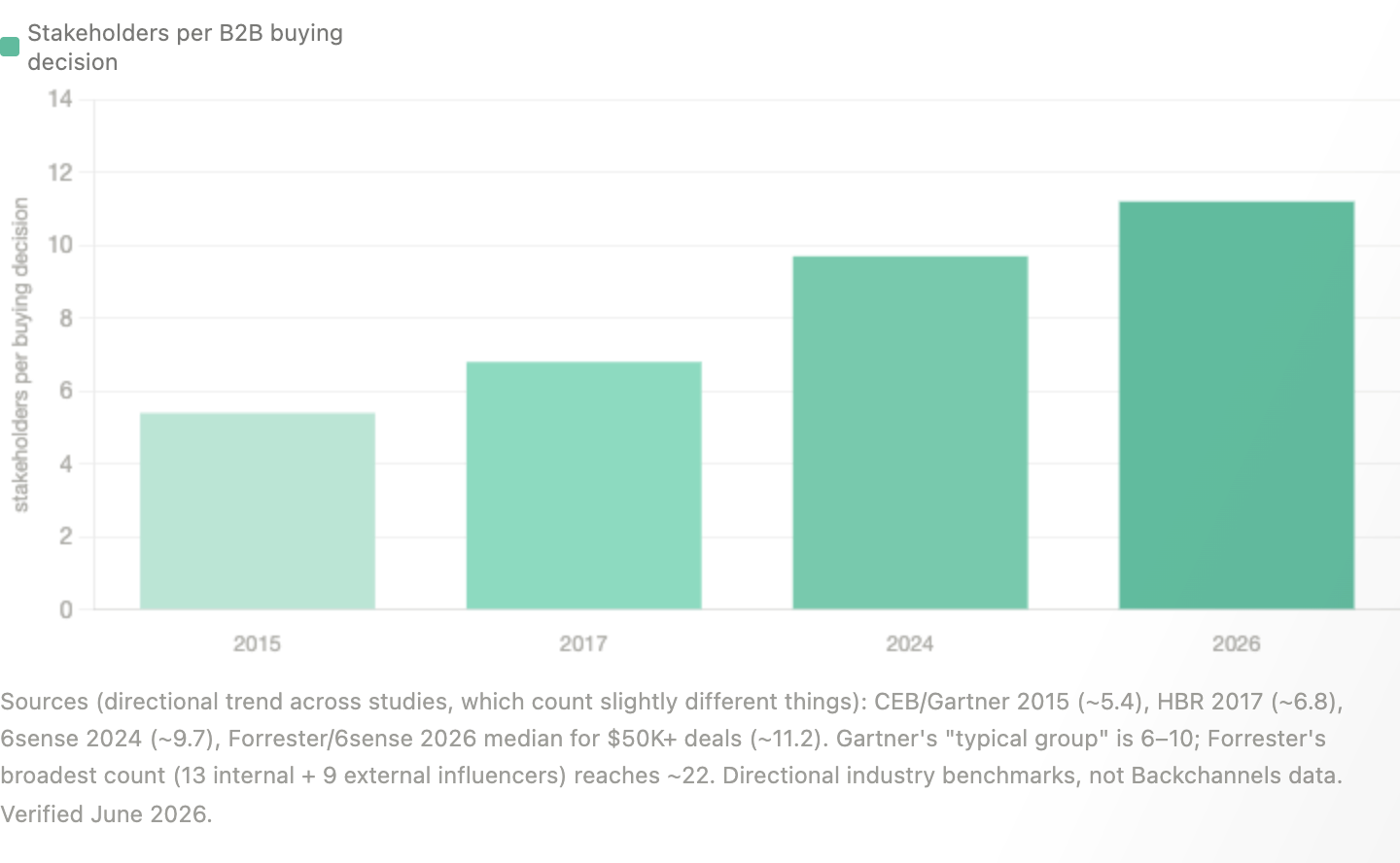
Who's on the buying committee
While the exact titles vary by company and deal size, most committees include a recognizable set of roles each evaluating the purchase through a different lens.
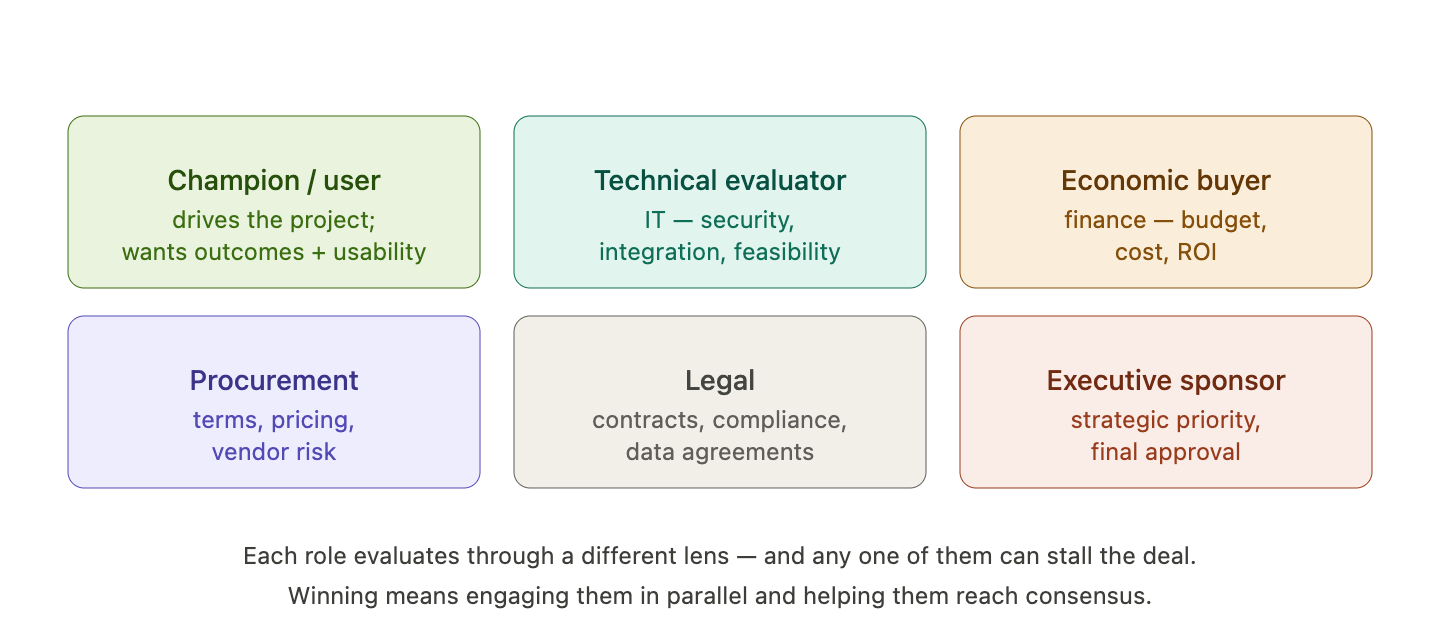
Each role surfaces different objections, which is why a single message rarely lands across the whole group. Here's what each cares about and how to win them:
How to sell to a buying committee
Selling to a committee is a fundamentally different motion than selling to an individual, and it rests on one core discipline: multi-threading building relationships with several stakeholders in parallel rather than relying on a single contact. The payoff is large and well-documented: deals multi-threaded across four or more committee members close at roughly twice the rate of single-threaded deals, because each additional relationship lowers the chance that any one person can stall the deal. Single-threading is fragile when your only contact goes quiet, gets reassigned, or loses budget, the deal dies with them.
Beyond multi-threading, three things matter. Enable your champion, because most internal selling happens in rooms you're not in give them the ROI case, the security summary, and the materials to build consensus on your behalf. Speak each stakeholder's language, tailoring the message so finance hears ROI, IT hears security, and the executive hears strategic impact. And quantify the cost of inaction, because the biggest competitor isn't another vendor it's "no decision." Across B2B, 40-60% of qualified B2B pipeline ends in "no decision," exceeding losses to any single competitor by 2-3x, usually because the committee never reached consensus that acting was worth the risk. The practical rule is to engage at least three stakeholders in parallel from early in the deal rather than sequentially.
The hard part is that you can't multi-thread a committee you can't see. Most CRMs hold one or two contacts at an account; the committee has many more, and new stakeholders join as the deal progresses. This is where Backchannels fits. As a buyer database with buying signals, it helps you map the account beyond your single champion surfacing the other relevant people inside the organization, keeping their information current as roles change, and flagging signals (like a new executive hire) that indicate the committee is expanding so you can engage the full group in parallel instead of betting the deal on one relationship.
Frequently asked questions
What is a buying committee in B2B?
It's the group of people inside a company who jointly research, evaluate, and approve a B2B purchase typically 6 to 10 stakeholders spanning end users, a champion, technical evaluators, finance, procurement, legal, and executives.
How many people are on a B2B buying committee?
Most research puts the typical group at 6 to 10 stakeholders, with the median for larger ($50K+) deals around 11. It scales with deal size: small deals may involve 2 to 4 people, mid-market 5 to 7, and enterprise 10 or more. Counting external influencers, some studies reach 20+.
Who is on a buying committee?
Commonly a champion or end user, a technical evaluator (IT/security), an economic buyer (finance), procurement, legal, and one or more executive sponsors each with different priorities and the ability to slow the deal.
What is multi-threading in sales?
Multi-threading means building relationships with several members of the buying committee at once, rather than relying on a single contact. Deals multi-threaded across four or more stakeholders close at roughly twice the rate of single-threaded ones.
Why do so many B2B deals end in "no decision"?
Because the committee never reaches consensus that acting is worth the risk. When the cost of inaction isn't quantified and the champion lacks the materials to build internal agreement, the default outcome is to do nothing which is why "no decision" beats any single competitor as the top reason deals are lost.
TRY BACKCHANNELS FREE
Your next customers are already in the database.
Backchannels gives you 225,000 verified software decision-makers. Filter to your exact ICP, preview matches for free, and push them straight into Salesforce or HubSpot. Pay per contact. No subscription, no contract.
Browse contacts freeNo credit card. Preview before you spend a credit.
No items found.
Final Thoughts
Published
September 30, 2026
Writer
Joe Backchannels
Share


Most Wanted

12 min read

12 min read

June 2026