.png)
The Backchannel
What is lead scoring?
Featured Blog

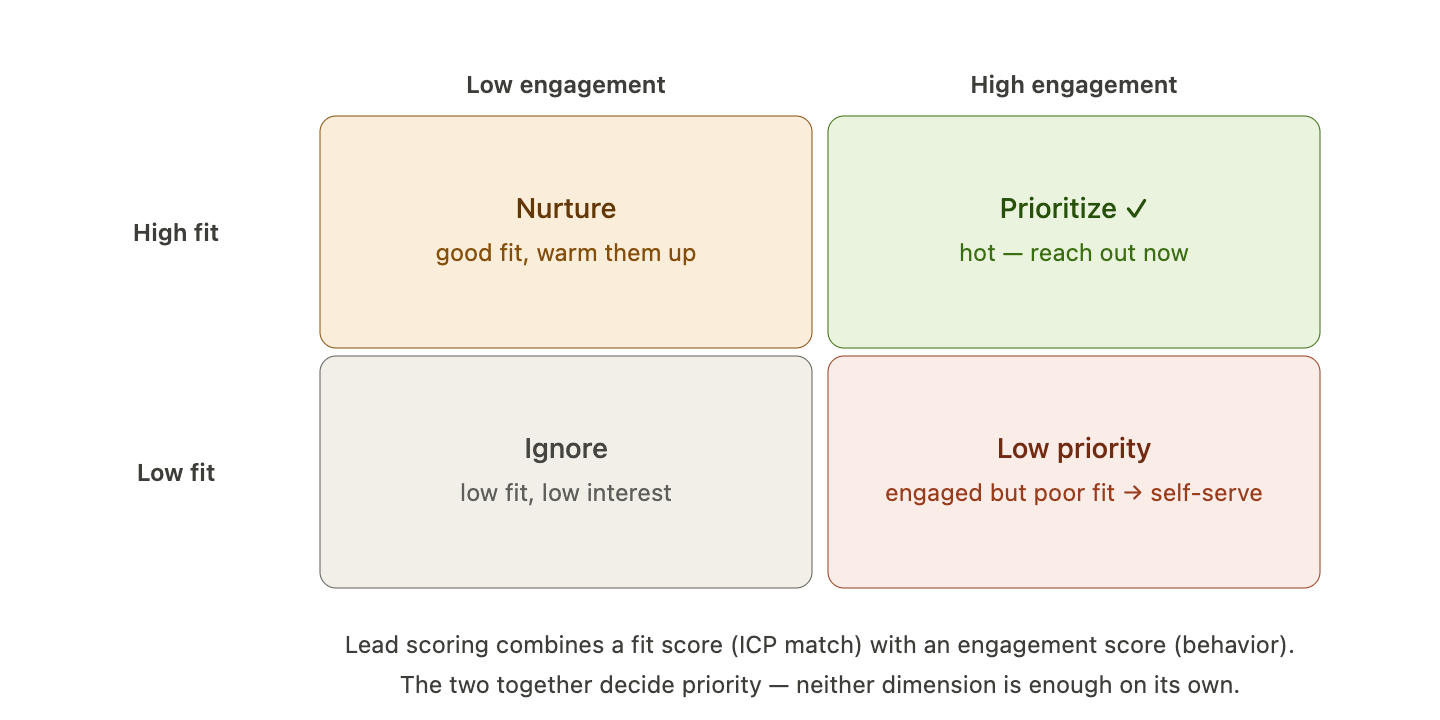
Lead scoring is a method of ranking leads by how likely they are to become customers, so sales focuses on the best ones first. Each lead earns points based on two things: fit (how well the company and contact match your ideal customer profile) and engagement (what they actually do visiting your pricing page, opening emails, requesting a demo). The higher the combined score, the higher the priority.
The point of scoring is to solve a universal problem: most leads aren't ready to buy, and reps waste enormous time figuring out which ones are. In fact, Only 25% of marketing leads are sales-ready when they are passed to sales. Lead scoring is the filter that separates the genuinely promising leads from the noise and yet Only 44% of companies currently use lead scoring, leaving more than half without a systematic approach to identifying their highest-quality prospects.
The two halves of a lead score: fit and engagement
A good lead score isn't one number from one dimension it's the combination of fit and engagement, which is why the most useful way to think about scoring is a simple 2×2. Fit tells you whether a lead is the right kind of company; engagement tells you whether they're paying attention right now. The two together decide what to do with a lead.
Rule-based vs. predictive lead scoring
There are two main ways to build a scoring model, and they suit different stages of maturity.
The guidance from practitioners is to Start rules-based first because it's explainable and you can iterate in days, not quarters, then graduate to predictive once you have enough history for the model to learn real patterns. The payoff for going predictive is real: Predictive lead scoring (AI-based) is 30% more accurate than traditional rule-based scoring and reduces false positives by 25%.
Why lead scoring matters
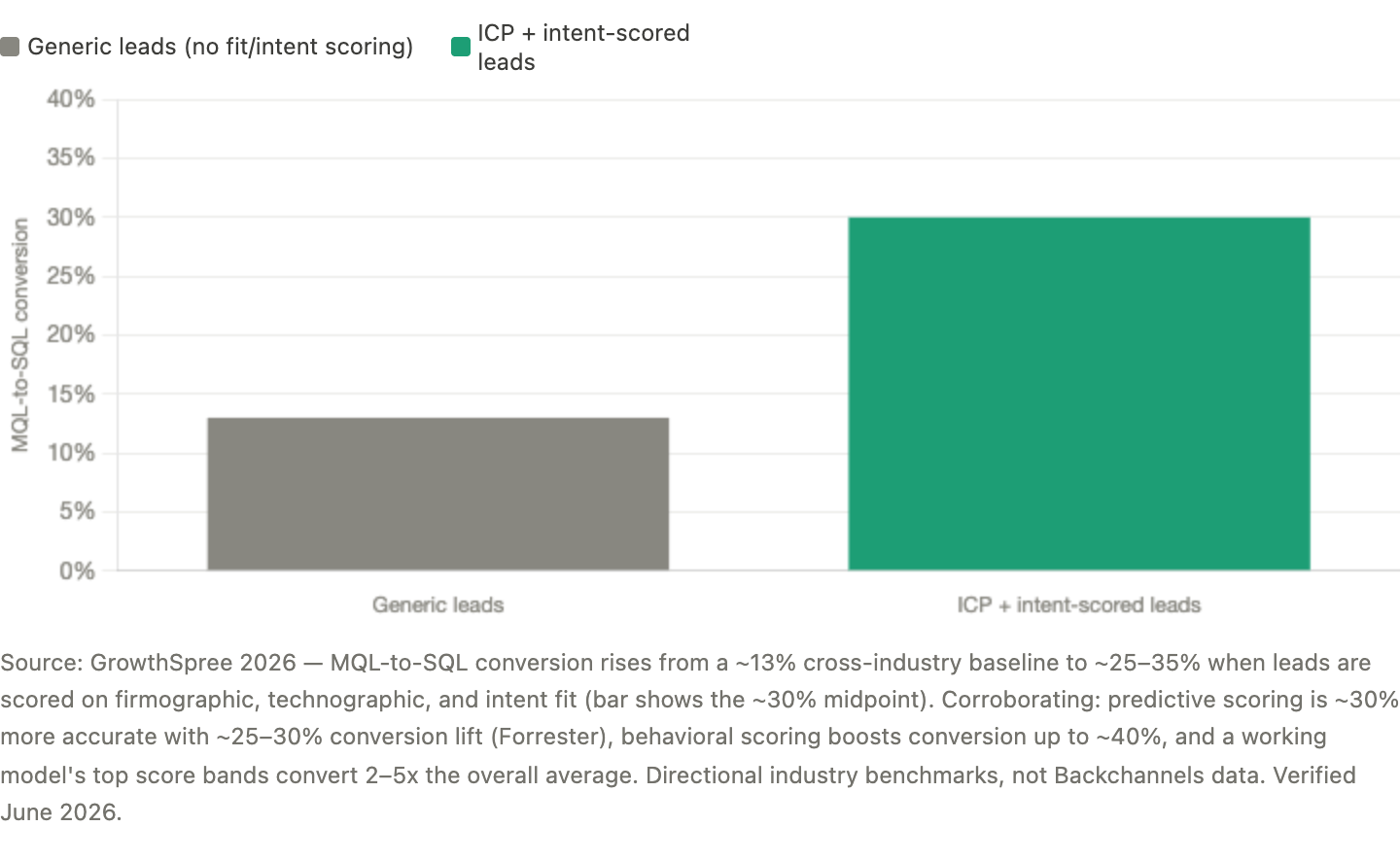
A well-built scoring model changes conversion economics, because it routes rep time to the leads that actually convert. The clearest evidence is what happens to MQL-to-SQL conversion when scoring incorporates real ICP and intent fit.
The thread through all of it: scoring is only as good as the data it runs on. A model can only score fit if it has accurate firmographic and technographic data, and can only score intent if it can see buying signals. This is exactly where Backchannels fits. As a buyer database with buying signals, it supplies both halves of the score rich ICP-fit data to grade how well an account matches your profile, plus the funding, hiring, and intent signals that reveal real engagement so your scoring model ranks leads on accurate fit and live signal rather than guesswork.
How to build a lead scoring model
A practical scoring model comes together in a few steps. First, pick your success event usually an SQL or opportunity created, since closed-won is slow and noisy. Second, score fit and engagement separately, then combine them, so a high-fit/low-engagement lead is handled differently from a low-fit/high-engagement one. Third, use bands, not a single cutoff a common setup is four to six bands with an MQL threshold around 60–100 points (many teams start at 70 and adjust). Fourth, add score decay, because intent is perishable: without it, a lead who was hot six months ago still looks hot in your CRM, and stale "MQLs" tank your conversion rate. Finally, validate with a lift chart a working model shows its top bands converting 2-5x higher SQL or opportunity rates than the overall average, not a flat line and feed closed-won data back so the model keeps learning.
Frequently asked questions
What is lead scoring in simple terms?
It's a way of ranking leads with points based on how well they fit your ideal customer (fit) and how they behave (engagement), so sales can focus on the highest-scoring, most likely-to-buy leads first.
What's the difference between fit and engagement in lead scoring?
Fit measures how well a lead matches your ICP industry, size, tech stack. Engagement measures their behavior site visits, demo requests, email clicks. A strong score needs both; a perfect-fit company that's ignoring you and a highly engaged company that's a poor fit are very different leads.
What's the difference between rule-based and predictive lead scoring?
Rule-based scoring uses points you assign manually transparent and quick to set up. Predictive scoring uses a model trained on your historical conversions more accurate (about 30% more accurate with fewer false positives) but it needs data history. Most teams start rule-based and move to predictive as they mature.
What is a good lead score threshold?
There's no universal number, but many B2B teams set an MQL threshold around 60–100 points and use four to six score bands rather than a single cutoff. Calibrate it using your sales acceptance rate and conversion-by-band over a few weeks.
Does lead scoring actually improve conversion?
Yes, when built well. Scoring leads on real ICP and intent fit can lift MQL-to-SQL conversion from around 13% toward 25–35%, and a well-calibrated model's top bands convert several times the overall average.
TRY BACKCHANNELS FREE
Your next customers are already in the database.
Backchannels gives you 225,000 verified software decision-makers. Filter to your exact ICP, preview matches for free, and push them straight into Salesforce or HubSpot. Pay per contact. No subscription, no contract.
Browse contacts freeNo credit card. Preview before you spend a credit.
No items found.
Final Thoughts
Published
October 6, 2026
Writer
Joe Backchannels
Share


Most Wanted

12 min read

12 min read

June 2026