.png)
The Backchannel
Why Bad Data Is Killing Your Pipeline (And How to Clean It)
Featured Blog

The Silent Tax on Every Pipeline
Bad data doesn't announce itself. There's no alert that fires when a contact's email goes stale, no error message when a rep wastes twenty minutes chasing a phone number that hasn't worked in eight months, no dashboard that flags the deal that died because the company had already been acquired and nobody updated the record. Bad data works quietly, imposing a continuous tax on your pipeline that almost never shows up as a line item anyone can point to. It just makes everything slightly worse, all the time, in ways that are individually small and collectively enormous.
The reason bad data is so destructive in B2B sales specifically is that the entire motion depends on the data being right. You can't reach a prospect whose contact information is wrong. You can't segment accurately if the firmographic data is inconsistent. You can't forecast reliably if the pipeline is cluttered with deals that aren't real. You can't personalize outreach if the job titles are out of date. Every downstream activity in the revenue motion inherits the quality of the data underneath it, which means that data quality isn't one factor among many it's the foundation that determines the ceiling on everything else.
This post is about how bad data specifically kills pipeline, the mechanisms through which it does its damage, and a practical approach to cleaning it and keeping it clean. The goal is to make a usually invisible problem visible enough that you can actually do something about it, because the teams that take data quality seriously have a structural advantage over the ones that treat it as someone else's problem to deal with eventually.
How Bad Data Actually Kills Pipeline
To fix the problem, you have to understand the specific mechanisms by which bad data destroys pipeline value. It's not a single failure it's several distinct failure modes that compound.
The first mechanism is wasted rep time. When contact data is wrong, reps spend their time on activity that can't possibly convert: emails to addresses that bounce, calls to numbers that don't connect, outreach to people who left the company months ago. This is the most direct cost, and it's substantial. A rep working a list that's 30% inaccurate is spending nearly a third of their prospecting time on contacts who cannot respond, regardless of how good their messaging is. The time isn't just wasted; it's demoralizing, because reps experience a string of failures that have nothing to do with their skill and everything to do with the quality of what they were given to work with.
This wasted-time problem also has a compounding effect on rep behavior that is rarely discussed. When reps repeatedly experience that the data they're given is unreliable, they stop trusting it entirely and they start doing their own manual research to verify contacts before reaching out, which is slower than working a clean list would have been and duplicates work the system should have done. The bad data doesn't just waste time directly; it trains reps into defensive habits that waste even more time, and it erodes their confidence in every tool and list the operations team provides. Once reps stop trusting the data, restoring that trust takes far longer than fixing the data itself.
The second mechanism is missed opportunities. Bad data doesn't just waste time on bad contacts it causes you to miss good ones. When records are duplicated, the engagement history is split across multiple entries, so the signal that a contact is genuinely interested gets diluted and overlooked. When firmographic data is wrong, accounts that perfectly match your ICP get filtered out of your targeting because the data says they don't qualify. When records are incomplete, a high-value prospect sits unworked because nobody has the information needed to reach them. The opportunities you miss because of bad data never show up in any report, because you never knew they were there.
The insidious thing about missed-opportunity costs is that they're completely invisible by definition. A wasted call at least leaves a record you can see the bounce, the failed connection. But an opportunity you never pursued because the data filtered it out, or a buying signal you never noticed because a duplicate split the engagement history, leaves no trace at all. You cannot measure what you never knew existed, which means this category of damage never appears in any analysis and never gets attributed to data quality. It is pure, silent loss, and it may well be the largest cost of bad data precisely because it's the one nobody can see.
The third mechanism is broken forecasting. When the pipeline is cluttered with deals that aren't real opportunities that should have been closed-lost months ago, duplicate deals counted twice, deals with wrong close dates or stale stages the forecast built on that pipeline is unreliable. Leadership makes decisions based on a number that doesn't reflect reality, and those decisions are wrong in proportion to how wrong the data is. A forecasting miss caused by bad pipeline data can drive bad hiring decisions, bad resource allocation, and bad commitments to the board, all downstream of records nobody bothered to keep clean.
Forecasting damage is particularly costly because of how far downstream its consequences travel. A sales forecast isn't just an internal number it drives hiring plans, budget allocation, board commitments, and investor expectations. When the forecast is built on a pipeline cluttered with phantom deals and stale data, every decision that depends on it inherits the error. A company might hire ahead of revenue that was never really coming, or hold back investment because the pipeline looked weaker than it actually was. The bad data in a few hundred deal records propagates outward into decisions worth far more than the records themselves, which is why pipeline hygiene deserves attention disproportionate to how mundane it seems.
The fourth mechanism is degraded customer experience. Bad data follows the customer past the point of sale. When a deal closes and the handoff to customer success carries wrong or incomplete information, onboarding starts on the wrong foot. When the same contact gets marketed to as a prospect after they've already become a customer because of a duplicate record, it signals that the company doesn't have its act together. These experiences erode trust at exactly the moments when trust matters most.
Where Bad Data Comes From
Bad data has two sources, and understanding the distinction matters because they require different fixes.
The first source is decay. Data that was accurate when it was entered becomes inaccurate over time as the real world changes. People change jobs, get promoted, change companies, change email addresses and phone numbers. Companies get acquired, change names, go out of business, restructure. This kind of decay happens at a rate of roughly 30% per year in B2B meaning that even a perfectly clean database degrades substantially within eighteen months if nothing is done to maintain it. Decay is not a failure of process; it's a natural force that has to be actively counteracted on an ongoing basis.
The second source is entry. Bad data enters the system at the point of creation through imports without validation, manual entry without standards, form fills with junk values, integrations that create records inconsistently. This kind of bad data is a process failure, and unlike decay, it's largely preventable. Every bad record that enters the system at creation is a record that didn't have to be bad, and preventing it at the point of entry is far cheaper than cleaning it up later.
The reason this distinction matters is that the two sources require fundamentally different responses. Decay requires ongoing enrichment and maintenance a recurring process that restores accuracy as the world changes. Entry requires validation and standards a preventive system that stops bad data from getting in. A complete data quality strategy addresses both: prevention at the point of entry to stop new bad data, and ongoing maintenance to counteract the decay of existing data. Addressing only one leaves the other source unchecked, and the database degrades regardless.
The Cleanup: Where to Start
When you're facing a database that's already polluted, the instinct is often to try to fix everything at once. This is a mistake. A large cleanup is overwhelming, and trying to do all of it simultaneously usually means none of it gets done well. The right approach is to prioritize based on impact, starting with the data that most directly affects near-term revenue.
Begin with your active pipeline and your in-ICP accounts. These are the records where data quality has the most immediate impact, because they're the records your team is working right now. A clean record on a dormant account that nobody is touching creates no value this quarter; a clean record on an active deal does. Concentrate your initial cleanup effort where it converts most directly into pipeline.
Within that priority set, address the highest-damage problems first. Duplicates come first, because they corrupt every downstream function segmentation, engagement tracking, reporting, and automation all break when the same entity exists multiple times. Deduplicate carefully, reviewing flagged pairs before merging and preserving the most complete data from each record. Then address accuracy: run your active contacts and accounts through an enrichment process to update stale fields current titles, verified emails, working phone numbers, correct firmographics. Then address completeness: fill the missing fields that prevent records from being worked. Then address pipeline hygiene: close out the dead deals, correct the stale stages, fix the wrong close dates, so the pipeline reflects reality.
This sequence duplicates, then accuracy, then completeness, then pipeline hygiene addresses the problems in order of how much damage they do, which means you get the largest improvement from the earliest effort. By the time you've worked through your active, in-ICP records in this order, you've recovered most of the available value, and you can extend the same process to the broader database at a more measured pace.
There's a useful way to think about the economics of data cleanup that helps with prioritization: every record has an expected value equal to the revenue it could contribute multiplied by the probability that contributing depends on the record being accurate. A record on an active, high-fit deal has enormous expected value, because a real opportunity hinges on the data being right. A record on a dormant account nobody is working has nearly zero expected value this quarter, no matter how clean it is. Cleaning effort should flow toward the records with the highest expected value, which is almost always the active and in-ICP set. This framing also explains why blanket "clean everything" projects feel so unrewarding: they spend equal effort on records of wildly unequal value, when the return comes almost entirely from a small, high-value subset.
Keeping It Clean: The Part Most Teams Skip
A cleanup without an ongoing maintenance system is a temporary fix. Within twelve to eighteen months, a cleaned database returns to its previous polluted state, because the two forces that created the pollution decay and bad entry are still operating. Every cleanup that doesn't install a maintenance system is just scheduling the next cleanup.
Keeping data clean requires three ongoing practices. The first is prevention at entry: validation rules that enforce standards on creation, so bad data can't get in; standardized formats for key fields; and automated enrichment that fills records correctly at the point of creation rather than leaving gaps for someone to fill later. The second is recurring enrichment: a scheduled process that re-verifies and updates your active records on a regular cadence more frequently for your most active accounts, less frequently for the broader database so that decay is counteracted continuously rather than allowed to accumulate. The third is ownership: a specific person accountable for data quality as part of their actual job, with the authority to enforce standards and the metrics to know whether quality is holding.
That third practice is the one most often missing, and its absence is usually why the previous cleanup didn't last. Data quality that is everyone's responsibility is no one's responsibility. Standards can be documented and enrichment can be scheduled, but without a specific owner watching the metrics and enforcing the standards, quality erodes as exceptions accumulate and no one is responsible for stopping the slide. The most important decision in keeping data clean is naming someone who owns it, because a system with an owner self-corrects and a system without one decays.
Making the Invisible Visible
The deepest challenge with data quality is that the problem is invisible, which means it perpetually loses the competition for attention and resources against problems that are visible. A missed quarter is visible. A rep complaining about a specific bad lead is visible. The slow, continuous tax that bad data imposes across the entire motion is not visible, so it goes unaddressed while more visible problems get all the attention.
The way to fix this is to make the cost of bad data visible enough that it can compete for resources. Measure it. Quantify the bounce rate on your outbound and translate it into wasted rep hours. Count the duplicates and estimate the engagement signal they're diluting. Track the percentage of your pipeline that turns out not to be real. Calculate the cost of a forecasting miss driven by bad pipeline data. When you put concrete numbers on the cost of bad data, it stops being a vague frustration and becomes a quantified problem that justifies investment and quantified problems get fixed in a way that vague frustrations never do.
This is ultimately the most important move in addressing data quality: converting an invisible, continuous tax into a visible, measured cost. The teams that do this find that the business case for data quality investment is overwhelming once the numbers are on the table, because the cost of bad data is almost always far larger than anyone assumed when it was invisible. The data was always taxing the pipeline. Measuring it is what finally makes the tax worth eliminating.
The Compounding Advantage of Clean Data
The flip side of bad data's continuous tax is clean data's continuous dividend. Just as bad data makes everything slightly worse all the time, clean data makes everything slightly better all the time and that improvement compounds across every activity in the revenue motion. Reps reach more of the people they're trying to reach. Targeting hits more of the right accounts. Forecasts reflect reality. Customer handoffs carry accurate information. None of these improvements is dramatic in isolation, but together, applied continuously across the entire motion, they constitute a structural advantage that competitors operating on dirty data cannot match no matter how good their reps or their messaging are.
This is why the teams that take data quality seriously win disproportionately. They're not necessarily working harder or selling better on any individual deal. They're operating on a cleaner foundation, which makes every individual deal slightly more likely to convert and every forecast slightly more reliable, and those slight advantages compound into a meaningful gap over time. Clean data isn't glamorous, and the work of maintaining it is unending. But it's one of the highest-return investments available in a revenue motion, precisely because it improves everything downstream at once. Start by making the cost visible, fix the highest-damage problems first, and install the ongoing system that keeps the data clean after you've cleaned it. The pipeline you save is the one you couldn't see bleeding.
TRY BACKCHANNELS FREE
Your next customers are already in the database.
Backchannels gives you 225,000 verified software decision-makers. Filter to your exact ICP, preview matches for free, and push them straight into Salesforce or HubSpot. Pay per contact. No subscription, no contract.
Browse contacts freeNo credit card. Preview before you spend a credit.
No items found.
Final Thoughts
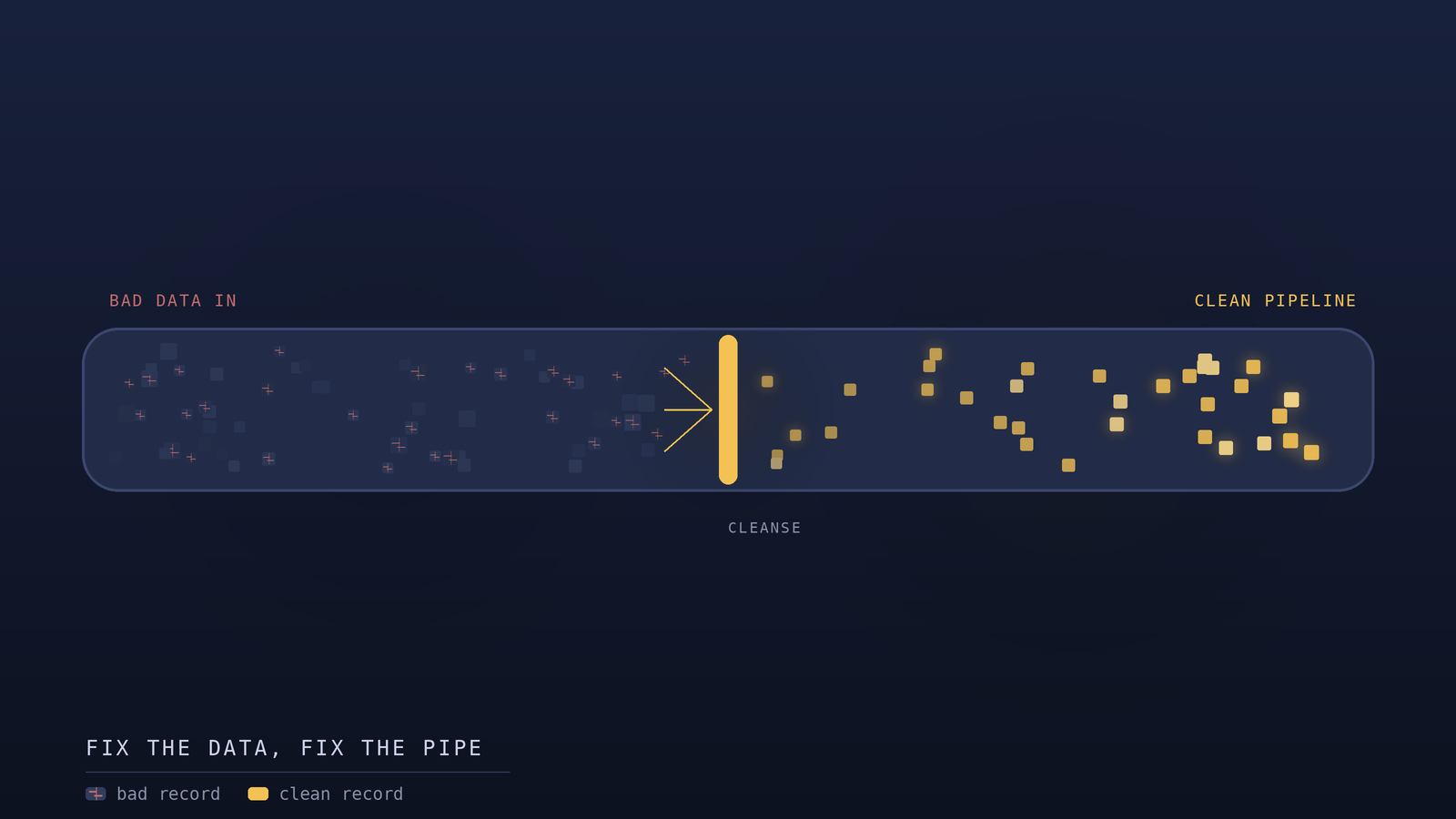
Bad data is a silent tax on every pipeline - wasted rep time, missed opportunities, broken forecasts. Make the cost visible, fix the highest-damage problems first, and install a system that keeps data clean after you clean it.
Published
August 14, 2026
Writer
Joe Backchannels
Share


Most Wanted


12 min read

12 min read

June 2026