.png)
The Backchannel
What is a sales trigger event?
Featured Blog

A sales trigger event is a specific, observable change at a company that creates a window of heightened receptiveness to a new solution and a natural reason to reach out. Common examples include a new funding round, a leadership change, a hiring surge, a merger or acquisition, an expansion into a new market, or a major product launch. The defining feature of a trigger event is timing: it marks a moment when a company's needs are actively shifting, which makes a well-timed, relevant message far more effective than the same pitch sent at random.
Put simply, a trigger event answers the question every seller struggles with when should I reach out? Reaching a prospect during a moment of active change, with a message that references that change, is dramatically more effective than cold outreach with no timing behind it. This is why trigger-based selling has become a core motion: by one estimate, 75% of B2B sales engagements in 2025 will originate from signal-based triggers like leadership changes or funding rounds.
Sales trigger event vs. buying signal
The two terms are closely related and often used together, but they're not identical:
In other words, every trigger event is a buying signal, but not every buying signal is a discrete event. A trigger event is the event-based slice and its special power is the time-limited opportunity it creates.
The main types of trigger events
Most high-value triggers fall into a few categories. Financial events funding rounds, IPOs, strong earnings, or acquisitions signal that budget exists; funding is especially potent because funding means money is available right now and investors expect it deployed toward growth. Leadership changes are among the strongest of all, since New executives are 10x more likely to bring in new vendors within their first 90 days. Growth events hiring surges, new offices, market expansion indicate scaling needs. Strategic events like product launches, rebrands, or new partnerships signal shifting priorities. And external events new regulations or competitor moves can force a company to act.
Why timing matters: the buying window
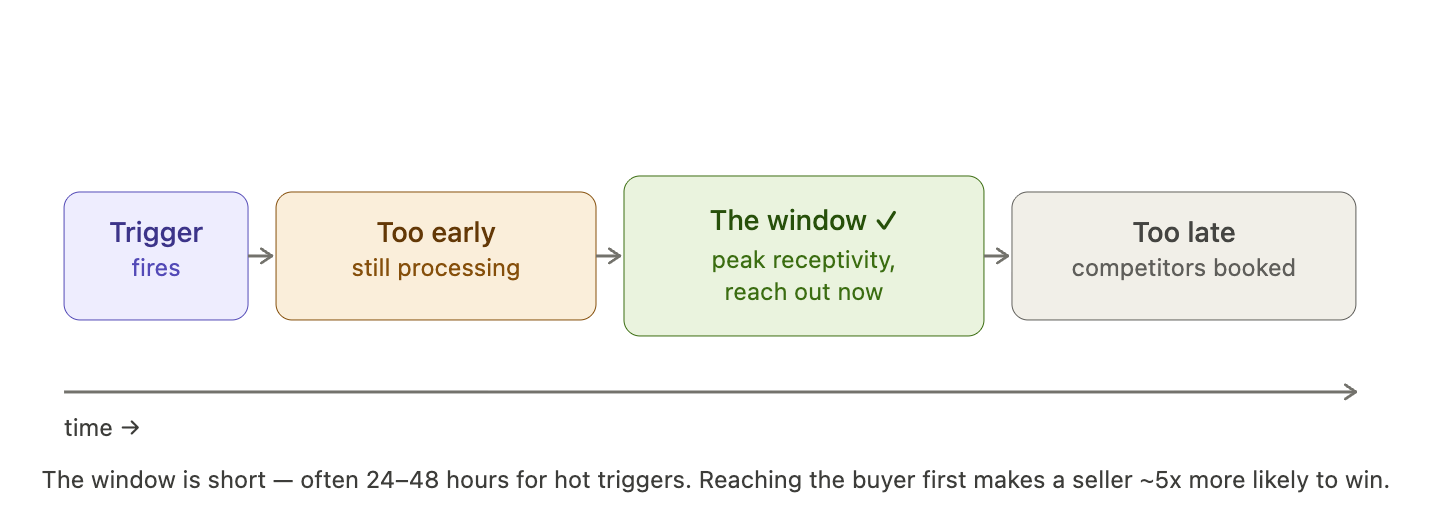
The catch with trigger events is that the window doesn't stay open. Reach out too early and the company hasn't absorbed the change yet; too late and competitors have already booked meetings.
Do trigger events actually work?
The data on trigger-based outreach is striking, precisely because it's the opposite of spray-and-pray. Generic cold email has been losing effectiveness for years, but messages tied to a real event perform on a different level: Trigger-based sequences typically achieve 12-25% reply rates, compared to the 5.8% cold email average.
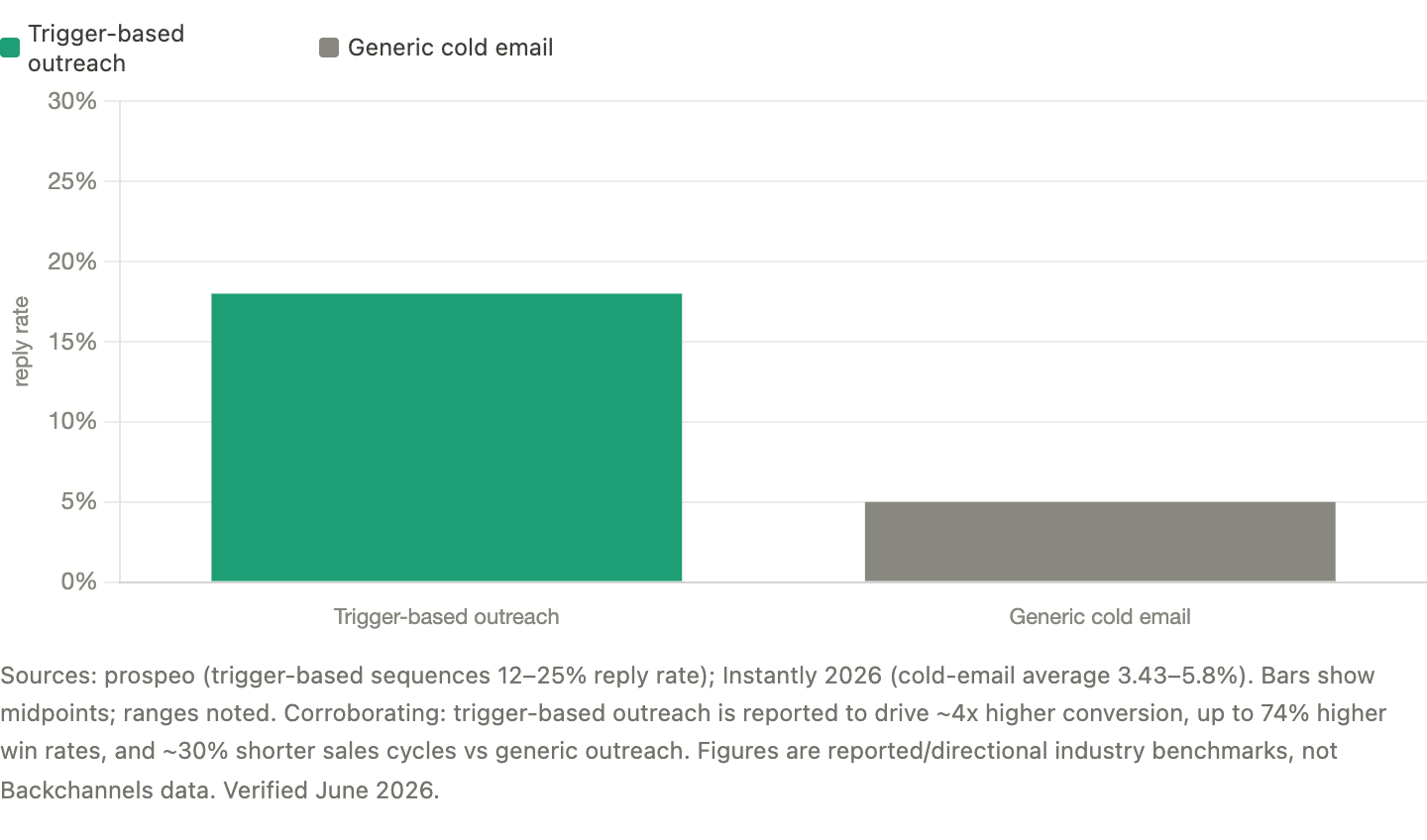
Beyond reply rates, trigger-based selling is reported to drive roughly 4x higher conversion than generic outreach, win-rate improvements of up to 74%, and about 30% shorter sales cycles. And there's a powerful first-mover effect: The first seller who contacts a decision maker after a trigger event is five times more likely to win the sale, while a large share of buyers simply choose whoever reaches them first. Speed is the whole game yet 55% of companies take more than five days to respond to leads, creating massive opportunity for teams that prioritize speed.
How to track and act on trigger events
A practical trigger-based motion has four parts. First, monitor for the events that matter for your product funding, leadership changes, hiring, expansion, and tech changes across your target accounts. Second, prioritize the triggers most correlated with buying (funding and new executives are the highest-signal for most teams). Third, reach out fast and relevantly, using a simple structure: reference the specific event, connect it to a challenge relevant to the buyer's role, then ask one short question. Fourth, be first the timing advantage evaporates once competitors arrive. The trigger has to connect directly to your value, or it's just a clever subject line.
This is core to what Backchannels does. As a buyer database with buying signals, it monitors your target accounts for the trigger events that matter funding, leadership moves, hiring surges, and more and surfaces them as they happen, so your team can reach the right person inside the window, while the change is still fresh and before competitors crowd in.
Frequently asked questions
What is a trigger event in sales?
A specific change at a company like new funding, a leadership hire, or an acquisition that creates a window of heightened need and a timely, relevant reason to reach out.
What are examples of sales trigger events?
Funding rounds, IPOs, mergers and acquisitions, new C-suite or department leaders, hiring surges, office or market expansion, product launches, rebrands, new partnerships, and regulatory changes.
What's the difference between a trigger event and a buying signal?
A trigger event is a discrete event. A buying signal is the broader category that also includes ongoing behaviors like website visits and third-party intent. Every trigger event is a buying signal, but not vice versa.
Why are trigger events important for sales?
Because timing drives results. Outreach tied to a real event gets far higher reply and conversion rates than generic cold outreach, and the first seller to reach a decision-maker after a trigger is several times more likely to win.
Which trigger events convert best?
Funding rounds and leadership changes are usually the highest-converting funding because budget is freshly available, and new executives because they're far more likely to bring in new vendors within their first 90 days.
TRY BACKCHANNELS FREE
Your next customers are already in the database.
Backchannels gives you 225,000 verified software decision-makers. Filter to your exact ICP, preview matches for free, and push them straight into Salesforce or HubSpot. Pay per contact. No subscription, no contract.
Browse contacts freeNo credit card. Preview before you spend a credit.
No items found.
Final Thoughts
Published
September 21, 2026
Writer
Joe Backchannels
Share


Most Wanted

12 min read

12 min read

June 2026