.png)
The Backchannel
We Killed Our Gated Content. Leads Went Up 40%
Featured Blog

TL;DR: We ungated our most popular asset a benchmark report that had been generating ~200 gated downloads a month and in 30 days it drew 4,300 views, 47 practitioner shares, and inbound from companies citing the report by name. Over the following six months, total qualified inbound leads rose 41%, sales cycles dropped from 51 to 34 days, and close rate climbed from 19% to 27%. The lesson isn't "ungate everything" it's gate based on what the content is for. Here's the framework.
Should you gate your content?
Gate content based on its job, not its value. Content whose job is to be discovered, shared, and remembered research, guides, opinion pieces, frameworks should not be gated, because the form filters out the amplifiers (journalists, newsletter editors, community sharers) who drive distribution. Content whose job is to facilitate an ongoing relationship or deliver a service live webinars, interactive tools, personalized assessments, high-intent trials can be gated, because the gate is a functional part of the experience rather than a toll. Ungating educational and thought-leadership content typically increases total qualified leads, not decreases them. The full framework and data follow below.
The Experiment We Were Afraid to Run
For three years we gated everything. Ebooks, benchmark reports, templates, webinar recordings, research papers if it was valuable, it was behind a form. The logic was airtight: create something useful, ask for contact information in exchange, add the contact to a nurture sequence, eventually convert them to a customer. Every demand gen playbook we'd read recommended this approach. Every martech vendor we worked with had software designed to optimize it.
The problem was that the results were getting worse. Our form fill rates had declined 35% over two years. The contacts we were capturing had lower and lower purchase intent our MQL-to-opportunity conversion rate had dropped from 22% to 9%. The sales team had started ignoring a significant percentage of the leads we were sending them because the quality had become so unreliable. And our best content the stuff we'd worked hardest to produce was sitting behind forms that were filtering out most of the audience who might have benefited from it and shared it.
One of our team members proposed ungating our most popular asset a 20-page benchmark report on outbound conversion rates that had been generating about 200 downloads per month and putting it on a public URL with no form. We were skeptical. We were also stuck. We ran the experiment.
What Happened When We Ungated
In the first 30 days after ungating the report: 4,300 page views. 47 LinkedIn shares by practitioners in our ICP, several with significant followings in the revenue operations space. Mentions in two industry newsletters with a combined subscriber base of over 30,000. Three separate companies reaching out to our sales team directly through our contact page, specifically referencing the report as the reason they were reaching out.
Compare that to the gated version's previous best month: 200 form fills, of which our conversion analysis suggested roughly 15% were genuinely qualified prospects. That's 30 qualified leads per month, captured in exchange for preventing 4,270 other readers from ever seeing the content.
The math started to look different.
When you frame it as a direct trade, the old logic collapses. We had been protecting 30 qualified leads a month by erecting a barrier that turned away thousands of readers including the exact people most likely to amplify the work to their own audiences. The form wasn't capturing value so much as suppressing it. The 30 leads were real, but they were a rounding error against the distribution we were forfeiting to get them.
Why Gating Hurts More Than It Helps
The business case for gated content rests on a simple equation: value of content plus friction of form equals captured lead. This equation has a hidden cost that most demand gen teams don't account for: every form is a filter, and filters don't just remove unqualified people. They remove amplifiers.
The people who won't trade their email address for your content include not just casual browsers and unqualified contacts, but also: journalists who might have covered your research, newsletter editors who might have featured your work, community moderators who might have shared it with their communities, practitioners who might have shared it with their networks, and potential customers who would have become genuinely interested but didn't want to start a vendor relationship before they'd even read what you had to say.
When you ungate, you lose the form fill but you gain distribution. And distribution in B2B SaaS is worth dramatically more than a list of email addresses that mostly bounce. Distribution builds the awareness and authority that makes every subsequent commercial touchpoint land differently. It's the difference between being a vendor people have heard of versus a vendor people are hearing about for the first time during a competitive evaluation.
The deepest cost of gating is invisible precisely because it never happens. A gated report can't be shared in a way that's useful clicking a link only sends a peer to another form, so people don't bother. That means gated content can't compound. Ungated content compounds: one practitioner shares it, their network reads it, a fraction of those readers share it again, and a single piece of work keeps generating awareness for months with no additional effort. You can measure the form fills you capture. You can't easily measure the chain of shares that a form prevents which is exactly why teams systematically over-value gating. The cost is real, but it's invisible, and invisible costs are the ones organizations consistently ignore.
What We Gated Instead
Ungating everything isn't the answer any more than gating everything was. The right framework is to gate based on what the content is for, not based on whether it's valuable.
Content whose job is to be discovered, shared, and remembered should not be gated. This includes research reports, educational guides, opinion pieces, frameworks, and any content whose primary value is building awareness and establishing your perspective as worth listening to. Gating this content kills its ability to do the job it's designed for.
Content whose job is to facilitate an ongoing relationship or provide a continuous service can be gated. This includes live webinars where registration enables reminder emails and follow-up, tools and templates that require login for access and updates, personalized assessments where a human interprets the results, and high-intent product trials that signal genuine purchase consideration. The gate here isn't an extraction mechanism it's a functional part of the experience.
When we shifted our gating strategy to this framework, we continued to capture leads but they were better leads, later in the buyer journey, with higher demonstrated intent. MQL-to-opportunity conversion rate improved from 9% back to 18% within two quarters. The volume was lower. The quality was significantly higher. The sales team started working the leads we sent them again.
The principle underneath the framework is about matching the moment to the ask. Early in the buyer journey, the visitor doesn't know or trust you yet, so asking for their contact information is a poor trade from their perspective and the people who refuse that trade include your best future advocates. Later in the journey, once they've consumed your thinking and want something interactive or service-like, providing contact information feels reasonable because they're getting something functional in return. Gating fails when it asks for commitment before trust exists. It works when the gate lines up with a moment where the visitor is genuinely ready to raise their hand. The job-based framework is really a way of detecting which moment you're in.
The 40% Lead Increase
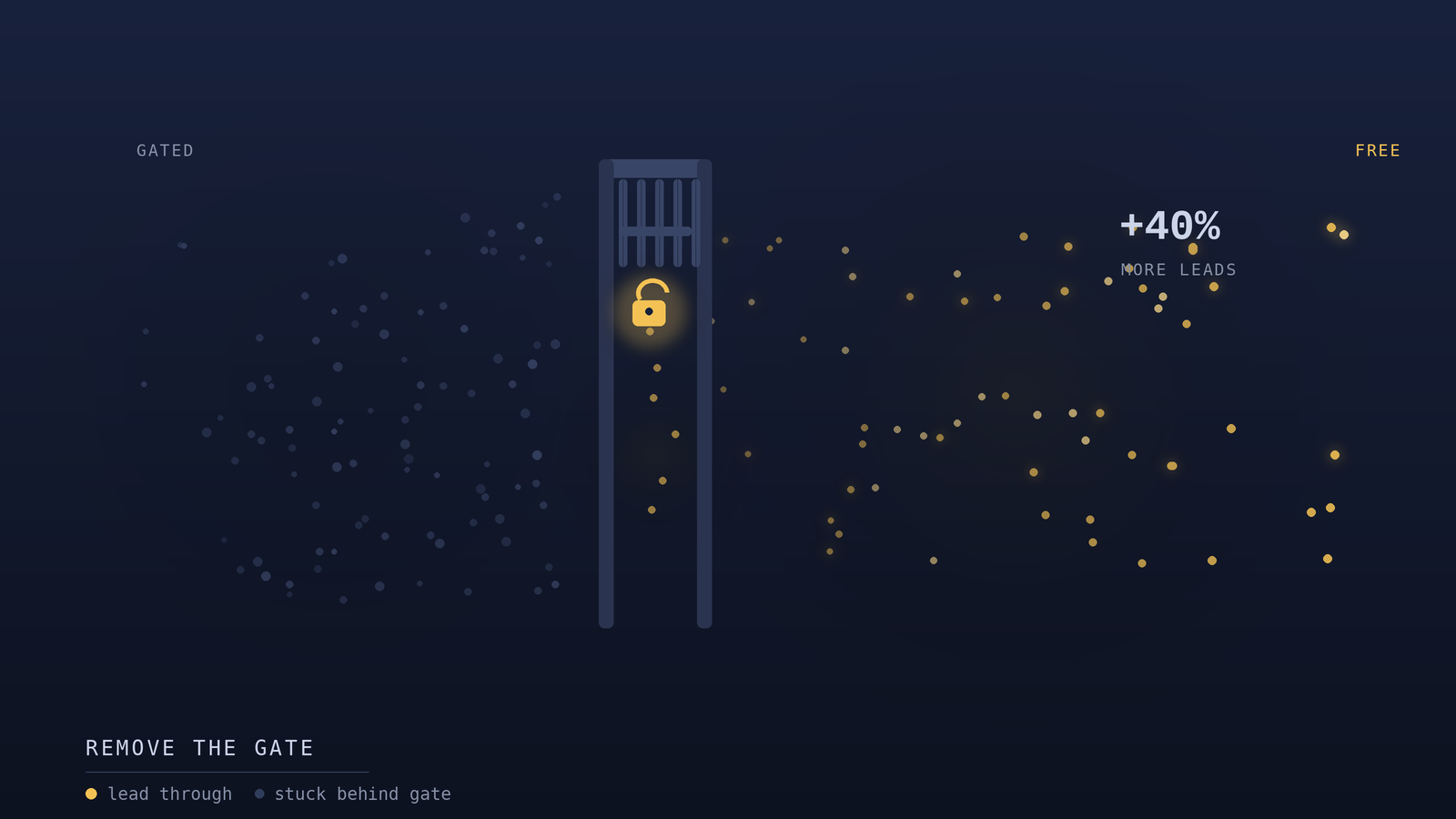
The counterintuitive headline of this story is that ungating content made our total lead volume go up, not down. Over the six months following our ungating experiment, total qualified inbound leads increased by 41% compared to the prior six months. The increase came through two channels: organic search traffic to the ungated reports and the adjacent content that ranked in their wake, and direct inbound from practitioners who had discovered our content through communities, newsletters, and social shares.
These inbound leads were qualitatively different from our gated form fills. Average sales cycle dropped from 51 days to 34 days. Close rate improved from 19% to 27%. And churn in the first 90 days was lower we believe because customers who came through ungated content had a more accurate understanding of what we actually did and what they were buying, having read our thinking before they'd ever spoken with a sales rep.
There's an important SEO mechanism behind the lead increase that's worth naming directly. A gated asset hidden behind a form is invisible to search engines they can't index what they can't reach, so the content generates no organic traffic and earns no backlinks. Ungated, that same report becomes a page search engines can crawl, rank, and surface to people actively searching for exactly that topic. It also becomes something other sites can link to, and backlinks are among the strongest ranking signals there are. Ungating didn't just remove a barrier for human readers; it converted a piece of dead, invisible content into a durable, compounding source of search traffic that keeps generating qualified leads month after month with no additional spend.
The Real Test for Every Piece of Content
Before your next piece of content goes live, ask this question: what is this content's job? If its job is to be discovered by the people who should know about it, shared by practitioners who find it useful, and remembered the next time a relevant buying trigger occurs a gate will prevent it from doing that job. Remove the gate and optimize for distribution instead.
If its job is to facilitate an ongoing relationship, capture intent at a specific moment in the buyer journey, or deliver a service that naturally requires a login a gate serves a functional purpose. Keep it.
The question isn't whether your content is valuable enough to gate. Almost all content that earns a gate is valuable enough to share freely, and its value compounds with every share. The question is what you're trading the distribution for, and whether that trade is worth it. For most educational and thought leadership content in B2B SaaS, it isn't.
How to Apply This to Your Content Library
If you want to act on this, start with an audit rather than a wholesale change. Pull a list of every gated asset you have and sort it by what each piece is actually for. The research reports, guides, frameworks, and opinion pieces the content built to be discovered and shared are your ungating candidates; removing those forms is where the distribution upside lives. Keep the gates on the genuinely functional assets: live webinars, interactive tools, assessments, and trials, where the form enables the experience rather than blocking it. Then, before ungating your highest-value report, make sure the page itself is built to capture the traffic it's about to receive clear on-page calls to action, internal links to related content, and a low-friction way for an interested reader to start a conversation when they're ready. Ungating removes the barrier; good page design converts the audience that barrier was keeping out.
Frequently Asked Questions
Should B2B content be gated or ungated?
It depends on the content's purpose. Content built to be discovered, shared, and remembered research, guides, frameworks, opinion pieces performs far better ungated, because forms filter out the journalists, editors, and practitioners who drive distribution. Content built to facilitate a relationship or deliver a service webinars, interactive tools, assessments, trials can be gated, because the form is functional. In our experience, ungating educational content increased total qualified leads by 41%.
Does ungating content reduce lead volume?
Counterintuitively, it often increases it. After we ungated our best asset, total qualified inbound leads rose 41% over six months. The gains came from organic search traffic (search engines can finally index the content) and from practitioner shares in communities and newsletters that a form would have prevented. You lose individual form fills but gain distribution worth far more.
Why is gated content bad for SEO?
Content behind a form is invisible to search engines they can't crawl or index what they can't reach, so it generates no organic traffic and earns no backlinks. Ungating turns the same asset into a crawlable, rankable page that can surface to people searching the topic and attract backlinks, one of the strongest ranking signals. This is a major reason ungated content compounds over time.
What content should you still gate?
Gate content where the form is a functional part of the experience, not a toll: live webinars (registration enables reminders and follow-up), interactive tools and templates that need a login, personalized assessments where a human interprets results, and high-intent product trials. These capture genuinely higher-intent leads later in the buyer journey, when providing contact information is a fair trade for the visitor.
Why did ungated leads convert better than gated form fills?
Leads from ungated content had read the company's thinking before ever talking to sales, so they arrived with a more accurate understanding of the product and better-calibrated expectations. In our data, ungated-sourced deals had shorter sales cycles (34 vs 51 days), higher close rates (27% vs 19%), and lower early churn. Self-education before contact produces better-fit buyers.
TRY BACKCHANNELS FREE
Your next customers are already in the database.
Backchannels gives you 225,000 verified software decision-makers. Filter to your exact ICP, preview matches for free, and push them straight into Salesforce or HubSpot. Pay per contact. No subscription, no contract.
Browse contacts freeNo credit card. Preview before you spend a credit.
No items found.
Final Thoughts
Every piece of content should earn its gate. For most educational and thought leadership content, the distribution lost is worth more than the leads gained. Stop gating the things that should spread freely.
Published
August 14, 2026
Writer
Joe Backchannels
Share


Most Wanted

12 min read

12 min read

June 2026