.png)
The Backchannel
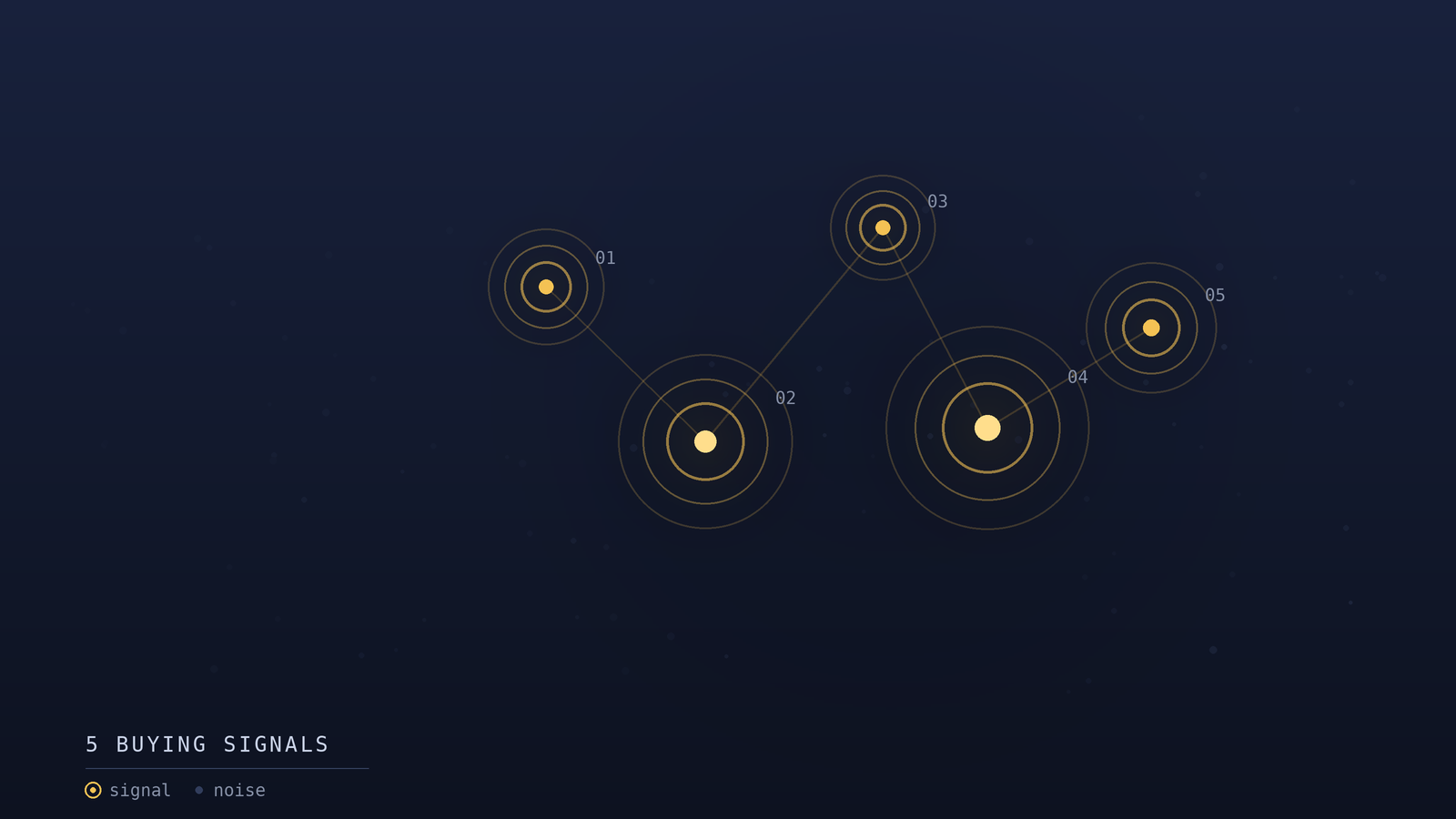
The 5 Buying Signals Most SDRs Completely Ignore
Featured Blog


The Real Reason Timing Beats Messaging
There's a popular debate in outbound sales circles about what matters more: the quality of your message or the quality of your list. Both sides make compelling arguments. The message camp argues that a great email can break through to almost anyone if it's precise enough. The list camp argues that even the best email fails if you're sending it to the wrong people. Both are partially right, and both miss the variable that, in our experience, does more to determine outbound outcomes than either one: timing.
The same email, sent to the same person, on two different days can produce completely different outcomes. The difference isn't the copy. It isn't the subject line or the CTA or the depth of personalization. It's whether the email lands when the prospect is actively experiencing the problem you solve, or when they're not thinking about it at all. Great timing can make a mediocre message work. Bad timing can kill a perfect one. And yet timing is almost never the focus of outbound training programs, sales enablement playbooks, or the endless stream of cold email advice that circulates in sales communities.
The best SDRs understand this intuitively. They're not just skilled at writing compelling outreach they're skilled at identifying when specific prospects are in an active buying window. They've built systems to surface those moments and act on them faster than their competitors. The result isn't just higher reply rates. It's higher-quality conversations with more qualified prospects who are genuinely in motion, which means shorter sales cycles, better conversion rates, and less time spent chasing people who aren't ready to buy.
Here are the five signals that most consistently predict buying readiness, why each one works, and exactly how to build the system to catch them.
Signal 1: A New Executive Hire
When a company brings in a new VP of Sales, CRO, CMO, or Head of RevOps, a clock starts. That person has a limited window typically 90 days, sometimes 60 to demonstrate impact, build credibility with their team, and establish themselves in the organization. During that window, they are uniquely receptive to tools, vendors, and solutions that can help them move faster and look smarter. They don't have entrenched relationships with existing vendors. They aren't defending the status quo because they didn't build it. They're actively looking for ways to make their mark before their judgment gets evaluated.
This creates one of the highest-converting outreach opportunities in B2B sales, and most SDRs miss it entirely because it doesn't show up in their CRM as a lead. It shows up as a LinkedIn post, a press release, or a job board update announcing a new hire and if you don't have a system to catch those signals, they pass by invisible while your competitors who do have the system are already in conversation with that executive.
How to catch this signal: set up Google Alerts for key job titles plus company names in your target account list. Use Backchannels or a similar tool that monitors leadership changes at your ICP accounts in real time, so you're not manually checking each account but instead receiving alerts when a trigger fires. Build an outreach template specifically for this scenario one that acknowledges the transition, leads with something highly relevant to the challenges a new leader in that role typically faces, and makes a small, low-commitment ask rather than immediately requesting a meeting or demo.
The timing matters as much as the signal itself. Reach out within the first two weeks of a new hire's announcement. By the time most SDRs notice the change through casual LinkedIn browsing, the window is already narrowing. The new executive is still orienting during weeks one and two deeply curious, actively building their vendor evaluation list, open to conversations they wouldn't have taken six months into the role. By week six or seven, their calendar is full, their priorities are set, and their appetite for vendor conversations has dropped significantly. Get there first.
What to say: don't lead with your product. Lead with a relevant problem this type of leader typically inherits when stepping into the role. "New CROs inheriting a team often find the pipeline data is less reliable than they'd hoped is that something you're navigating?" is a much more effective opener than any product pitch, because it demonstrates that you understand the specific challenge of their situation rather than just knowing they exist and having something to sell. That distinction is felt immediately by the reader.
One more thing worth noting on this signal: don't just reach out to the new executive. Reach out to the people who now report to them or work alongside them. Those people are watching closely, evaluating whether the new leader is going to bring changes, and often have their own buying authority for tools in adjacent categories. A single executive hire can trigger multiple relevant outreach opportunities if you're looking carefully at the org.
Signal 2: A Job Posting That Reveals a Pain
Every job posting a company publishes is a window into their current problems, investments, and priorities. When a company is hiring three SDRs, they're about to have a significant scaling challenge in outbound execution. When they're hiring a Revenue Operations Manager, they're acknowledging that their current RevOps function is inadequate for where they're trying to go. When they're posting for a Sales Enablement Specialist, they know their reps aren't equipped the way they should be. The job posting is the company speaking candidly, in their own words, about exactly what's broken.
Job postings are public, timely, and specific. They represent a company essentially volunteering information about their current pain without any of the defensiveness they'd bring to a vendor conversation. If your product solves the problem that drives a particular type of hire, a job posting at a target account is as close to a hand-raise as you'll ever get in outbound except nobody labeled it as a hand-raise, which is why most teams miss it.
How to systematize this: identify the two or three job titles or job description keywords that most reliably predict buying intent for your product. If you sell sales engagement software, it might be SDR, BDR, or Sales Development Representative. If you sell CRM tools, it might be RevOps or CRM Administrator. If you sell data enrichment, it might be anything in the demand generation or data function. Build monitoring for these keywords across your target account list using tools like LinkedIn job alerts, Builtin, or Greenhouse job feeds if your targets are primarily venture-backed companies.
Don't limit yourself to monitoring only for roles that directly use your product. Think one level up: what does a company need to be hiring for in order to need what you sell? If you sell a product that helps SDR teams prospect faster, any company hiring multiple SDRs is about to feel the productivity pain your product addresses at a scale they haven't experienced before. Get there before the new hires start, when the team is planning how to onboard and enable them that's when tooling decisions get made.
When a relevant posting fires, act within 48 hours. If a company has been posting for three weeks, the hire is likely underway and the pain is already being addressed through other channels. Speed is the differentiator here, not the sophistication of your message.
What to say: reference the posting directly but don't make it feel like surveillance. "Noticed you're hiring for X that usually means [problem]. Is that something the team is working through right now?" This works because it's honest about how you know, it demonstrates real attentiveness to their business without being intrusive, and it frames your outreach as relevant rather than random. You're not a stranger with a pitch. You're someone who was paying attention to their situation.
Signal 3: A Recent Funding Round
Funding announcements are the most widely tracked buying signal in B2B sales and also the most poorly executed against. Every SDR team knows to look at Crunchbase. The result is that within 24 hours of a company announcing a Series B, their inbox is flooded with identical outreach from vendors who all had the same idea at the same time, all starting with some variation of "Congrats on the round we'd love to help you scale."
This approach doesn't work because it's undifferentiated. When a buyer receives 30 emails that all start the same way and all connect funding to growth in the same generic logic chain, none of them feel like signal. They all feel like noise. The teams that consistently convert funding signals into pipeline aren't the ones with better messaging about funding. They're the ones who get there first within hours of the announcement, not days and who connect the funding event specifically and intelligently to the pain they solve rather than generically congratulating the company on their momentum.
Why funding rounds matter: a freshly funded company has two things simultaneously that are rarely aligned in the buying world: money available to invest and intense pressure to perform against the commitments they made to investors. The money creates budget. The pressure creates urgency. The combination is genuinely rare, and it represents a narrow window where even relatively early-stage vendors can get meetings they wouldn't normally be able to book. Additionally, funding rounds typically precede aggressive hiring across every function, which drives tooling needs as existing processes stop scaling under the new headcount. The window of peak buying receptivity starts at announcement and narrows significantly over the following 30 to 60 days as the initial excitement translates into concrete planning and specific vendor decisions.
How to operationalize: set up real-time alerts through Crunchbase Pro, PitchBook, or Dealroom for your target accounts. Better still, configure alerts for the broader profile of companies that match your ICP stage, sector, geography, revenue range so you're not just catching known accounts but discovering new ones as they become funded and therefore potentially relevant. Build templated outreach for different funding stages. A Seed round email looks different from a Series B email, because the company's scale and therefore their specific operational pains are different. A $3M Seed company is worried about finding product-market fit and building the first repeatable sales motion. A $20M Series B company is worried about scaling a motion they've already proven and hiring fast enough to meet investor expectations. Speak to the specific anxiety of the stage, not the generic excitement of having raised money.
What not to do: don't just congratulate them on the funding and then transition to a product pitch. That sequence is so common it's become a running joke inside buyer organizations that receive high volumes of outbound. Instead, acknowledge the milestone with one sentence and then move directly and specifically to the operational challenge your product solves at their stage of growth. Show that you know what comes next for a company at this stage because you've been through this conversation many times and that you have something specific to offer that's relevant to where they are right now.
Signal 4: A Competitor Mention on Social
When a prospect posts publicly about a frustration with a competitor or asks their professional network for alternatives to a tool they're currently using they're volunteering information that would normally take three discovery calls to uncover. They're telling you they're in-market. They're unsatisfied with the current solution. They're open to alternatives. Right now. In public. And they didn't address that post to you, which means the outreach you send in response can feel like a genuine response to something they said rather than a cold pitch from a stranger.
This is the closest thing to warm outreach that exists in outbound sales, and it's dramatically underutilized because catching it consistently requires infrastructure that most teams haven't built. Occasional manual discovery of competitor complaints doesn't create a competitive advantage. Systematic infrastructure that surfaces these signals in real time does.
How to build the infrastructure: set up social listening through a tool like Mention, Brandwatch, or even a carefully configured set of LinkedIn and X searches for your key competitors' names combined with negative intent phrases: "frustrated with," "looking for alternatives to," "anyone else having issues with," "considering switching from," "what's better than." These searches surface real-time conversations happening in your target market where someone is essentially raising their hand and asking for exactly what you offer.
When you catch one, respond within hours not days. The prospect's frustration peaks at the moment they post. That's when they're most actively seeking alternatives and most receptive to a relevant, thoughtful response from someone who understands their situation. Two days later, they've either resolved the frustration through their own network, started a conversation with someone else who got there first, or mentally filed it under "I'll deal with this eventually." The buying window after a public frustration post is real and narrow.
What to say: be direct but not predatory. Reference what you saw without making it feel like surveillance. "Saw your post about [competitor] we help teams who've run into [specific frustration] move to a setup that fixes that. Happy to share what others in your situation have done if useful." Brief, relevant, low-pressure. Let the relevance of your timing do the selling. You don't need to make a strong pitch here because the context has already done that work they've told you they have the problem, you've told them you know how to solve it. The only job of the message is to be human enough to earn a reply.
One nuance worth noting: distinguish between prospects who are frustrated with a specific competitor and prospects who are frustrated with the category itself. Someone frustrated with a competitor is expressing product dissatisfaction they believe the category is worth investing in but the specific tool isn't delivering. Someone frustrated with the category may be expressing fit dissatisfaction they're not sure they need a solution at all. The first group needs a comparison; the second group needs education about the problem before they'll be receptive to any product conversation.
Signal 5: A Technology Stack Change
Tools like BuiltWith, Datanyze, and G2 Buyer Intent can track when a company adds or removes technology from their public-facing or self-reported stack. This is a powerful signal for two distinct reasons that are often conflated but represent fundamentally different buying situations.
First, when a company adds a technology, it tells you what adjacent tools and integrations they're likely to be evaluating in the next 90 days. If a company just deployed Salesforce, they're about to be in the market for everything that lives in or connects to the Salesforce ecosystem: data enrichment products that enrich Salesforce records, sequence tools that sync bidirectionally with Salesforce, reporting tools built on Salesforce data, and integration middleware that connects Salesforce to the rest of their stack. Your window to position as the natural complement to their new deployment is early before their adjacent stack decisions are made, before a Salesforce implementation partner has already recommended a competitor, before the team has formed habits around a different solution.
Second, when a company removes a technology especially if it's one of your direct competitors you're seeing evidence of active dissatisfaction and demonstrated willingness to change. This is arguably more valuable than a new adoption signal because it tells you not just that they're investing in a category but that they've already decided their current solution in that category isn't good enough. The buying intent is proven. The evaluation process is likely underway. The question is whether you can get into the conversation before it closes around a decision you weren't part of.
How to act on stack changes: build monitoring for your competitors' technology signatures using BuiltWith or similar tools, configured to alert you when a target account removes a competitor from their stack. Set up complementary monitoring for the addition of technologies that create adjacent buying intent for your product. Assign outreach to fire within 48 hours of a detected change, with messaging that specifically and intelligently connects the technology event to the solution you provide. "Noticed you recently moved away from [competitor] we work with a lot of teams making that transition. Worth a 15-minute conversation about what you're moving toward?" is more effective than any cold email, because it starts from a position of genuine relevance rather than hope.
Building the Signal System
Reading about these five signals, the reaction most SDRs have is: "This makes sense, but it sounds like a lot of infrastructure to build." That's accurate. And it's exactly why most teams don't build it which is exactly why the teams that do build it have a durable competitive advantage in outbound efficiency that isn't easily copied by competitors who haven't made the same investment.
Here's a practical framework for getting started without trying to implement everything at once. Pick one signal whichever one is most predictive for your specific ICP based on what you already know about your best customers and when they typically enter buying windows. Build the monitoring infrastructure for that signal only. Write two or three outreach templates for that trigger scenario. Run the system for 90 days, track the conversion rate against your baseline outbound performance, and let the data tell you whether the investment is worth expanding to additional signals.
In our experience working with SDR teams that have built signal systems, signal-based outreach consistently converts at 3 to 5 times the rate of cold, untriggered outreach to the same account and contact profiles. That means 3 to 5 times the pipeline per contact touched, at the same sending volume. Compounded across a full SDR team over a year, the revenue impact is substantial. But it starts with one signal, one monitoring setup, and the operational discipline to actually act on triggers within 24 to 48 hours rather than letting them accumulate in a queue that never gets worked.
The SDRs who consistently outperform their peers aren't more charming, more persistent, or better at handling objections than the average rep. They're better at identifying the moments when outreach will land and they've built the systems to be reliably present for those moments. That's a learnable skill. And like all learnable skills, it starts with deciding to build it deliberately rather than waiting for timing to happen by accident.
TRY BACKCHANNELS FREE
Your next customers are already in the database.
Backchannels gives you 225,000 verified software decision-makers. Filter to your exact ICP, preview matches for free, and push them straight into Salesforce or HubSpot. Pay per contact. No subscription, no contract.
Browse contacts freeNo credit card. Preview before you spend a credit.
No items found.
Final Thoughts
Timing is the variable most outbound teams never systematically optimize for. Build the infrastructure to catch signals early, and let them do your targeting for you.
Published
August 14, 2026
Writer
Joe Backchannels
Share


Most Wanted


12 min read

12 min read

June 2026