.png)
The Backchannel
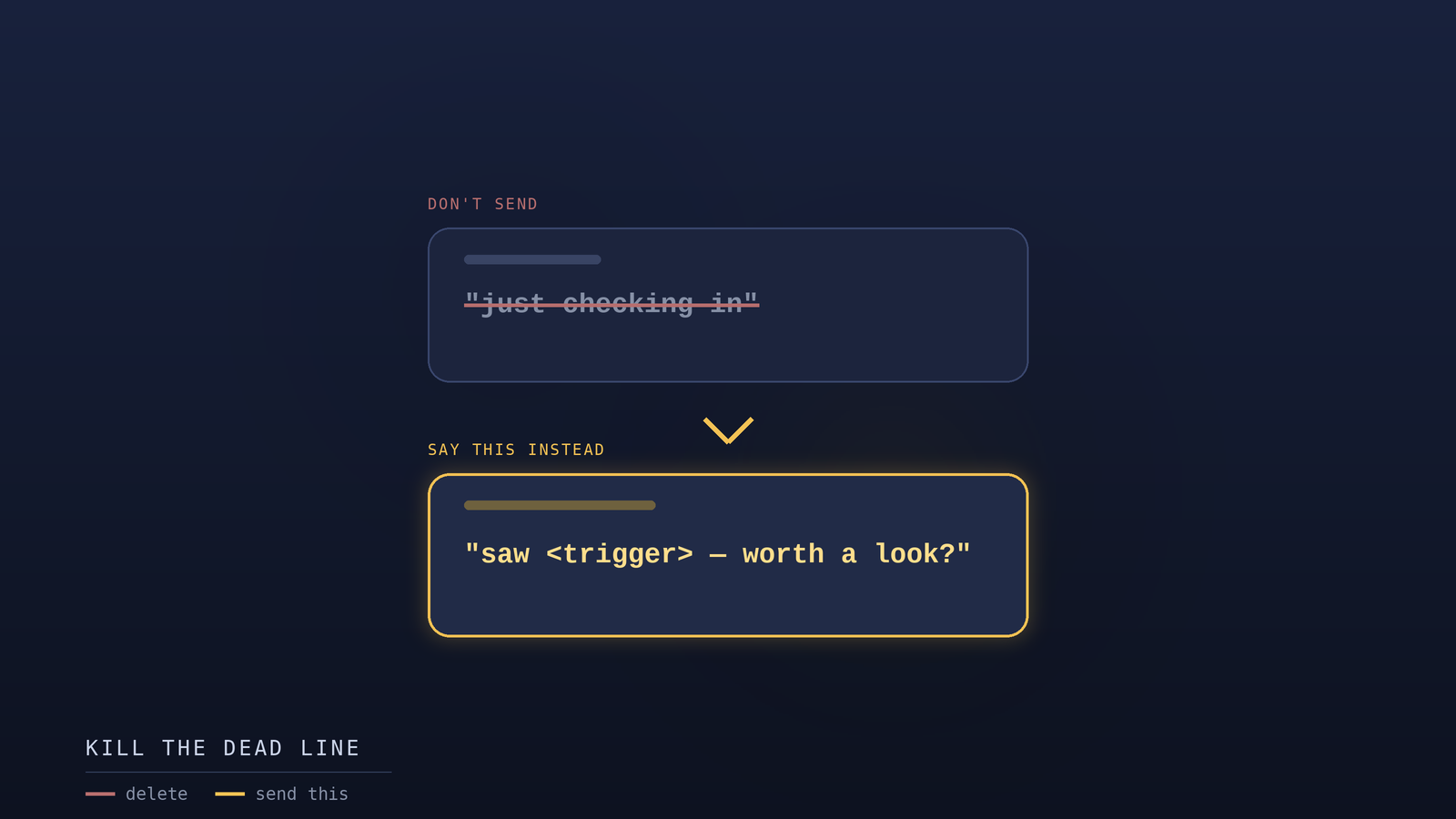
Stop Using 'Just Checking In' Say This Instead
Featured Blog

TL;DR: "Just checking in" fails because it gives the recipient no reason to respond it serves the sender, not them. Every follow-up should answer one question from the buyer's side: "why is this person reaching out right now?" This post gives five situation-specific replacements: after a demo, after a "not right now," after three weeks of silence (the breakup email), when you have something genuinely new, and when your champion goes quiet. Each is built around a reason that exists for the recipient.
What should you say instead of "just checking in"?
Instead of "just checking in," send a follow-up built around a reason that exists for the recipient, not the sender new information they'd find useful, a question only they can answer, or a door closing they may want to keep open. The test for every follow-up is whether it honestly answers the buyer's question: "why is this person reaching out to me right now?" If the only honest answer is "because they haven't heard from me," it isn't worth sending. The five situation-specific templates below show exactly what to send instead.
The Follow-Up Problem
"Just checking in to see if you had a chance to review..." is the most common sentence in sales follow-up emails. It's also one of the most reliably ineffective. It adds no value to the recipient. It signals no urgency, no new information, no reason to act. It communicates exactly one thing: that the sender hasn't heard from them and wants to. That's not a reason to respond.
And yet it dominates follow-up inboxes across every industry, because it fills a real need: the need to follow up without having anything specific to say. When a deal has gone quiet and the salesperson doesn't know why, the temptation to send something anything is strong. "Just checking in" is what happens when that temptation wins over the discipline to wait until there's actually something worth saying.
This post is about building that discipline and about what to say instead, organized by the specific situation the follow-up is responding to. The goal is follow-up that creates value for the recipient rather than follow-up that simply reminds them you exist.
The Underlying Principle
Before getting into specific situations and scripts, one principle governs everything: every follow-up email you send should be able to answer this question from the recipient's perspective "Why is this person reaching out to me right now?"
If the honest answer is "because they haven't heard from me and they want to," that's not a good enough reason to send an email. It's a reason for the sender, not the recipient. And recipients can feel the difference. They don't consciously analyze it, but they sense when an email is about the sender's needs rather than their own, and they respond or don't respond accordingly.
Every follow-up in the examples below is built around a reason that exists for the recipient: new information they might find useful, a question they might be able to answer, a door closing that they might want to keep open. The sender's need to maintain momentum is a secondary motivation that doesn't appear in the message itself.
It's worth understanding why this principle is so reliable. A salesperson's inbox math and a buyer's inbox math are completely different. The salesperson has maybe a few dozen open deals and remembers each one vividly; the follow-up feels significant to them. The buyer has hundreds of emails and barely remembers the conversation; the follow-up is just one more thing demanding attention. "Just checking in" lands in that crowded inbox carrying no value, so it gets deprioritized indefinitely. A follow-up carrying genuine information or a genuine question earns its place because it gives the buyer something rather than asking them for something. The asymmetry of attention is the entire reason value-first follow-up wins.
Situation 1: They Went Dark After a Demo
A deal goes quiet after a demo that seemed to go well. You had good energy in the call, they asked questions, they seemed engaged. Then silence. No response to your follow-up email, no response to a second attempt.
Wrong approach: "Hi [Name], just following up on our demo last week. Would love to keep the conversation going. Do you have 30 minutes to discuss next steps?"
This is the "just checking in" problem in a slightly longer form. It adds no information and makes no contribution to the prospect's decision process.
Right approach: address the specific thing that either went well or caused hesitation in the demo. If they raised a concern about integration time, send a one-page breakdown of typical implementation timelines with a comparable customer as a reference. If they asked a lot of questions about a specific use case, send a case study that addresses that exact use case. If the demo revealed a feature gap they mentioned, send a note about where that's heading on the roadmap.
The subject line should reference the specific thing: "Re: [specific concern they raised]" or "Thought you'd find this useful after Tuesday's conversation." The email should be brief: one paragraph connecting what you're sending to what they mentioned, and a low-pressure question about whether it addresses what they were thinking about.
The reason post-demo silence happens is almost always that the deal hit an unspoken objection or lost momentum to a competing priority not that the prospect forgot. A generic check-in does nothing about either cause. Sending something that addresses the specific concern they raised does two things at once: it provides genuine value, and it surfaces the objection that may be silently killing the deal, giving them an easy opening to tell you what's actually holding things up.
Situation 2: They Said "Not Right Now"
A prospect expressed genuine interest but said the timing wasn't right. They were in budget planning. They had a higher priority project consuming their bandwidth. The quarter was almost over and they weren't going to start a new evaluation. They said to follow up in 60 to 90 days.
Wrong approach: follow up in exactly 60 to 90 days with "Hi [Name], it's been 90 days since we last spoke. Are you ready to revisit?"
This does nothing beyond reminding them the time period has passed. It assumes their situation hasn't changed in ways that might be relevant, and it doesn't give them a new reason to engage.
Right approach: before following up on the agreed date, look for something that's changed in either your product, their business, or the relevant market landscape that gives the follow-up a new angle. A new case study from their specific industry. A recent product release that addresses the concern they'd raised. An article about a challenge they mentioned. Lead with that new piece of information and use it to reopen the conversation naturally: "A lot has changed since we last spoke specifically [thing that's relevant to what you discussed]. Wanted to reconnect given where things stood when we last talked."
The discipline here is to actually track these deferred follow-ups with enough context to make them useful later. Most salespeople set a reminder that says "follow up with [Name]" and arrive at the date with nothing but the reminder. The reps who win these deals log why the timing was off and what the prospect cared about, so when the date arrives they can connect a genuine development to that specific context. The follow-up then feels like a continuation of a real conversation rather than an alarm clock going off.
Situation 3: Three Weeks of Radio Silence
You've sent two or three follow-up emails after an initial conversation or demo, and none of them have generated a response. The prospect hasn't said no. They've just stopped engaging.
Wrong approach: continue sending variations of "just checking in" until they either respond or you get tired of trying.
Right approach: send a breakup email. Not an aggressive or passive-aggressive one a genuine, gracious acknowledgment that the timing may not be right and an explicit closing of the loop. The specific language matters: "[Name] I've reached out a few times and haven't heard back, so I'm going to assume the timing just isn't right. I'll close this out on my end for now. If that changes new quarter, new priority, new context please don't hesitate to reach out."
The breakup email consistently generates responses from people who've gone silent often higher response rates than any previous follow-up in the same thread. The psychology is simple: the prospect who's been avoiding your emails has been managing a low-level guilt about not responding. The breakup email releases that guilt by removing the obligation to respond, which paradoxically makes responding easier. And the prospect who was genuinely interested but too busy suddenly doesn't want the conversation to end on a closed note.
One caution worth noting: the breakup email only works when it's genuine. If you send it as a manipulation tactic fully intending to keep emailing if it doesn't work prospects can sense the theater, and you've spent your last credible touch on a bluff. Mean it. Be genuinely prepared to close the loop. The sincerity is what makes it effective, and it's also what preserves the relationship for a future re-engagement if their situation changes down the line.
Situation 4: You Have Something New and Relevant
You published a new benchmark report, released a case study from their industry, launched a product feature that directly addresses something they'd mentioned as a gap, or saw a news article directly relevant to a challenge they'd named in your last conversation.
This is the easiest follow-up to write and it's the one most salespeople fail to do because it requires actively looking for material rather than defaulting to a check-in. Lead with the content: "Saw this and thought of what you mentioned about [specific challenge] in our last conversation. Might be useful." Nothing more is needed. The content does the work. If it's genuinely relevant, it demonstrates that you were listening, you've been thinking about their situation, and you have something to contribute beyond selling.
The deeper advantage of this kind of follow-up is what it signals about the ongoing relationship. Every time you send something genuinely useful with no ask attached, you build a small amount of credibility and goodwill. Do this two or three times across a deferred deal and you've become a source of value rather than a source of pressure which means that when the timing does become right, you're the vendor they trust, not the one they've been avoiding. This is the rare follow-up that compounds in your favor the more you send it, precisely because it never asks for anything.
Situation 5: The Champion Has Gone Quiet
Your champion was engaged, was driving the internal process, and then suddenly stopped responding. Internally, something has probably shifted: a budget freeze, a priority change, an internal political dynamic you weren't aware of, a project getting deprioritized.
Wrong approach: keep emailing your champion and hoping they re-engage.
Right approach: try two things simultaneously. First, email your champion directly and name what you're observing: "I've noticed I haven't heard from you in a few weeks, which usually means something has shifted. If there's something I can help you navigate internally, I'm happy to provide whatever would make that easier case studies, ROI models, executive talking points." Second, if you have another contact in the account, reach out to them with something value-first that doesn't explicitly reference the stalled deal.
Naming the elephant in the room with your champion often unlocks more honest communication than any amount of neutral checking-in. They know the deal has stalled. You know the deal has stalled. A message that acknowledges this directly gives them permission to tell you what's actually happening, which is the only information that can actually unblock the deal.
The offer to equip your champion is the most important part of this message, and it reflects a reality most salespeople forget: when a champion goes quiet, it's often because they hit internal resistance they don't know how to overcome, not because they lost interest. They may be facing a skeptical CFO, a competing priority from leadership, or a stakeholder they can't get a meeting with. Your champion is selling for you inside an organization you can't see into, and they may be losing that internal sale. Giving them the specific tools to win it the ROI model that answers the CFO's objection, the one-pager that aligns a reluctant stakeholder is often what actually unblocks the deal, because it addresses the real obstacle rather than the symptom of silence.
Building the Discipline
The thread connecting all five situations is a single shift in mindset: stop sending follow-ups when you have nothing to say, and start treating every follow-up as an opportunity to deliver value. This requires more work than "just checking in" it means tracking what each prospect cares about, looking for genuinely relevant material, and resisting the urge to send something just to feel like you're making progress. But that work is precisely what separates follow-up that advances deals from follow-up that quietly trains prospects to ignore you. The discipline isn't about writing cleverer emails. It's about earning the right to be in the inbox every single time.
Frequently Asked Questions
Why is "just checking in" a bad follow-up?
"Just checking in" communicates only one thing: that the sender hasn't heard back and wants to. It delivers no value, no new information, and no reason for the recipient to respond. Because a buyer's inbox is crowded and the deal isn't top-of-mind for them, a value-free follow-up gets deprioritized indefinitely. Effective follow-ups give the recipient something information, a relevant question, or a graceful close.
What should you send after a demo when the prospect goes silent?
Send something that addresses the specific concern or use case they raised in the demo an implementation timeline, a relevant case study, or a roadmap note. Reference it directly in the subject line ("Re: [their concern]"). This provides genuine value and surfaces the unspoken objection that's usually the real cause of post-demo silence, giving the prospect an easy way to tell you what's holding things up.
Does the "breakup email" actually work?
Yes breakup emails often generate higher response rates than any prior follow-up in the thread. They work by releasing the prospect from the low-level guilt of not responding, which paradoxically makes replying easier, and by prompting genuinely interested-but-busy buyers not to let the conversation close. The key is sincerity: it only works if you're genuinely prepared to close the loop, not using it as a bluff.
How do you follow up after a prospect says "not right now"?
Don't simply return on the agreed date asking if they're ready. Before following up, find something that has changed a new industry case study, a relevant product release, an article about a challenge they named and lead with that. Connect it to the specific context from your last conversation so the follow-up feels like a continuation rather than a calendar reminder going off.
What should you do when your champion stops responding?
Do two things at once. Email your champion and name what you're seeing ("haven't heard from you in a few weeks, which usually means something shifted"), then offer to equip them with tools ROI models, case studies, executive talking points — to navigate internal resistance. Separately, reach out to another contact in the account with something value-first. Champions often go quiet because they're losing an internal sale, and giving them ammunition is what unblocks the deal.
TRY BACKCHANNELS FREE
Your next customers are already in the database.
Backchannels gives you 225,000 verified software decision-makers. Filter to your exact ICP, preview matches for free, and push them straight into Salesforce or HubSpot. Pay per contact. No subscription, no contract.
Browse contacts freeNo credit card. Preview before you spend a credit.
No items found.
Final Thoughts
Every follow-up should answer one question: why is this person reaching out right now? If the honest answer is 'because I haven't heard from them,' that's not a good enough reason. Find a better one.
Published
August 14, 2026
Writer
Joe Backchannels
Share


Most Wanted

12 min read

12 min read

June 2026