.png)
The Backchannel
PLG vs. Sales-Led: We Tried Both. Here's the Truth
Featured Blog

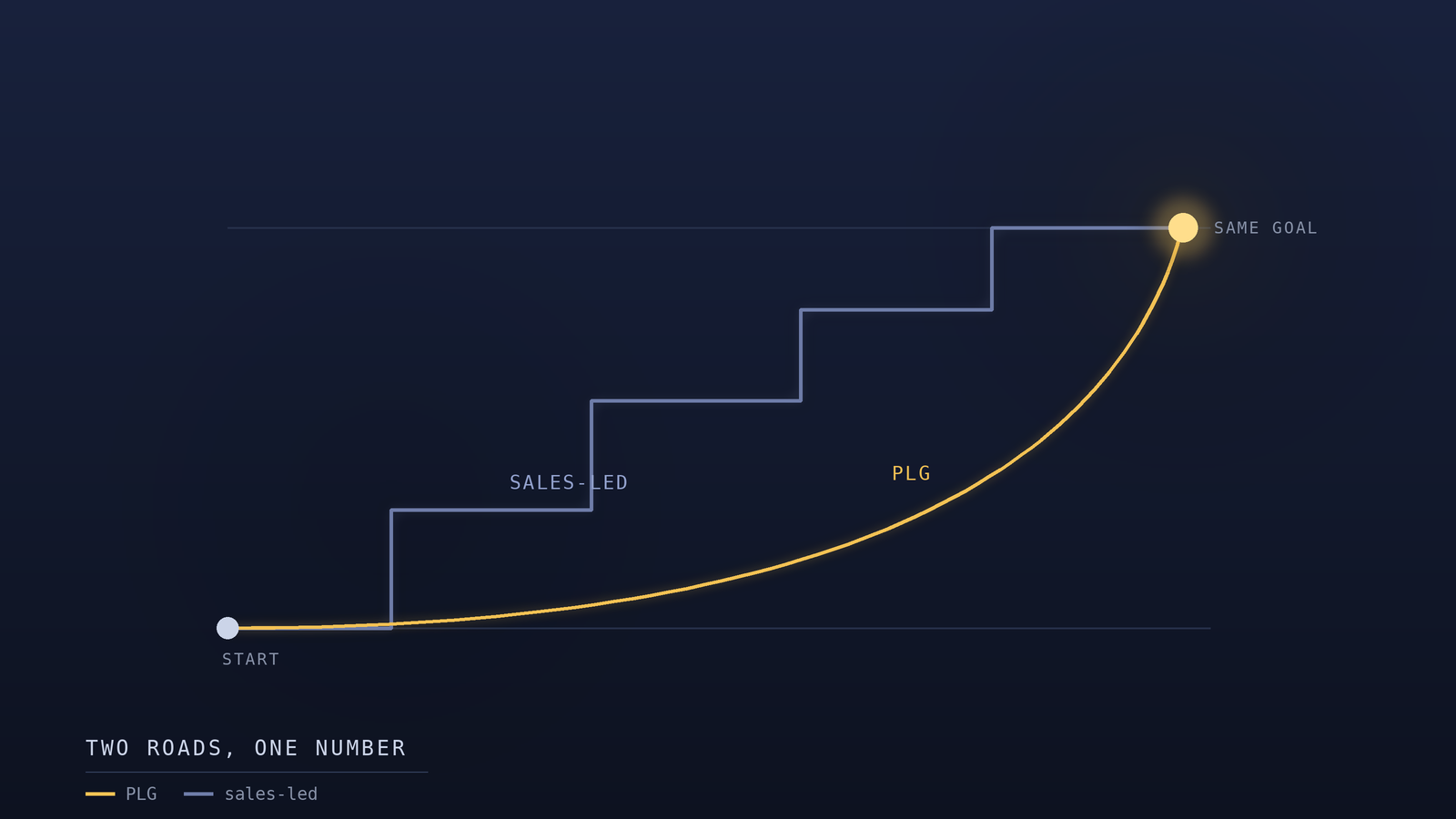
TL;DR: We ran product-led growth (PLG) and sales-led motions simultaneously for 18 months. Neither "won." PLG was unambiguously better for SMB (sub-$5K ACV, CAC ~40% of sales-led), while sales-led was clearly better for mid-market ($15K–$50K ACV, multi-stakeholder deals). The real answer is a deliberate hybrid: route buyers to the motion that fits their purchase complexity. The expensive mistake is forcing every buyer through one motion. Here's the full breakdown.
Is PLG or sales-led better for B2B SaaS?
Neither is universally better the right motion depends on the buyer segment, deal size, and purchase complexity. In our 18-month head-to-head, PLG produced lower CAC and faster acquisition for small, single-stakeholder purchases under roughly $5K ACV, while sales-led produced dramatically higher conversion for complex, multi-stakeholder deals above $15K ACV. The highest-performing approach is a hybrid that routes each buyer to the motion matching their profile. The detailed evidence and routing logic follow below.
The Debate That's Wasting Everyone's Time
If you spend any time in SaaS circles, you've encountered the PLG versus sales-led debate in its many forms. Product-led growth advocates argue that modern B2B buyers want to try before they buy, that human-heavy sales motions don't scale, and that the future belongs to products that sell themselves. Sales-led advocates counter that PLG only works for a narrow category of products, that enterprise buyers require human guidance, and that giving away your product for free trains the market to undervalue it.
Both camps make compelling arguments. Both camps have impressive logos on their side. And the debate itself is mostly a distraction from the question that actually matters: which motion fits which segment of your specific market?
We ran both motions simultaneously for 18 months. Not as a controlled experiment with clean separation, but as a genuine operational reality where we were actively trying to figure out how to serve different segments of our market in different ways. Here's what we learned, including the parts of the PLG narrative that are real and the parts that are overhyped.
What PLG Actually Requires (And Most People Get Wrong)
Product-led growth is not a free trial. It's not a freemium tier. It's not adding a self-serve signup flow to your existing product and calling it PLG. These are tactics that might be part of a PLG motion, but they are not the motion itself.
PLG is a growth model where the product is the primary driver of acquisition, activation, retention, and expansion. Users discover the product, experience its value quickly and without significant friction, and make purchasing decisions with minimal or no human involvement. Slack, Figma, Notion, and Calendly are the canonical examples because they were architected from day one to deliver a specific, meaningful value to a single user quickly enough that the user would want to come back, share it with colleagues, and eventually pay for it.
Building a product that can do this requires an enormous amount of investment in places that most SaaS companies don't prioritize. Time-to-first-value has to be measured in minutes or hours, not days or weeks. Onboarding has to be self-explanatory to someone with no prior exposure to the product. The core value proposition has to be deliverable to a single user acting alone, before they've recruited any colleagues or configured any integrations. If any of those conditions aren't met, PLG as a primary motion will underperform, not because PLG doesn't work but because the product isn't ready to deliver what PLG requires.
Most companies that "try PLG" haven't done this work. They've added a free tier and assumed that access to the product is equivalent to experiencing its value. It isn't. And when the PLG motion underperforms, they conclude that PLG doesn't work for their market, when the actual conclusion should be that their product doesn't yet deliver the kind of frictionless, immediate value that PLG requires.
There's a useful diagnostic here. Ask whether a brand-new user, alone, with no onboarding call and no help from your team, can reach a moment where your product has visibly made their work better within their first session. If the honest answer is no, you don't have a PLG-ready product yet, and adding a free tier will simply generate a large population of users who sign up, fail to find value, and churn silently. The free tier isn't the motion. The self-evident, single-user value is the motion, and the free tier is just the delivery mechanism for it.
What Sales-Led Actually Requires (And Why It's Harder Than It Looks)
Sales-led is the default growth model for most B2B SaaS, and like PLG, it's frequently misunderstood. Sales-led doesn't mean "we have sales reps who close deals." It means the human element of the sales process is the primary vehicle for communicating value, qualifying fit, managing the buying process, and ultimately driving a decision.
Done well, sales-led is genuinely powerful for products where the value is complex, where the buying process involves multiple stakeholders, or where the ROI case requires customization to a specific customer's situation that a self-serve experience can't provide. The human element isn't just a crutch for products that aren't self-evidently valuable it's a genuine value-add for a segment of buyers who want to be guided through a complex decision by someone who understands their specific context.
Done poorly which is how it's done at most companies sales-led becomes a crutch that compensates for unclear positioning, weak product onboarding, and an inability to communicate value without a slide deck. If your sales reps are doing what your website should be doing, you don't have a sales motion. You have a marketing problem dressed up as a sales process.
The way to tell the difference is to look at what your reps spend their time explaining. If they're spending the first half of every call explaining what the product is and why the category matters work that good positioning and a clear website should have already done then the sales team is compensating for an upstream failure, and every deal is more expensive than it should be. If instead they're spending their time understanding the specific customer's situation and mapping the product to it, that's genuine sales value-add, and it's the kind of work that justifies the cost of a human-led motion. The distinction matters because it determines whether your sales-led motion is a strength or an expensive bandage.
What We Learned Running Both
When we ran both motions simultaneously and analyzed the results by segment and deal size, the pattern was clear and consistent.
In our SMB segment companies with 10 to 50 employees, deals under $5,000 ACV PLG was unambiguously superior. These buyers found us through search, signed up for a free tier, and either converted to paid or didn't, with minimal human involvement on either path. Our Customer Acquisition Cost in this segment through PLG was roughly 40% of our CAC through sales-led motions. Churn was slightly higher, but the volume of customers and the speed of acquisition more than compensated.
In our mid-market segment companies with 100 to 500 employees, deals of $15,000 to $50,000 ACV sales-led was clearly superior. These buyers had procurement processes. They needed security reviews. They had multiple stakeholders who needed to be aligned. Trying to push them through a self-serve experience created friction that killed deals. They wanted a demo. They wanted to talk to someone who could explain how the product would work in their specific environment. A sales rep who could answer those questions converted at dramatically higher rates than the self-serve flow that worked fine for SMB.
The insight this produced wasn't "PLG beats sales-led" or the reverse. It was that different buying motions are appropriate for different buyers, and forcing all buyers through the same motion regardless of fit is one of the most common and expensive mistakes in SaaS GTM.
The Hybrid Model Is Not a Compromise
When we talk about running both PLG and sales-led, people often interpret this as a lack of conviction as if we couldn't commit to one approach so we split the difference. This is the wrong frame.
The hybrid model isn't a compromise. It's a more sophisticated market segmentation than either pure approach allows. The insight is that different segments of your market have genuinely different buying preferences, and those preferences are driven by real structural differences in the complexity of the purchase, the number of stakeholders involved, and the risk tolerance of the buyer. A $1,500 ARR purchase by a 15-person startup is a different transaction in every meaningful way from a $45,000 ARR purchase by a 300-person company with a formal procurement process. They should not go through the same motion.
Building the operational infrastructure to serve both motions simultaneously is not trivial. You need different onboarding experiences for self-serve versus sales-assisted customers. You need different tooling to support SDRs reaching mid-market buyers versus a product team optimizing conversion from free to paid. You need handoff logic to identify when a self-serve user has become large enough or complex enough to warrant sales attention without losing them in the transition.
These are solvable problems. They're not the problems most companies focus on when they think about PLG versus sales-led, but they're the problems that actually determine whether the hybrid model works in practice.
The piece that ties the hybrid together and the piece most companies get wrong is the routing logic between the two motions. The goal is to let self-serve handle everything it can, while catching the accounts that warrant human attention before they slip away. In practice that means watching for signals that a self-serve user has outgrown the self-serve motion: usage crossing a threshold, multiple users from the same company signing up, a company-size or domain signal that indicates a mid-market buyer, or explicit actions like viewing enterprise pricing or asking about security and SSO. When those signals fire, the account gets routed to sales. When they don't, the account stays in the efficient self-serve flow. Getting this routing right is what separates a hybrid that compounds from one that just runs two disconnected motions in parallel.
When to Choose Each
PLG is the right primary motion when: your product can deliver a meaningful "aha moment" to a single user within their first session, your ACV is below $8,000 and the unit economics of self-serve work, your buyers prefer to evaluate tools independently before involving procurement, and you have the product and engineering resources to build and continuously improve a world-class onboarding experience.
Sales-led is the right primary motion when: your product requires configuration, integration, or professional services before delivering value, your ACV is above $15,000 and the economics justify a human sales process, buying decisions involve multiple stakeholders who need to be aligned, or your buyers are in regulated industries with procurement requirements that self-serve can't accommodate.
If your market contains both types of buyers which most SaaS markets do, just at different scales the question isn't which to choose. It's how to build the infrastructure to serve both, and what the routing logic should be to ensure buyers are moving through the right motion for their profile. That's harder than choosing a camp. It's also what the best-performing companies are actually doing.
Frequently Asked Questions
What is the difference between PLG and sales-led growth?
Product-led growth (PLG) makes the product itself the primary driver of acquisition, activation, and expansion users discover it, experience value, and buy with little or no human involvement. Sales-led growth makes the human sales process the primary vehicle for communicating value and driving the decision. PLG suits simple, single-user, lower-cost purchases; sales-led suits complex, multi-stakeholder, higher-cost ones.
Is PLG just a free trial or freemium tier?
No. A free trial or freemium tier is a tactic, not a motion. True PLG requires a product architected to deliver meaningful value to a single user within their first session, with no human help. Adding a free tier to a product that can't deliver fast, self-evident, single-user value typically produces signups that churn silently rather than real PLG growth.
When should a SaaS company use sales-led instead of PLG?
Use sales-led when the product requires configuration or integration before delivering value, when ACV is high enough (roughly $15K+) to justify a human process, when multiple stakeholders must be aligned, or when buyers are in regulated industries with procurement requirements self-serve can't accommodate. In our data, sales-led dramatically outperformed PLG for mid-market deals of $15K–$50K ACV.
Can you run PLG and sales-led at the same time?
Yes, and the best-performing SaaS companies often do. A hybrid model routes each buyer to the motion that fits their purchase complexity self-serve for small, single-stakeholder deals and sales-assisted for larger, multi-stakeholder ones. It requires separate onboarding experiences, tooling, and clear handoff logic to move users between motions, but it serves each segment the way it actually wants to buy.
Does PLG have higher or lower CAC than sales-led?
For the right segment, PLG typically has dramatically lower customer acquisition cost. In our 18-month comparison, PLG CAC in the SMB segment was roughly 40% of sales-led CAC for the same type of buyer. However, PLG's cost advantage only holds when the product can deliver self-serve value; for complex deals, sales-led converts far better and is worth its higher cost.
TRY BACKCHANNELS FREE
Your next customers are already in the database.
Backchannels gives you 225,000 verified software decision-makers. Filter to your exact ICP, preview matches for free, and push them straight into Salesforce or HubSpot. Pay per contact. No subscription, no contract.
Browse contacts freeNo credit card. Preview before you spend a credit.
No items found.
Final Thoughts
PLG vs. sales-led is the wrong question. The right question is which motion fits which segment of your market. The companies winning in 2026 have answered that question with precision, not ideology.
Published
August 14, 2026
Writer
Joe Backchannels
Share


Most Wanted

12 min read

12 min read

June 2026