.png)
The Backchannel
The Exact LinkedIn Message That Got Us a 34% Reply Rate
Featured Blog

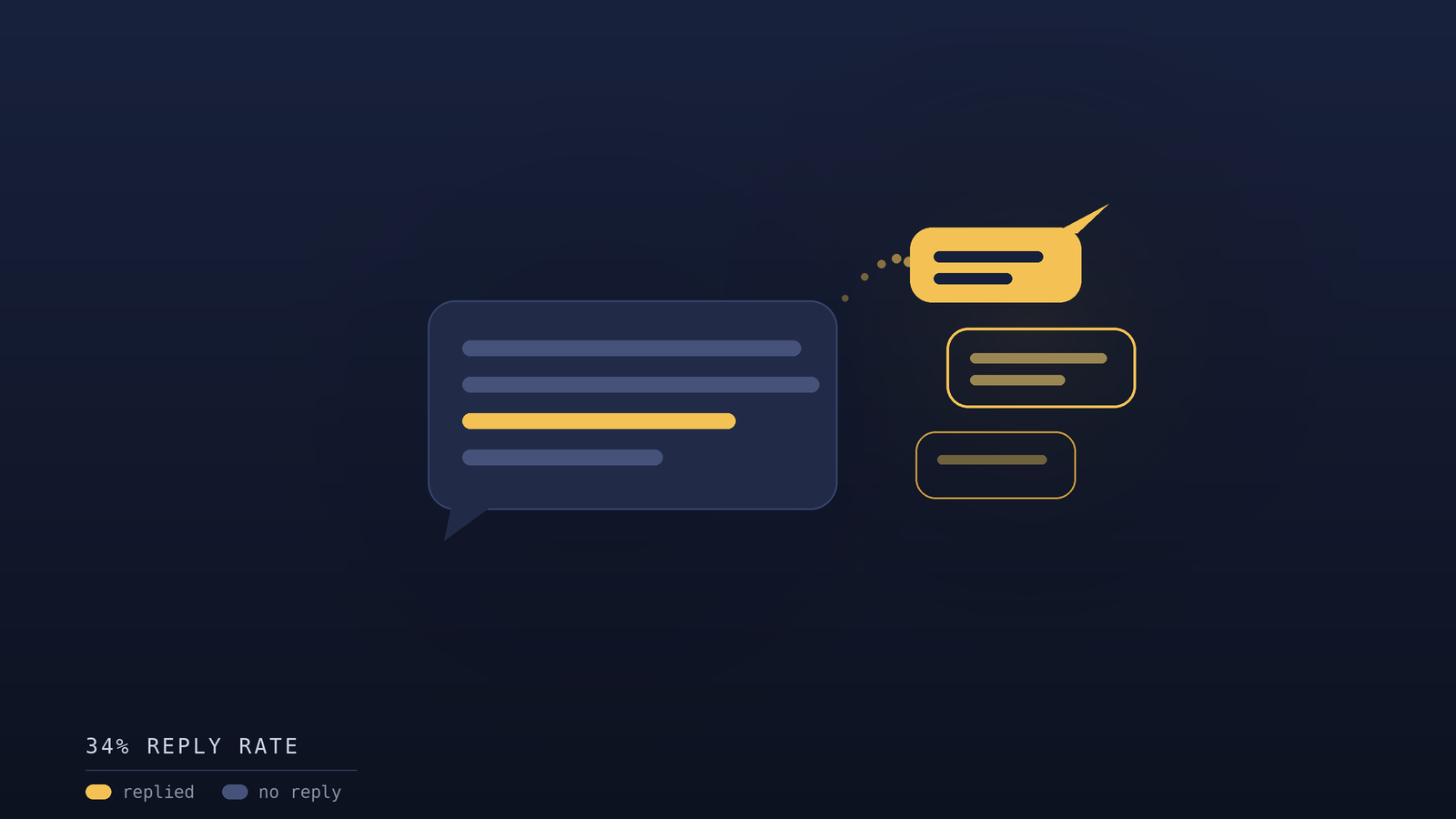
TL;DR: A three-part LinkedIn sequence a 38-word connection note, a 28-word diagnostic first message, and one low-pressure follow-up produced a 34% reply rate across 200+ sends to VP and Director-level B2B SaaS buyers, roughly 3x the 8–12% benchmark for that audience. The reason isn't clever copy. It's structure: a small ask before a large one, a genuine question instead of a pitch, and the discipline to stop after two touches. The full messages and the reasoning behind each are below.
What was the actual LinkedIn message?
Here is the complete sequence, so you can adapt it before reading the analysis.
Connection request (38 words): "Hey [Name] saw you're leading sales at [Company]. We help SaaS teams find verified buyer contacts without the data cleanup headache. Thought it might be relevant. Happy to share more if so."
First message after they accept (28 words): "Thanks for connecting. Quick question are you currently building out your outbound contact lists manually, or do you have a system for that?"
One follow-up, five days later if no reply: "No worries if the timing's off just wanted to make sure this didn't get buried. Either way, happy to share what's been working for similar teams if ever useful."
That's the entire sequence. The connection note and first message together total 66 words, and the first message is the one that drove the 34% reply rate.
Why LinkedIn Outreach Fails So Consistently
If you work in B2B sales and you've sent LinkedIn outreach, you already know that most of it doesn't work. The reply rates are discouraging. The responses you do get are mostly rejections or requests to be removed. And the people who never respond at all which is the majority leave you wondering whether your message even registered before it was archived.
The common diagnosis for this problem is messaging quality: if only the email were better written, if only the subject line were stronger, if only the value proposition were clearer. But in our experience, the messaging is rarely the primary issue. The primary issue is structure and framing the fundamental architecture of how the outreach is sequenced and what it asks for at each stage.
Most LinkedIn outreach fails because it tries to do too much too fast. It opens with flattery, pivots to a pitch, and closes with a meeting request all in a single message to someone who has no relationship with the sender and no established reason to invest time in their pitch. The sequence is fundamentally misaligned with how professional trust is built. Trust requires a series of low-stakes positive interactions before high-stakes requests are appropriate. Most LinkedIn outreach skips straight to the high-stakes request and wonders why it doesn't convert.
There's a deeper reason this pattern persists. Most SDRs are measured on activity volume connection requests sent, messages delivered, meetings booked this week. That measurement system creates pressure to compress the entire sales motion into the fewest possible touches, because every additional touch is a delay against a weekly number. So reps front-load the ask. They pitch in the connection request because waiting feels like wasted time. The irony is that this compression is precisely what destroys conversion. By trying to go faster, the average rep goes slower, because they burn the relationship before it has a chance to form.
When one of our sequences hit a 34% reply rate across more than 200 sends to VP and Director-level buyers at B2B SaaS companies, we didn't assume we'd gotten lucky. We analyzed exactly what we'd done differently, and we're sharing it here in full not just the messages, but the reasoning behind every choice, so you can adapt the principles to your own market rather than copying our words and hoping they transfer.
The Target and Why It Matters
Context on who we were reaching: VP and Director-level sales leaders at B2B SaaS companies with 50 to 300 employees. This is a sophisticated, high-volume outreach target segment. These buyers receive dozens of LinkedIn connection requests weekly and have developed well-calibrated filters for anything that smells like a sales approach.
A 34% reply rate in this segment isn't just good. It's genuinely unusual. The benchmark for well-executed LinkedIn outreach targeting this profile is 8 to 12%. We were roughly three times that. Understanding why requires looking at the specific mechanics of every element of the sequence.
It's worth being precise about why the seniority of the target matters so much here. The more senior the buyer, the more outreach they receive, and the more refined their filtering becomes. A VP of Sales has, almost by definition, been an SDR or an AE earlier in their career. They know every tactic in the playbook because they've run those tactics themselves. The fake personalization, the manufactured urgency, the "I noticed you're the decision-maker for..." opener they've sent those exact messages. This means that with senior buyers, anything that reads as a technique is immediately recognized as a technique, and recognition is fatal. What works on sophisticated buyers is not a better technique. It's the absence of technique communication that reads as a genuine professional reaching out, because it actually is.
The Connection Request: The First Test
LinkedIn limits connection request notes to 300 characters. This constraint, which most people experience as a limitation, is actually a gift. It eliminates the option of sending a lengthy pitch in your connection request and forces you to communicate one clear thing in very little space.
The note we tested: "Hey [Name] saw you're leading sales at [Company]. We help SaaS teams find verified buyer contacts without the data cleanup headache. Thought it might be relevant. Happy to share more if so."
Count the words. It's 38. In 38 words, this note accomplishes three things. It identifies who the sender is someone who helps with a specific, named problem. It makes a relevance claim that the recipient can immediately evaluate either the data cleanup headache resonates with their actual experience or it doesn't. And it makes a small, non-committal ask "happy to share more if so" is an invitation, not a request.
What it doesn't do: flatter the recipient on their impressive career trajectory, claim to have been following their company for some time, or propose a meeting before any interest has been established.
Connection acceptance rate with this note: 61%. Without any note: 42% in a concurrent test to the same target segment. The additional 19 percentage points of acceptance came from honest, specific framing. People accepted because the note told them exactly why a connection might be worth having, not because of a generic request to join their network.
There's a subtle point in that note that's easy to miss: the phrase "thought it might be relevant" does important work. It signals that the sender has made a judgment that this particular person might care, while simultaneously acknowledging that they might not. That small concession the implicit admission that this could be off-base is what makes it read as human rather than automated. An algorithm blasting 500 connection requests doesn't hedge. A person who actually considered whether this individual might care does. The hedge is the tell that there's a human on the other end, and that tell is worth real percentage points.
One more thing about the connection note worth examining: it names the problem, not the product. "Verified buyer contacts without the data cleanup headache" is a description of an outcome and a pain, not a description of what the software does. We never say "we're a contact database platform with X million records and Y% accuracy." That framing invites immediate comparison-shopping and skepticism about claims. Naming the pain the data cleanup headache invites recognition instead. The recipient's internal response is "ugh, yes, the data cleanup headache," not "let me evaluate whether your accuracy claim is credible." Recognition opens doors. Claims invite scrutiny.
The First Message: Where Most People Blow It
A connection acceptance is not an invitation to pitch. It's an invitation to continue a conversation that's still in its earliest stages. Most people blow the first message by treating the acceptance as permission to send the pitch they were holding back from the connection request.
Our first message after a connection accepted: "Thanks for connecting. Quick question are you currently building out your outbound contact lists manually, or do you have a system for that?"
That's the whole message. 28 words. No product mention. No transition to value proposition. Just a direct, diagnostic question about a specific operational task we knew our ICP performs regularly and finds painful.
This message generated 34% reply rate. Let's break down exactly why it worked.
It's a question, not a statement
Questions invite responses. Statements invite agreement or silent disagreement. By asking about their current situation rather than telling them about ours, we shifted the dynamic from pitch to conversation. The prospect isn't being asked to evaluate a product they're being asked to describe their own experience. That's a much lower-resistance interaction.
There's a well-documented social reflex at work here. When someone asks you a direct, reasonable question, the default human response is to answer it. Not answering requires a small act of will you have to actively decide to ignore the message. A statement, by contrast, requires no response; silence is the path of least resistance. By structuring the entire message as a question, we shifted the path of least resistance from "ignore" to "answer." That single structural choice is responsible for a large share of the reply rate.
It's diagnostic by design
The question is constructed so that either answer is useful. If they say "we have a solid system," that opens a conversation about what their system is and whether it has gaps. If they say "mostly manually, honestly it's a pain," they've self-identified as someone experiencing exactly the problem we solve. The question creates a sorting mechanism that generates qualified leads through their own responses rather than through external filtering.
This is the part most people miss when they try to copy the approach. The question isn't just an engagement tactic it's a qualification tool disguised as a conversation starter. The "manual or system" framing maps directly onto our ICP's buying readiness. Someone doing it manually has the pain. Someone with a system might have an inadequate system, which is a different but still workable conversation. And someone with a genuinely great system that they're happy with is, usefully, disqualifying themselves early, which saves everyone time. The question does the work of three discovery questions in a single sentence, and it does that work before we've spent any effort on a prospect who isn't a fit.
It names something specific
"Building out outbound contact lists" is a specific activity that real sales leaders do every week. It's not abstract. It's not a vague reference to "pipeline challenges" or "sales efficiency." It names a task that our ICP can immediately place in their daily reality and evaluate for personal relevance. The specificity creates recognition: "This person understands what I actually do."
Compare it to the generic alternatives that most outreach defaults to. "How are you thinking about your pipeline strategy this quarter?" is a question, but it's a question about an abstraction, and abstractions don't create recognition. "Are you building out your contact lists manually or with a system?" names a concrete task with concrete friction. The difference in specificity is the difference between a message that feels like it was written for this person's actual job and one that feels like it was written for a job title. Buyers respond to the former and ignore the latter.
It's short
The connection note and first message together total 66 words. We're not asking the prospect to read a paragraph before they've decided we're worth engaging with. We're making it as easy as possible to respond, and the length of the ask is directly proportional to the probability of getting it answered.
Length functions as a cost. Every additional sentence you ask a busy person to read before they understand what you want is a small tax on their attention, and taxes suppress the behavior they're applied to. A 28-word message can be read in the preview pane, on a phone, between meetings, without opening anything. The decision to respond can be made instantly because the entire context is visible at once. The moment a message requires scrolling or expanding to comprehend, you've introduced friction, and friction at the comprehension stage kills replies before the quality of your idea ever gets evaluated.
The One Follow-Up: Knowing When to Stop
Not everyone replied to the first message. For those who didn't, we sent one follow-up after five days: "No worries if the timing's off just wanted to make sure this didn't get buried. Either way, happy to share what's been working for similar teams if ever useful."
This single follow-up added 8 percentage points to our total reply rate. It's written in a way that gives the prospect explicit permission not to respond "no worries if the timing's off" which is the phrase that paradoxically increases response probability. People are more likely to respond when the pressure is removed than when it's maintained.
The psychology here is worth dwelling on because it's so counterintuitive to how most follow-ups are written. The standard follow-up applies pressure: "Just following up on my message below," or worse, "Bumping this to the top of your inbox," or worst of all, "I haven't heard back did you get a chance to review?" Every one of these increases the social pressure on the recipient, and increased pressure triggers avoidance. When someone feels pursued, the comfortable response is to retreat. By explicitly releasing the prospect from any obligation "no worries if the timing's off" we removed the pressure that would otherwise drive avoidance, which freed people to respond on their own terms. Many of them did.
The phrase "what's been working for similar teams" also does quiet work. It positions the sender as someone who has visibility into how comparable companies are solving the problem, which is a form of value the prospect can't get by ignoring the message. It's not "let me show you my product." It's "I have pattern knowledge from your peer set that might be useful to you." That's a genuinely attractive offer to a sales leader who wants to know what their competitors and peers are doing.
We did not send a third message. This is a discipline that most outbound practitioners don't maintain, and it's the right one. A third message on LinkedIn, to someone who hasn't responded to two, reads as persistence that's tipping toward desperation. It damages whatever impression was built by the first two messages. Two touches, then silence. If they weren't ready for the first two, give them time and let a future trigger or a different channel bring them back.
There's a longer-term reason to stop at two that goes beyond the immediate sequence. The buyers in your target market are people you may be selling to for years. A prospect who isn't ready today might be ready in six months when their situation changes a new initiative, a new pain, a new budget. If your last interaction with them was a respectful, low-pressure pair of messages, you're welcome to reach out again later. If your last interaction was a third or fourth message that made them feel hounded, you've poisoned the well. Restraint in the present preserves the relationship for the future, and in B2B sales the future is where most of the value is.
The Profile Problem Nobody Talks About
The messages we've described above will underperform significantly if the profile they come from is weak. Profile quality is a larger variable in LinkedIn outreach conversion than most SDRs acknowledge.
A profile that reads as a dedicated sales account sparse professional history, a headline that's essentially a pitch, connection activity that's obviously mass-oriented reduces both connection acceptance rates and reply rates significantly. Buyers can read these signals. When a profile looks like a machine built for outreach rather than a professional human being who happens to be reaching out, the response is skepticism before the first word of the message is read.
The profiles that generate the best results have complete, credible professional histories. They have an active posting cadence that demonstrates genuine expertise and engagement with the space. They read as belonging to a real person with a real professional identity, not a function in an outbound process. If your SDRs are doing LinkedIn outreach from profiles that don't reflect this, the messages won't perform regardless of how well-crafted they are.
Here's the mechanism behind why the profile matters so much: when you send a connection request, the first thing a considered prospect does is click your profile to decide whether to accept. In those few seconds, they're answering a single question "is this a real person worth knowing, or a salesperson trying to get at me?" Everything on the profile is evidence in that judgment. A headline that says "Helping SaaS teams 10x their pipeline 🚀" is evidence for "salesperson." A headline that describes a genuine professional identity, combined with posts that share real, useful thinking about the problems your buyers face, is evidence for "real person worth knowing." The message you send never gets a fair hearing if the profile has already lost the case.
This is why the highest-performing LinkedIn outreach is often run from the profiles of founders, senior leaders, or genuine subject-matter experts rather than from junior SDR accounts. It's not that those people are better writers. It's that their profiles pass the credibility test instantly, which means their messages get read on their merits. If you're building a LinkedIn motion, investing in the credibility of the sending profiles real photos, complete histories, a consistent cadence of genuinely useful posts is not a nice-to-have. It's a precondition for the messages working at all.
What We're Testing Next
The 34% result has held consistently enough to become our baseline. We're now running experiments to see if we can improve it further.
Active tests: voice messages as an alternative to text for the first post-connection message. Early data suggests there's a novelty and humanity factor in voice that drives a different kind of engagement hearing an actual human voice, with its natural imperfections and warmth, is much harder to dismiss as automated than text is. The early reply rates on voice are promising, though the operational cost of recording individual voice messages at scale is a real constraint we're still working through.
Video messages for high-value, enterprise-tier targets where the additional investment is justified by deal size. For a deal worth six figures, spending three minutes recording a personalized video that references the prospect's specific situation is easily worth it. For volume outreach to smaller accounts, the math doesn't work. We're mapping out exactly where on the deal-size spectrum the additional effort of video starts to pay for itself.
Leading with a specific piece of content a benchmark or an insight specific to their role rather than a diagnostic question, to test whether value-first outperforms curiosity-first in this segment. The hypothesis is that opening with "we just pulled data showing the median SaaS SDR spends 9 hours a week on list-building happy to share the full breakdown" might outperform the diagnostic question for certain sub-segments, particularly more analytical buyers who respond to data. We don't have a verdict yet, but the early signal suggests the right answer may vary by buyer persona, which would mean the optimal opening isn't universal but should be matched to the type of person you're reaching.
What won't change regardless of test outcomes: the underlying principles. Be direct about why you're reaching out. Make a small ask before a large one. Respect that a connection acceptance is not a sales conversation. And treat the person on the other end as an intelligent professional whose time is worth respecting rather than a lead record with a meeting attached to it. Every tactic we test is downstream of those principles. The tactics will keep evolving as the platform changes and as buyers' filters adapt. The principles are stable because they're grounded in how professional trust actually forms, which doesn't change with the platform or the year. Get the principles right, and the specific tactics become details you can optimize. Get the principles wrong, and no amount of tactical cleverness will save the outreach.
Frequently Asked Questions
What is a good reply rate for LinkedIn outreach?
For well-executed cold outreach to senior B2B buyers (VP and Director level), 8–12% is a strong benchmark. Average outreach to that audience runs lower, around 5–8%. The sequence described here reached 34%, roughly 3x the benchmark, by leading with a diagnostic question instead of a pitch and keeping the connection note and first message to a combined 66 words.
Should you include a note with a LinkedIn connection request?
Yes, when the note is short and specific. In a head-to-head test, a 38-word note that named a specific pain achieved a 61% acceptance rate versus 42% for a blank request to the same audience. The note works because it tells the recipient exactly why connecting might be worth their time. Long or pitch-heavy notes do not show the same benefit.
What should the first LinkedIn message after connecting say?
Don't pitch. Ask a specific, diagnostic question about a task your buyer does regularly. The highest-performing message here was 28 words: "Thanks for connecting. Quick question are you currently building out your outbound contact lists manually, or do you have a system for that?" A question invites a reply; a pitch invites silence.
How many LinkedIn follow-up messages should you send?
Two touches total: the first message, then one follow-up about five days later. A third message to a non-responder reads as desperation and damages the impression built by the first two. Stopping at two also preserves the relationship for future outreach when timing may be better.
Why do most LinkedIn sales messages get ignored?
They try to do too much too fast opening with flattery, pivoting to a pitch, and asking for a meeting before any trust exists. Senior buyers recognize this pattern instantly. Outreach performs better when it makes a small ask first, asks a genuine question, and comes from a credible, complete profile rather than an obvious sales account.
Does your LinkedIn profile affect outreach reply rates?
Significantly. Before accepting a request, prospects click the profile to decide whether you're a real person worth knowing or a salesperson to avoid. A sparse profile or a pitch-style headline lowers both acceptance and reply rates, regardless of how good the message is. Complete histories and a genuine posting cadence are a precondition for the messages working.
TRY BACKCHANNELS FREE
Your next customers are already in the database.
Backchannels gives you 225,000 verified software decision-makers. Filter to your exact ICP, preview matches for free, and push them straight into Salesforce or HubSpot. Pay per contact. No subscription, no contract.
Browse contacts freeNo credit card. Preview before you spend a credit.
No items found.
Final Thoughts
A 34% reply rate isn't magic. It's the product of short messages, honest framing, a diagnostic question, and exactly one follow-up. The principle is simple. The discipline to execute it is the hard part.
Published
August 14, 2026
Writer
Joe Backchannels
Share


Most Wanted

12 min read

12 min read

June 2026