.png)
The Backchannel
I Analyzed 500 Lost Deals. Here's Why We Keep Losing
Featured Blog

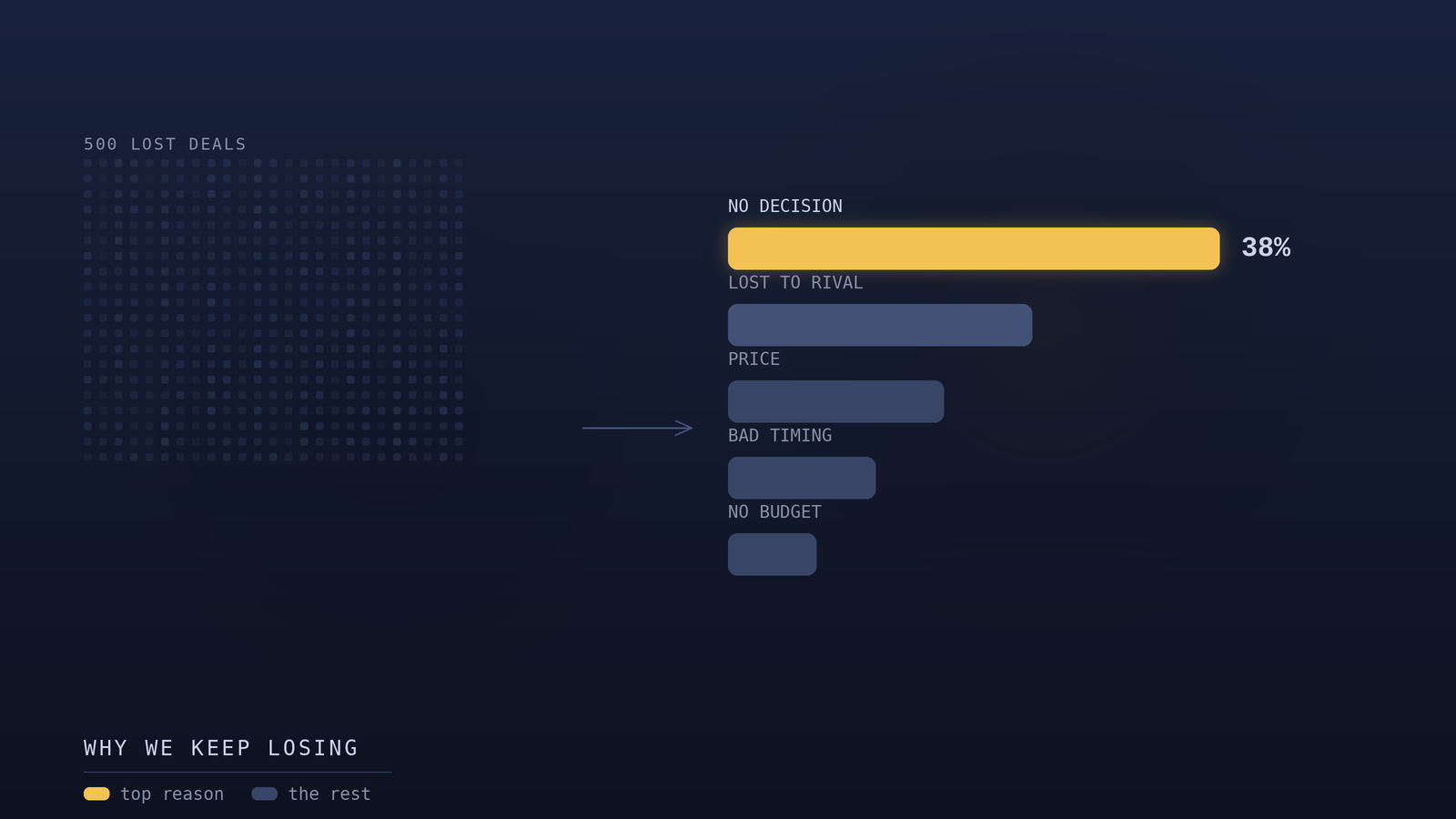
TL;DR: We reviewed 500 closed-lost opportunities from the past 18 months, going past the CRM loss reasons to the actual root cause of each. The findings: 31% were lost to no urgency, 24% to the wrong champion, 19% to a competitor's established relationship, 14% to price without demonstrated value, and only 12% to genuine product gaps despite reps attributing roughly 35% of losses to product. The takeaway: most losses are fixable through process, not product. Here's the full breakdown.
Why do most B2B sales deals get lost?
Most B2B deals are not lost to price or missing product features they're lost to process failures earlier in the sales cycle. In an analysis of 500 closed-lost deals, the largest root causes were a failure to create urgency (31%), investing in a champion who couldn't drive the decision (24%), and a competitor's pre-existing relationship (19%). Price (14%) and genuine product gaps (12%) were the smallest categories, and both were heavily over-attributed in CRM data. The detailed findings and fixes follow below.
Why Nobody Does This
Lost deal analysis is one of the most universally recommended and universally avoided practices in B2B sales. Every sales methodology endorses it. Every VP of Sales knows it's valuable. Almost no one does it rigorously, because doing it rigorously requires acknowledging things that are uncomfortable: that deals were lost for reasons within the team's control, that the loss reasons entered in the CRM are often rationalizations rather than root causes, and that patterns in your losses reveal systematic weaknesses in your process that weren't visible when looking at individual deals in isolation.
We did it anyway. We pulled 500 closed-lost opportunities from the previous 18 months, went through every call recording and email thread we could access, and categorized every loss by what we believed to be the actual root cause not the proximate reason entered in the CRM, but the underlying failure that made the proximate reason possible. Here's what we found, including the parts that were uncomfortable to share with the broader team.
First: The Problem With How Losses Get Recorded
Before sharing the findings, a methodological note that explains why most companies don't have accurate loss data even when they think they do.
Loss reasons in CRMs are entered by the reps who lost the deals. This creates a systematic bias: reps have an incentive to attribute losses to factors outside their control product gaps, pricing, competitive relationships, budget freezes rather than to factors within their control, like failing to build a champion, failing to create urgency, or mismanaging the evaluation process. This isn't dishonest behavior. It's human nature operating under performance pressure.
When we cross-referenced the loss reasons our reps had entered in the CRM against the actual call recordings and email threads, the mismatch was significant. Deals recorded as "lost to product gaps" were often lost to a failure to demonstrate product value during the demo. Deals recorded as "budget" were often lost because the rep had never quantified the ROI in a way that made the budget conversation worth having. Deals recorded as "competitor relationship" were often lost because the rep had never gotten access to the actual decision-maker.
The data we're sharing below reflects our attempt to get past the surface reasons to the actual root causes. It required time-consuming individual review of each deal. It was worth it.
This matters beyond our own team, because most companies are making strategic decisions on the basis of the surface-level loss reasons. If your CRM says you're losing 35% of deals to product gaps, you'll pressure your product team to close those gaps and you'll be solving the wrong problem, because the real number is far lower. Inaccurate loss data doesn't just misdescribe the past; it misdirects the future. The single most valuable output of a rigorous loss analysis is often the correction of what everyone believed the loss reasons were.
Loss Reason 1: No Urgency (31% of Losses)
The single most common root cause of our losses was not price. Not competition. Not product gaps. It was our failure to create urgency around the decision. The prospect agreed the problem was real. They liked the solution. They just didn't feel enough pressure to prioritize the decision over everything else competing for their attention.
Urgency in B2B sales is poorly understood. Most reps confuse urgency tactics artificial scarcity, quarter-end discounts, "limited spots" messaging with genuine urgency. Sophisticated buyers see through urgency tactics immediately, and they resent them. Genuine urgency comes from quantifying the cost of inaction: what does every month without solving this problem cost the prospect in real, specific terms?
In the deals we lost to lack of urgency, this quantification almost never happened. The rep demonstrated the product, the prospect agreed it was good, and then the deal drifted indefinitely because there was no economic case for making a decision now rather than later. The antidote isn't pressure tactics. It's helping the prospect understand with specific numbers tied to their specific situation what the problem is costing them and why waiting is itself a decision with a cost.
For each of these deals in retrospect, we asked: what was the monthly cost of the prospect's status quo? If we couldn't answer that question, we'd failed at the most important part of the sales process. In almost every no-urgency loss, the answer was that we hadn't done that work.
The reason this is the largest category is worth sitting with. "No decision" is the most common competitor in B2B sales more deals are lost to the prospect doing nothing than to any rival vendor. A prospect who agrees the problem is real but doesn't act has been sold on the problem but not on the urgency of solving it now. The fix isn't a better product demo; it's a cost-of-inaction conversation that makes the status quo feel more expensive than the purchase. Reps who skip that conversation are leaving the largest, most addressable category of losses entirely unaddressed.
Loss Reason 2: Wrong Champion (24% of Losses)
Nearly a quarter of our losses came down to a single root cause: we invested our relationship-building in someone who was enthusiastic but couldn't actually drive the buying decision. They attended every meeting. They asked great questions. They sent us warm emails after demos. They said things like "I'm going to take this to my leadership team." And then they didn't or they did and it went nowhere because they lacked the authority, the organizational influence, or the relationship with the economic buyer to move a purchase decision forward.
The accessible champion is one of the most persistent traps in complex B2B sales. The person who responds fastest, engages most enthusiastically, and schedules calls most readily is frequently not the person who can make the decision. They're the person who experiences the pain most acutely and wants the solution most urgently. Those are not the same as having buying authority.
The diagnostic question that catches this early: "How do buying decisions like this typically get made here?" Ask it by the second meeting. A genuine champion can answer it clearly and specifically. They can name the process, identify the other stakeholders, and articulate what each of those stakeholders' concerns are likely to be. A false champion answers vaguely, expresses uncertainty about the process, or pivots to "I'll figure that out" signals that they're not actually navigating the internal decision process on your behalf.
In every deal we lost to the wrong champion problem, the earliest point at which we could have caught it was the second or third meeting. We almost always caught it much later, after months of investment in a relationship that couldn't close.
The deeper lesson here is that enthusiasm is not the same signal as influence, and reps consistently confuse the two because enthusiasm is so much easier to see. An enthusiastic contact feels like progress. They're responsive, they're positive, they make the deal feel alive. But responsiveness correlates with availability, not authority and the people with real buying power are often the least available and the slowest to respond. The discipline is to qualify for influence explicitly and early, even when you have an enthusiastic contact who makes it tempting to skip that step, because the cost of discovering the influence gap three months in is the entire deal.
Loss Reason 3: Competitor Had an Established Relationship (19% of Losses)
In 19% of our losses, the root cause wasn't product inferiority, price, or process failure. It was simply that a competitor had a pre-existing relationship with the decision-maker that we didn't have. They were the known quantity. We were the challenger trying to overcome an existing trust relationship without having established one of our own first.
This is a fundamentally different problem from the others, because the solution isn't better selling it's earlier relationship-building. The deals we lost to relationship advantage were almost all deals where we entered the evaluation after the buying process had already started, which meant the competitor had weeks or months of relationship advantage that we were trying to overcome in a compressed evaluation period.
The only sustainable answer to this pattern is to build relationships at target accounts before buying processes start. Content, community events, executive networking, and strategic introductions through mutual contacts all help. The goal is to be in the buyer's consideration set before they've started evaluating to be a familiar face and a trusted perspective rather than a new vendor they're meeting for the first time during a competitive evaluation.
There's an important strategic implication buried in this category: these losses are largely determined before the deal ever enters your pipeline. By the time a relationship-advantaged deal shows up as an opportunity, much of the outcome is already set, because the competitor has banked months of trust you can't replicate in a three-week evaluation. This means the fix lives upstream of sales entirely in marketing, content, community, and brand-building that put you in the buyer's mind before they have a need. Treating these as sales losses misplaces the solution. They're really demand-generation and brand problems wearing the costume of a lost deal.
Loss Reason 4: Price Without Demonstrated Value (14% of Losses)
We lost 14% of deals where price was the stated objection. But when we reviewed the actual deal histories, almost none of these were cases where we were genuinely too expensive for what we offered. We were too expensive relative to the value we had demonstrated in the sales process. The prospect couldn't see enough ROI to justify the cost delta versus a cheaper alternative, because we'd never made the ROI case compellingly enough.
In almost every price-objection loss, the same pattern appeared: ROI conversations happened too late, typically in response to the pricing objection rather than proactively before price was ever raised. By the time we were defending our price, the prospect had already anchored to the lower alternative, and our job was to move them off a position rather than build a position from the start.
The fix: build the ROI case early, before price enters the conversation, with numbers that are specific to the prospect's situation rather than generic industry averages. The stronger and earlier the value case, the less price becomes a point of resistance rather than a point of negotiation.
It's worth being precise about what "price objection" usually means, because the phrase is misleading. When a prospect says "you're too expensive," they very rarely mean "your price exceeds my budget in absolute terms." They almost always mean "I don't see enough value to justify this price relative to the alternative." Those are completely different problems with completely different solutions. The first is a genuine budget mismatch you may not be able to solve. The second is a value-demonstration failure you absolutely can solve by making the ROI concrete and specific before the prospect has anchored on a competitor's lower number. Reps who hear "too expensive" and immediately reach for a discount are treating a value problem as a price problem, which trains the prospect to negotiate rather than fixing the actual gap.
Loss Reason 5: Genuine Product Gaps (12% of Losses)
Only 12% of our losses were attributable to genuine product gaps features or capabilities we simply didn't have that a competitor offered. This was both reassuring and instructive. Reassuring because the vast majority of our losses were fixable through process improvements rather than product development. Instructive because it revealed how dramatically reps over-attribute losses to product: our CRM data suggested product gaps as a factor in roughly 35% of losses, while the actual number was 12%.
The over-attribution of losses to product gaps is worth understanding because it has real consequences. It drives an incorrect signal to the product team about what to build. It protects reps from self-examination about their process. And it creates a false sense that fixing the product will fix the conversion rate, when in reality most of the fix is in the selling motion.
This single finding 35% claimed versus 12% actual is arguably the most valuable output of the entire analysis, because of what it would have caused if left uncorrected. A product roadmap built around closing the "gaps" that were costing 35% of deals would have poured engineering resources into features that, in reality, were responsible for a third of that. Meanwhile, the actual largest causes of loss urgency and champion qualification require no engineering at all; they require coaching, process discipline, and better discovery. The over-attribution doesn't just waste product resources; it starves the real problems of attention by misdiagnosing where the losses are coming from. Getting this number right is what lets a company invest in the fixes that actually move the win rate.
What to Do With This
The practical conclusion from analyzing 500 losses is that the win rate is mostly a sales-execution problem, not a product problem and it's addressable without shipping a single new feature. Start by auditing your own closed-lost deals against call recordings rather than trusting the CRM loss reasons, because the gap between the two is where the real insight lives. Then focus coaching on the two largest, most fixable categories: building genuine urgency through cost-of-inaction conversations, and qualifying for real buying influence early rather than mistaking enthusiasm for authority. Those two changes alone addressed a majority of our losses, and neither required anything from the product team. The losses were never as inevitable as the CRM made them look.
Frequently Asked Questions
What is the most common reason B2B deals are lost?
In an analysis of 500 closed-lost deals, the most common root cause was a failure to create urgency 31% of losses. These were deals where the prospect agreed the problem was real and liked the solution but never felt enough pressure to prioritize the decision. The largest competitor in B2B sales is usually "no decision," not a rival vendor.
Are most deals lost on price?
No. Only 14% of losses had price as the genuine root cause, and almost none of those were true budget mismatches. "Too expensive" almost always means "I don't see enough value to justify this price versus the alternative" a value-demonstration failure, not a pricing problem. The fix is making the ROI case concrete and early, before the prospect anchors on a cheaper option.
Why is CRM loss-reason data unreliable?
Loss reasons are entered by the reps who lost the deals, who have a natural incentive to attribute losses to factors outside their control product, price, budget rather than to process failures like weak urgency or poor champion qualification. In our analysis, reps attributed ~35% of losses to product gaps, but rigorous review of call recordings showed the real figure was 12%.
How do you know if you have the wrong champion in a deal?
Ask by the second meeting: "How do buying decisions like this typically get made here?" A real champion answers specifically naming the process, the stakeholders, and their likely concerns. A false champion is vague or says "I'll figure that out." Enthusiasm and responsiveness are not signals of authority; the people with real buying power are often the least available.
Can you reduce lost deals without improving the product?
Yes. In our analysis, roughly 88% of losses traced to process and positioning failures no urgency, wrong champion, late relationship-building, weak value demonstration rather than genuine product gaps. The two largest categories, urgency and champion qualification, are addressed entirely through better discovery and coaching, with no product changes required.
TRY BACKCHANNELS FREE
Your next customers are already in the database.
Backchannels gives you 225,000 verified software decision-makers. Filter to your exact ICP, preview matches for free, and push them straight into Salesforce or HubSpot. Pay per contact. No subscription, no contract.
Browse contacts freeNo credit card. Preview before you spend a credit.
No items found.
Final Thoughts
We went through 500 lost deals and the most uncomfortable finding was this: most losses had nothing to do with the product. They were failures of process, champion development, and urgency creation all fixable with the right attention.
Published
August 14, 2026
Writer
Joe Backchannels
Share


Most Wanted

12 min read

12 min read

June 2026