.png)
The Backchannel
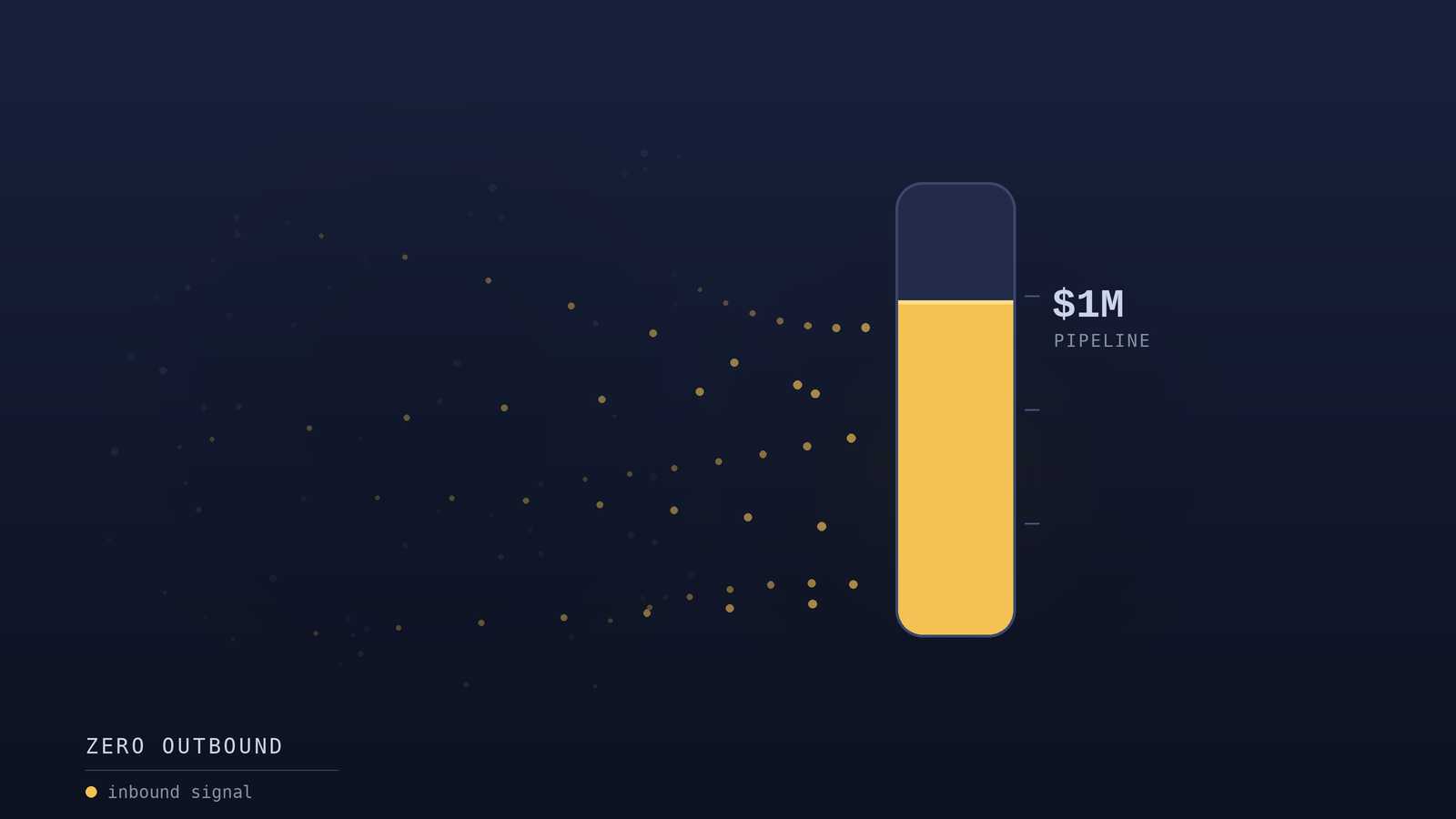
How We Built a $1M Pipeline With Zero Outbound
Featured Blog

TL;DR: We paused 100% of outbound sales activity for 90 days and bet the quarter on inbound and community-led growth. The result: $1.1M in pipeline (versus $820K the prior outbound quarter), a 26% close rate (versus 17%), sales cycles 31 days instead of 47, and CAC down 38%. The engine had three layers one deep content channel, a problem-centric community, and content that invited conversation. Here's exactly how we built it, the full numbers, and what we'd do differently.
Can you build pipeline without outbound?
Yes but not quickly, and not by accident. In our 90-day experiment, inbound and community-led motion generated more pipeline than the prior outbound quarter, at a lower cost per acquisition and with measurably better retention. The catch is that inbound compounds slowly and requires real investment in content depth and community trust before it produces pipeline. It is not a faster replacement for outbound; it's a different engine with a different payback curve. The rest of this post breaks down precisely what we built and the results it produced.
The Uncomfortable Conversation We Had to Have
For the first three years of our outbound program, we told ourselves the story that most sales teams tell themselves: the results would improve if we just optimized harder. Better sequences. More personalization. Stronger subject lines. Higher daily activity volume. We had an answer for every underperforming metric, and the answer was always more of the same thing we were already doing, executed better.
Then we looked at the data honestly for the first time.
Reply rates had declined for six consecutive quarters. Cost per opportunity had nearly doubled. The quality of the opportunities we were generating was measurably lower than it had been, as evidenced by win rates that were dropping even as activity volume increased. Meanwhile, the small number of deals that came in through inbound channels an unexpected blog post ranking, a mention in an industry newsletter, a LinkedIn post by our founder that got traction were converting at close rates 50% higher than outbound, with sales cycles 30% shorter, and at CAC that was significantly lower.
The numbers were telling us something we didn't want to hear. So we decided to actually hear it. We turned off all outbound activity for 90 days and bet the quarter entirely on inbound and community-led growth.
This is the story of what happened, what worked, what didn't, and what we'd do differently.
Why We Chose 90 Days
The duration wasn't arbitrary. We needed long enough for inbound channels to generate enough data to draw conclusions organic content takes time to build momentum, community takes time to develop trust, and brand takes time to compound. At the same time, we couldn't go too long without meaningful pipeline results before the business was in jeopardy.
90 days was the minimum viable experiment length. We committed to it completely, which meant no "just in case" cold calls alongside the inbound experiment, no safety net sequences running in the background. The results needed to be clean to be useful.
This level of commitment is harder than it sounds, and it's the part most teams get wrong when they "try inbound." They run a half-hearted content effort alongside their existing outbound motion, can't attribute results cleanly to either, and conclude that inbound doesn't work. The only way to know what inbound can actually produce is to give it a window where it's the only thing producing. That's uncomfortable, and it's exactly why the experiment was worth running.
What We Built: The Three-Layer Approach
Layer 1: One Channel, Done Deeply
The most predictable failure mode in inbound GTM is spreading effort across too many channels simultaneously. Teams try to run a blog, a podcast, a YouTube channel, a LinkedIn presence, a newsletter, and a Twitter account at the same time. The result is mediocre execution across all of them, which builds no meaningful audience on any of them.
We made a deliberate choice to go deep on one channel: LinkedIn. Specifically, building our founder's personal brand as a genuine practitioner and thought leader for revenue operators. Not the company LinkedIn page. Not a branded content account. The founder's personal account, posting five times per week with content that was genuinely useful, genuinely opinionated, and genuinely written from the perspective of someone who had experienced the problems they were writing about.
The content topics were all chosen by a single filter: what does our ICP deal with every day that they'd appreciate an honest perspective on? Bad contact data. Misaligned ICPs. The gap between what leadership thinks the pipeline looks like and what it actually looks like. Why most outbound benchmarks are misleading. How to identify whether a deal is actually progressing or just looking like it is. Every post was written for a specific person in a specific situation, not for the broadest possible audience.
What we didn't post: product announcements, company news, feature releases, customer logos, or anything that primarily served our marketing interests rather than the reader's actual needs. The commitment to genuine value over promotional content was the most important editorial decision we made.
The reason a single channel done deeply outperforms many channels done shallowly comes down to how audiences form. An audience isn't built by reach; it's built by repetition and consistency in a place where the same people return. Posting five times a week on one platform meant the same readers saw our founder's thinking again and again, and repeated exposure to genuinely useful ideas is what converts a stranger into someone who trusts you. Spreading that same volume of effort across six platforms would have meant nobody saw enough of it to develop that trust.
Layer 2: A Community Built Around the Problem, Not the Product
Three weeks into the experiment, we launched a Slack community for revenue operators. The framing was deliberate: this was a community for practitioners dealing with GTM challenges, not a community for customers of our product or prospective buyers of our solution.
That distinction matters more than it might seem. A product-centric community creates a dynamic where every interaction is colored by the commercial relationship between host and members. Members are conscious of the vendor context and participate accordingly more cautiously, less candidly, more performatively. A problem-centric community creates a peer dynamic where the host is a participant rather than a vendor, and where the commercial context recedes into the background.
We seeded it by personally reaching out to 50 practitioners in our network people who were already engaging with the LinkedIn content and had demonstrated genuine opinions about the problems we were discussing. The first month was purely facilitation: asking good questions, sharing useful resources, connecting members with each other, answering questions generously without steering conversations toward our product.
By day 45, we had 300 members. By day 90, we had over 400, and the community had developed enough momentum to sustain conversations without active facilitation on our end. The quality of the conversations candid discussions about real GTM challenges by people who were dealing with them actively was something that our content alone couldn't have created.
The commercial benefit emerged organically. When members started asking "what tool do you use for X?" in the context of problems we solve, our name came up. Not from us from other members who had either become customers or who were familiar with our product through our content. That kind of third-party mention in a trusted peer context is worth more than any outbound sequence or paid ad.
This is the mechanism that makes community such a durable growth asset: the recommendation comes from a peer, not the vendor, which means it carries the credibility that vendor claims never can. A prospect will discount anything you say about your own product by some skepticism factor. They apply no such discount to a peer in a community they trust, answering a question with no commercial motive. Building the environment where those peer recommendations happen is slow, but once it exists it produces a kind of demand that's almost impossible for competitors to disrupt.
Layer 3: Content That Invited Conversation
Every piece of content we published every LinkedIn post, every community contribution, every article ended with a low-friction invitation to continue the conversation. Not "book a demo here." Not "click to learn more about our product." Just: "If you're dealing with this, DM me. Happy to think it through."
This framing generated inbound outreach from people who had been consuming our content for weeks before they ever sent a message. They'd already formed a view of how we thought about the problems they faced. The first conversation wasn't cold it was a continuation of an ongoing relationship that had been building through content.
The quality of those conversations was dramatically different from cold outbound conversations. There was no warm-up required. No "let me tell you why we're relevant to you" stage. The prospect already knew why we were relevant. The conversation started at the stage where a good outbound conversation might arrive after 20 minutes of discovery. That compression of trust-building into the pre-conversation phase was the most powerful output of the inbound strategy.
It's worth naming why this works at a structural level. In outbound, trust-building happens inside the sales conversation, which means the rep spends the first portion of every call establishing credibility from zero. In content-led inbound, trust-building happens before the conversation, distributed across weeks of the prospect consuming your thinking on their own time. By the time they reach out, the credibility work is already done. You've effectively moved the most expensive part of the sales process out of the sales process and into content that scales infinitely. That's the entire economic argument for inbound in a single idea.
The 90-Day Results
Here's the data from the experiment period compared to the prior quarter's outbound-led results:
Pipeline created: $1.1 million versus $820,000 in the prior outbound quarter. Demos booked: 23. Deals closed: 6. Average sales cycle on inbound deals: 31 days versus 47 days for prior outbound deals. Close rate: 26% versus 17%. Customer Acquisition Cost: down 38%.
The results weren't uniformly better on every dimension. Pipeline volume was up, but it was more concentrated in a smaller number of high-quality conversations rather than spread across a larger funnel of lower-quality outbound leads. That meant our pipeline coverage ratio was tighter less buffer against deals that fell out. For a team that had been used to a large quantity of opportunities to make up for low conversion rates, the shift to fewer, better opportunities required a different approach to pipeline management.
The most meaningful finding beyond the immediate metrics: customers acquired through inbound channels had measurably better retention at the 6-month mark than our historical outbound customer base. We believe this is because inbound customers came to us already understanding our perspective on the problem, with expectations calibrated by content we'd published rather than by promises made in a sales process. The fit was better because the qualification happened through content consumption before any conversation occurred.
This retention difference is the most underrated part of the entire experiment. Most GTM analysis stops at acquisition cost and close rate, but retention is where the compounding actually happens. A customer who stays and expands is worth multiples of one who churns at month nine, and the data suggested that the way a customer enters your funnel predicts how long they stay. Inbound customers self-selected on fit before they ever spoke to us, and that fit showed up months later as retention. Outbound, by contrast, can persuade a marginally-fit buyer to purchase and marginally-fit buyers are exactly the ones who churn.
What We Turned Back On And What We Changed
After 90 days, we didn't keep outbound off. We turned it back on but fundamentally different from how it had been running before the experiment.
The ICP targeting was tighter, informed by patterns we'd observed in who engaged with our inbound content and who converted most effectively from community relationships to customers. The messaging was sharper, built from the language our ICP had used in community conversations and LinkedIn comments to describe their own problems. The sequences were shorter, because we'd learned that the buyers who convert quickly respond to directness, and the ones who take longer aren't going to be accelerated by more touches.
The outbound, running against a better-defined ICP with sharper messaging, converted at significantly higher rates than it had before the experiment. In retrospect, the 90-day pause wasn't just an inbound experiment it was also an outbound improvement program, because it forced us to build the inbound infrastructure and audience that makes outbound land better when it does run.
The lesson isn't that you should turn off your outbound. It's that inbound and outbound are complements, not competitors. Inbound builds the awareness and trust that makes outbound land in a different way. Outbound reaches buyers who haven't discovered you through inbound yet. The companies that build both engines well are the ones that compound fastest over time.
How to Run This Experiment Yourself
If you want to test whether inbound can carry meaningful pipeline for your business, a few principles from our experience are worth applying. Commit to a clean window running inbound alongside full-volume outbound makes the results impossible to attribute. Pick one channel where your ICP actually spends time and go uncomfortably deep rather than spreading across many. Build community around the problem you solve, not the product you sell, so participation stays candid. End every piece of content with a low-friction invitation rather than a demo CTA. And measure retention, not just acquisition, because the durability of inbound-sourced customers is where much of the value lives. None of this produces results in week one. All of it compounds if you sustain it.
Frequently Asked Questions
Can you really build a B2B pipeline without cold outreach?
Yes. In our 90-day experiment, content and community-led inbound produced $1.1M in pipeline with no outbound activity at all more than the prior outbound quarter's $820K. However, inbound compounds slowly and requires sustained investment in content and community before it produces pipeline, so it works best as a long-term engine rather than a quick fix.
Is inbound or outbound better for B2B SaaS?
Neither is universally better they're complements. Inbound produced higher close rates (26% vs 17%), shorter sales cycles (31 vs 47 days), lower CAC (down 38%), and better retention in our experiment. But outbound reaches buyers who haven't discovered you yet. The strongest GTM motions run both, with inbound building the trust that makes outbound land better.
How long does it take for inbound marketing to generate pipeline?
In our case, meaningful pipeline materialized within a 90-day window, but that was built on an existing (if small) content and audience base. For a true cold start, expect longer. Content needs time to build momentum, and community needs time to develop trust before either reliably produces pipeline.
Why do inbound-sourced customers retain better?
Inbound customers self-qualify on fit before they ever talk to sales. They consume your content, understand your perspective on the problem, and reach out because it resonates. That means expectations are calibrated before the sale, the fit is better, and better-fit customers churn less. In our data, inbound customers retained measurably better at six months than outbound-sourced ones.
What's the biggest mistake teams make when trying inbound?
Spreading effort across too many channels at once a blog, a podcast, YouTube, a newsletter, multiple social platforms which produces mediocre output everywhere and an audience nowhere. The second biggest mistake is running a half-hearted inbound effort alongside full outbound, which makes results impossible to attribute. Pick one channel, go deep, and commit to a clean measurement window.
TRY BACKCHANNELS FREE
Your next customers are already in the database.
Backchannels gives you 225,000 verified software decision-makers. Filter to your exact ICP, preview matches for free, and push them straight into Salesforce or HubSpot. Pay per contact. No subscription, no contract.
Browse contacts freeNo credit card. Preview before you spend a credit.
No items found.
Final Thoughts
We turned off outbound for 90 days and built $1.1M in pipeline. The lesson isn't that outbound is dead. It's that inbound and outbound compound together when both are built well.
Published
August 14, 2026
Writer
Joe Backchannels
Share


Most Wanted

12 min read

12 min read

June 2026