.png)
The Backchannel
How to Build a Demand Gen Engine With a Team of Two
Featured Blog


TL;DR: Demand generation is a focus problem, not a budget problem. A two-person team can outperform departments 5x its size by following four disciplines: the 3-Channel Rule (pick exactly three complementary channels usually content SEO, LinkedIn, and email nurture), a one-to-many content engine (one substantial piece per week fuels everything else), a 50/50 split between creation and distribution, and a deliberately minimal operations stack. Done well, this produces 40–50 quality content pieces a year and enough inbound to support 3–5 AEs. Here's the system.
Can a small team do demand generation effectively?
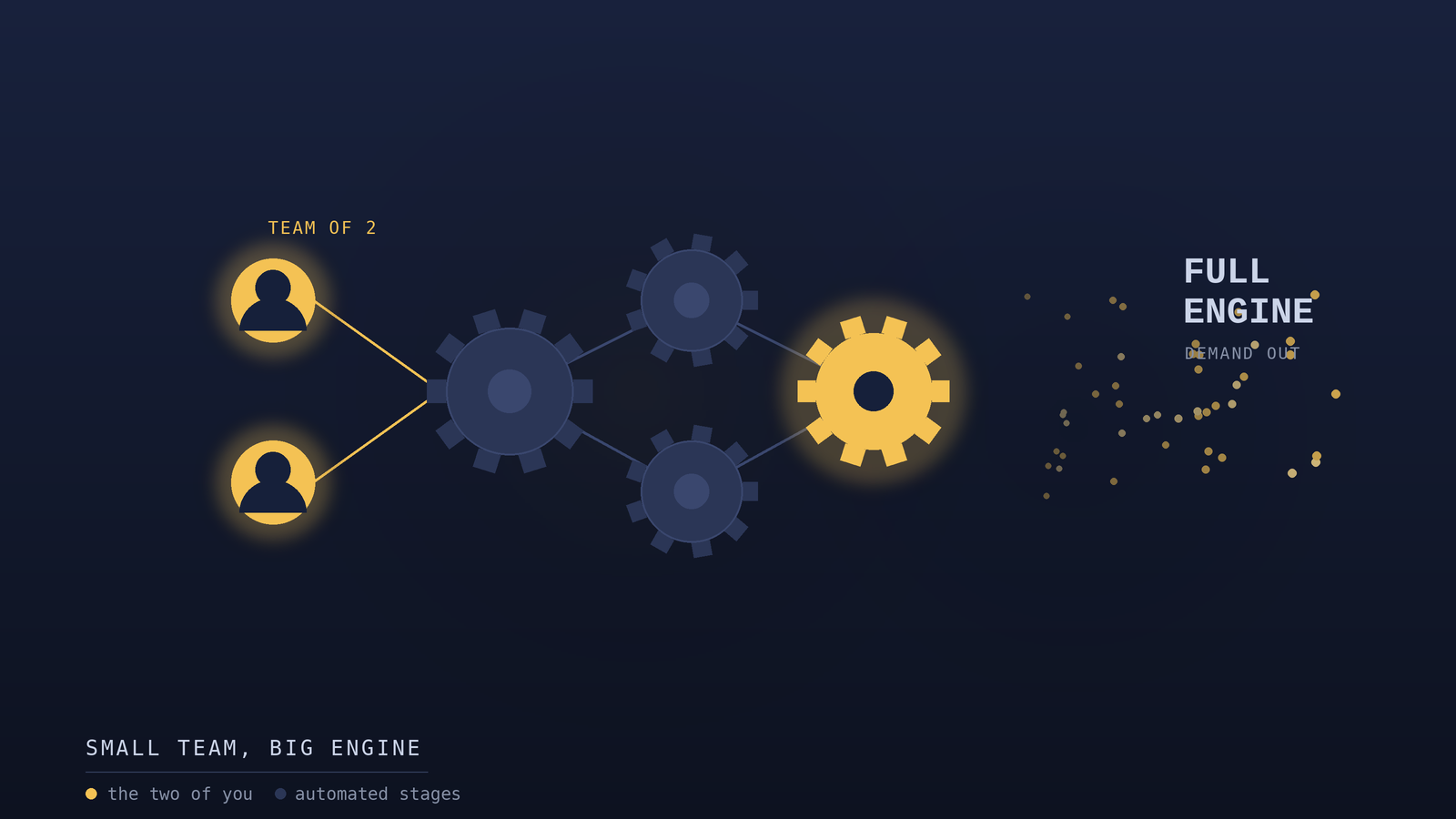
Yes some of the most efficient demand gen programs run on just two people, one focused on content and messaging and one on distribution and operations. They outperform larger teams not because of a hidden advantage but because constraint forces better decisions: concentrating on three complementary channels instead of spreading thin, repurposing one substantial piece of content into many formats, and investing as much in distribution as in creation. The full operating system follows below.
The Resources Myth
There's a widely held belief in B2B marketing that demand generation is fundamentally a resource problem. The teams generating the most pipeline have the biggest budgets, the most headcount, and the most sophisticated martech stacks. If you're a two-person team without enterprise-scale resources, you're playing a different game and expecting similar results isn't realistic.
This belief is wrong. Some of the most efficient demand gen programs we've observed run on teams of two: one person focused on content and messaging, one person focused on distribution and operations. Between them, they're generating more qualified pipeline than marketing departments with five times their headcount not because they have a secret advantage, but because they've made better decisions about where to focus.
This post is about those decisions: what a two-person team should focus on, what they should ignore, and the specific operational system that makes the approach work.
The reason constraint can outperform abundance is counterintuitive but consistent: a large team with a large budget can afford to be everywhere and try everything, which means it's never forced to decide what actually matters. A two-person team has no such luxury. Every hour spent on a low-yield channel is an hour visibly stolen from a high-yield one, so the constraint forces a ruthless prioritization that larger teams rarely impose on themselves. The focus isn't a workaround for having fewer resources it's the actual source of the advantage.
The 3-Channel Rule
The most common failure mode for small demand gen teams is channel proliferation. The pressure to be present everywhere LinkedIn, content SEO, a newsletter, a podcast, YouTube, Twitter, community forums is understandable. Your buyers are in multiple places and you don't want to miss any of them. But a two-person team that tries to maintain a meaningful presence across six channels will be mediocre on all of them, which is effectively invisible. Mediocre distribution on many channels beats zero distribution on no channels, but it doesn't beat excellent distribution on a few channels, which is what you're actually choosing between.
The 3-Channel Rule is a constraint: pick exactly three channels, commit to building real presence on all three, and decline every invitation to add a fourth until you've genuinely maxed out what the first three can produce. Three channels is the right number because it allows for complementary channels that reinforce each other without spreading a small team too thin to execute well on any of them.
For most B2B SaaS companies with a small demand gen team, the right three channels are content SEO, LinkedIn, and email nurture. These three work together in a way that compounds. Content SEO builds a base of inbound traffic from people who are actively searching for solutions in your category. LinkedIn builds awareness with the audience you want to reach, including people who aren't searching yet but fit your ICP. Email nurture maintains a relationship with the contacts from both channels until they're ready to engage in a sales conversation. Together, they create a flywheel: SEO drives new subscribers to your email list, LinkedIn amplifies your content and drives direct inbound, and email nurture converts both into pipeline over time.
The specific reason these three channels work as a set is that they cover the three distinct states a future buyer can be in. Some people are actively searching for a solution right now SEO catches them. Some people have the problem but aren't searching yet LinkedIn builds awareness with them so you're top of mind when they do start looking. And some people are interested but not ready to buy email nurture keeps the relationship warm until their timing changes. A channel mix that covers all three states captures demand across the full readiness spectrum. Adding a fourth channel rarely covers a state the first three missed; it just splits your effort across redundant coverage.
The Content Engine: One Piece, Many Formats
The fundamental challenge for a two-person demand gen team is creating enough content to maintain a consistent presence across three channels without burning out or producing mediocre work. The solution is the one-to-many content model: one substantial, original piece of content per week becomes the raw material for everything else.
The substantial piece a long-form blog post, a data report, an in-depth guide, or a detailed case study is where the real intellectual work happens. It requires research, original thinking, and careful writing. It's the hardest thing you'll create each week. Everything else is a derivative: simpler to produce, faster to publish, built from the same source material rather than requiring original research and analysis.
From one piece of long-form content, a two-person team can produce: three to five LinkedIn posts, each highlighting a different angle, insight, or specific finding from the original piece; one or two email newsletter segments; a short-form content clip or visual; and a social content thread. The specifics vary by channel and format preferences, but the principle is consistent: create the intellectual foundation once and distribute it in as many formats as the channels you're active on require.
This approach does something important beyond resolving the production capacity problem: it creates message consistency. When the same core idea is expressed across multiple channels in multiple formats over multiple days, the audience's likelihood of encountering and retaining it increases significantly. Repetition with variation is how ideas stick in professional contexts, and the one-to-many model creates that repetition without requiring new thinking for each format.
There's also a quality argument for the one-to-many model that often gets overlooked. Because all the intellectual effort concentrates into a single substantial piece each week, that piece can be genuinely excellent well-researched, original, carefully argued rather than one of five mediocre things produced under time pressure. A team trying to create original content natively for every channel ends up spreading its thinking thin across all of them. A team that does its best thinking once and adapts it everywhere gets both depth and breadth from the same effort. The constraint of two people, again, forces the better approach.
The Distribution Playbook
Content without distribution is a tree falling in an empty forest. Most small demand gen teams allocate 80% of their effort to content creation and 20% to distribution. The right ratio, especially early in building a program, is closer to 50-50. Creating excellent content and failing to get it in front of the right people is a waste. Getting mediocre content in front of the right people is also a waste. The goal is excellent content AND distribution, which requires deliberate investment in both.
The distribution person on a two-person team should spend meaningful time building relationships with the communities, newsletters, and content amplifiers where the ICP spends time. Not one-time submissions or promotional requests genuine, consistent participation that builds the kind of credibility that makes future sharing feel like a natural contribution rather than a promotional ask. This means regularly participating in relevant Slack communities, engaging authentically with newsletters in the space, and building relationships with the practitioners who have audiences that overlap with your ICP.
Over time, these relationships create distribution leverage that compounds. When you publish something genuinely useful, you have an audience of practitioners who know your work and are inclined to share it. That organic amplification is worth far more per reader than any paid distribution channel, because it carries the implicit endorsement of the person who shared it.
The reason the 50/50 split feels wrong but is right comes down to a bias toward visible output. Creating content feels productive at the end of the day you have an artifact to show for your time. Distribution feels less tangible: an hour spent participating in a community or building a relationship with a newsletter editor produces nothing you can point to immediately. So teams over-invest in the part that feels like progress and under-invest in the part that actually determines whether anyone sees the work. But content that no one reads has exactly zero impact regardless of its quality, which means under-distributing is the single most expensive mistake a small content team can make. The discipline is to treat getting the content seen as equally important as making it good.
The Operations Layer
A two-person team can produce excellent content and distribute it well, but without clean operational infrastructure the program will have gaps, inconsistencies, and missed opportunities that subtract from the results.
The minimum viable operations stack: a content calendar that maps topics to publication dates three to four weeks out, so the team is never deciding what to create the day it's due; an email nurture sequence with at least five to seven touches that runs automatically for every new subscriber, so that the list being built through content is being actively cultivated even during weeks when the team is focused on production; a CRM or marketing automation tool with basic lead scoring that flags high-intent behavior for immediate sales follow-up; and a simple weekly report tracking three to five metrics new subscribers, organic traffic, MQL quality, and pipeline influenced by marketing content.
Keeping the operations layer simple is as important as having it. A two-person team that builds an elaborate martech stack will spend more time maintaining the stack than creating content. The goal is the minimum infrastructure required to run the program consistently, not the most sophisticated infrastructure available.
There's a specific trap worth naming here, because small teams fall into it constantly: mistaking tooling for progress. It's tempting to believe that the next platform, the next integration, the next automation will unlock growth and martech vendors are happy to encourage that belief. But every tool added to the stack carries an ongoing maintenance cost, a learning curve, and a configuration burden that pulls time away from the two things that actually generate pipeline: creating good content and getting it distributed. For a two-person team, the martech stack should be boring and stable. The leverage is in the work, not the tools that surround it.
What This Can Actually Produce
With the right channel focus, content engine, distribution relationships, and operational discipline, a two-person demand gen team can build a content library of 40 to 50 high-quality pieces per year, grow an email newsletter to 2,000 or more engaged subscribers, establish a meaningful LinkedIn presence with consistent reach into the target ICP, and generate enough qualified inbound to support a sales team of three to five account executives. We've seen this done, repeatedly, by teams with no advantages beyond good judgment about where to focus their limited time.
The constraint is always the same: ruthless prioritization. Not adding a fourth channel when the third is still building. Not chasing viral moments at the expense of consistent production. Not optimizing for vanity metrics when pipeline is the actual output. A two-person team that internalizes these constraints and executes patiently will consistently outperform larger teams that haven't. That's not a consolation it's a genuine competitive advantage if you're willing to earn it.
The compounding nature of this system is what makes the patience worth it. A content library doesn't just sit there each piece keeps attracting search traffic month after month, so year two starts from a much higher base than year one. An email list grows cumulatively, so the audience you can reach with each new piece gets larger over time. The LinkedIn presence builds recognition, so each post reaches further than the last. None of this happens in the first month, which is exactly why so many teams abandon the approach before it pays off. The two-person teams that win are the ones that execute the same disciplined system consistently long enough for the compounding to take hold.
Frequently Asked Questions
How many channels should a small demand gen team focus on?
Exactly three. A two-person team that spreads across six channels will be mediocre everywhere, which is effectively invisible. Three complementary channels typically content SEO, LinkedIn, and email nurture reinforce each other without overextending the team. Don't add a fourth until you've genuinely maxed out what the first three can produce.
What is the one-to-many content model?
It's a content system where one substantial, original piece per week a long-form post, data report, or in-depth guide becomes the raw material for everything else: three to five LinkedIn posts, one or two newsletter segments, and short-form clips or threads. It solves the production-capacity problem for small teams while creating message consistency through repetition with variation.
How should a small team split time between creating and distributing content?
Roughly 50/50, especially early on. Most small teams default to 80% creation and 20% distribution because creating feels more productive, but content no one sees has zero impact regardless of quality. Investing equally in distribution community participation, newsletter relationships, practitioner amplification is what determines whether the content actually generates pipeline.
What's the minimum martech stack for a two-person demand gen team?
Keep it deliberately small: a content calendar planned three to four weeks out, an automated 5–7 touch email nurture sequence, a CRM with basic lead scoring that flags high-intent behavior for sales, and a simple weekly report tracking 3–5 metrics. An elaborate stack costs more time to maintain than it returns; the leverage is in the work, not the tools.
Can two people really generate enough pipeline to support a sales team?
Yes. With focused channel selection, a one-to-many content engine, strong distribution, and lean operations, a two-person team can produce 40–50 quality content pieces a year, grow a newsletter past 2,000 engaged subscribers, and generate enough qualified inbound to support 3–5 account executives. The results compound over time, so consistency matters more than headcount.
TRY BACKCHANNELS FREE
Your next customers are already in the database.
Backchannels gives you 225,000 verified software decision-makers. Filter to your exact ICP, preview matches for free, and push them straight into Salesforce or HubSpot. Pay per contact. No subscription, no contract.
Browse contacts freeNo credit card. Preview before you spend a credit.
No items found.
Final Thoughts
A two-person demand gen team can build significant pipeline if it makes ruthlessly good decisions about focus. Three channels. One piece of content. Distributed everywhere it belongs. That's the system.
Published
August 14, 2026
Writer
Joe Backchannels
Share


Most Wanted


12 min read

12 min read

June 2026