.png)
The Backchannel
The Follow-Up Sequence That Resurrects Dead Deals
Featured Blog

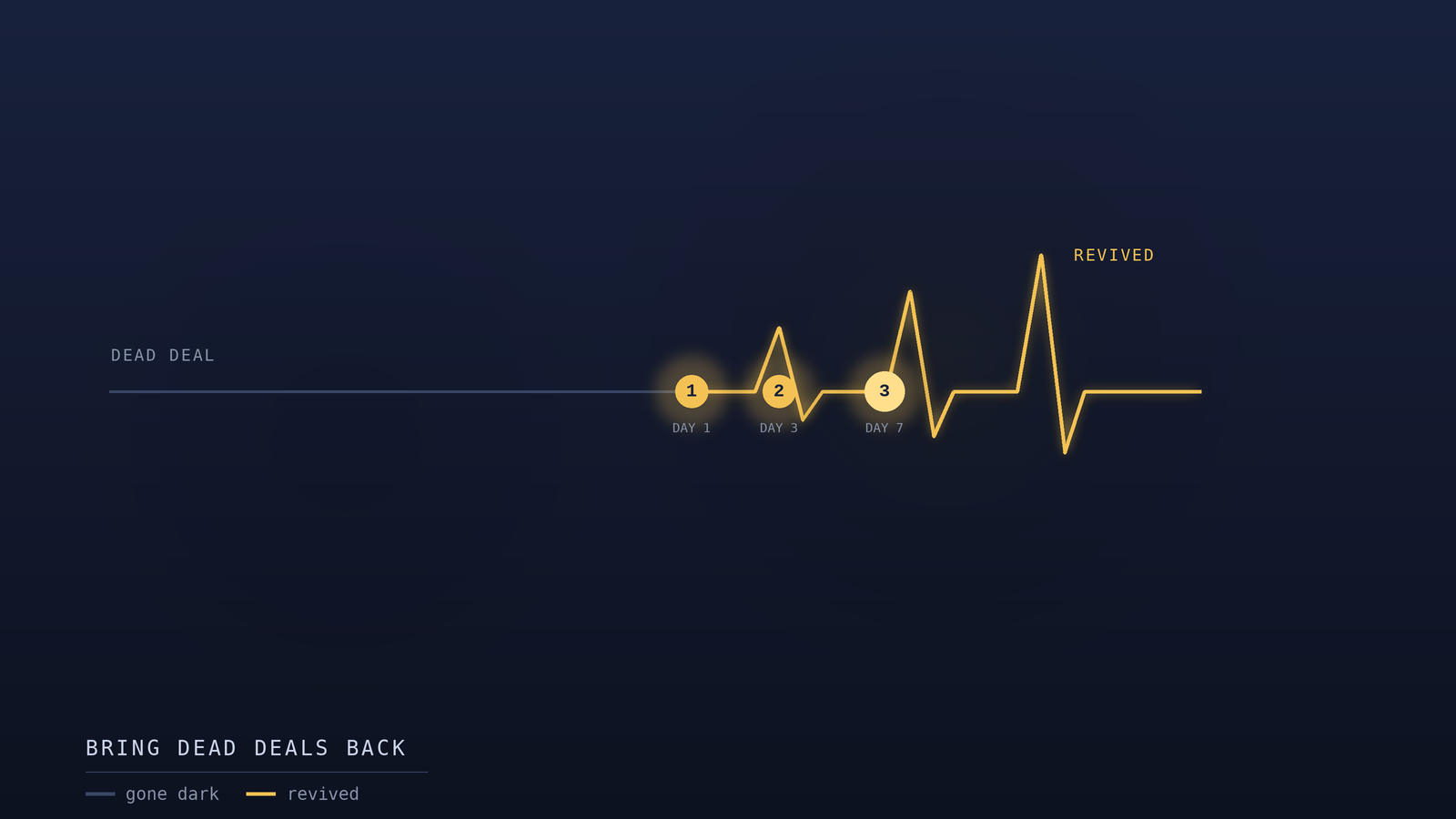
TL;DR: Most "dead" deals aren't dead they're paused. Research shows 20–30% of closed-lost deals eventually buy in the category, just on a different timeline. The question is whether you're the vendor they remember when timing shifts. This six-touch sequence keeps dormant deals warm over six months using value-first, low-pressure contact: a breakup email at day 30, a relevant insight at day 60, trigger-event outreach whenever it fires, a new angle at day 90, a peer reference at day 120, and a genuinely human check-in at day 180.
How do you re-engage a dead sales deal?
You re-engage a dormant deal by maintaining a low-pressure, value-first presence over months rather than sending repeated check-ins. The most effective approach is a planned sequence of spaced touches starting with a breakup email that removes the pressure to respond, followed by genuinely useful insights, trigger-based outreach timed to events at the account, a new reason to talk, and a peer reference. The goal is to be the first vendor the buyer thinks of when their timing finally shifts. The full six-touch, six-month sequence follows below.
The Graveyard in Your CRM
Every sales team has a graveyard. It lives in the closed-lost section of the CRM, full of deals that were marked lost not because the prospect said a definitive no, but because they stopped responding and the rep eventually ran out of follow-up options. The deals that drifted. The champions who went dark. The evaluations that got deprioritized when something more urgent came along internally.
These deals feel dead. They're often not. Research on B2B buying patterns consistently shows that 20 to 30 percent of closed-lost deals eventually purchase a solution in the category they just do it on a different timeline than the original sales cycle allowed for. The question is whether you'll be the vendor they call when the timing finally shifts, or whether you'll have faded from their memory in favor of whoever stayed in touch more thoughtfully.
This post is about the six-touch sequence we use to keep dormant deals warm over a six-month period not through aggressive check-ins, but through the kind of low-pressure, genuinely useful contact that keeps a relationship alive without demanding anything in return.
Why Most Deals Go Dark
Understanding why deals go dark is essential to knowing how to bring them back.
In our experience analyzing stalled and lost deals, the most common reasons are: a budget freeze or reallocation that happened after the evaluation started; a champion who lost organizational support or left the company; a higher-priority project that consumed the bandwidth the deal needed; internal skepticism from a stakeholder who was never fully engaged; and timing mismatch where the buying process started too early relative to when the company was actually ready to implement.
What's notable about this list is that none of these reasons are permanent. Budgets unfreeze. Champions get replaced by new champions. Priority projects end. Skeptics get overruled when the urgency increases. And timing mismatch resolves itself when the company reaches the readiness that was originally missing.
A deal that went dark for any of these reasons is not a dead deal. It's a paused deal. The question is what happens in the pause specifically, whether you use the pause to maintain a presence that makes re-engagement natural when the circumstances change.
This reframe from "dead" to "paused" matters because it changes how you treat the deal. A rep who believes a deal is dead stops investing in the relationship and lets it go cold. A rep who understands the deal is paused, waiting on a circumstance that will eventually change, treats the intervening months as an opportunity to stay present so they're positioned to win when the pause ends. The mindset determines the behavior, and the behavior determines whether you're remembered.
Touch 1: The Breakup Email (Day 30 of Silence)
The counterintuitive first move when a deal has gone silent for 30 days is to send a breakup email. Not aggressive, not passive-aggressive a genuine, gracious acknowledgment that the timing may not be right, combined with an explicit close of the outstanding thread.
The message: "[Name] I've reached out a few times without hearing back, so I'll assume the timing just isn't right. I'll close this out on my end and won't keep filling your inbox. If anything changes new quarter, new project, new priority please don't hesitate to reach out."
The breakup email typically generates a 20 to 30 percent response rate from people who had not responded to anything in the previous 30 days. The mechanism: most prospects who've gone dark aren't disinterested they're busy, or they're managing an internal situation they can't discuss openly, or they feel guilty about the silence. The breakup email releases the social pressure by removing the expectation of a response, which paradoxically makes responding easier. It also creates a mild version of the door-closing psychology people don't want options to disappear, even options they haven't acted on.
The reason the breakup email belongs at the start of a re-engagement sequence rather than the end is subtle but important. It serves as a clean reset. If the prospect responds, you've reopened an active conversation and may not need the rest of the sequence at all. If they don't, you've signaled that you respect their attention and won't hound them which is precisely what earns you permission to make the lighter, value-first touches that follow without being perceived as a pest. The breakup email isn't the last resort; it's the foundation that makes everything after it welcome rather than annoying.
Touch 2: The Relevant Insight (Day 60)
If the breakup email didn't generate a response, wait 30 days and then send something genuinely useful with no reference to the previous thread. A benchmark report that's directly relevant to a challenge they mentioned. A case study from their specific industry. A short article about a trend that's likely affecting their business.
The framing should be brief and unconditional: "Saw this and thought of what you mentioned about [specific challenge]. Thought it might be useful regardless of where things stand." No ask. No pitch. No reference to the deal. Just something useful from someone who's been thinking about their situation.
This touch establishes a pattern of contact that's value-first rather than sales-first which is the pattern that keeps a relationship alive during a long pause without creating resentment at the persistence.
The phrase "regardless of where things stand" is doing deliberate work here. It explicitly decouples the useful thing you're sharing from any expectation of deal progress, which is what makes it land as a genuine gesture rather than a thinly veiled attempt to restart the sales process. Prospects are highly attuned to the difference between contact that serves them and contact that serves the salesperson's pipeline. This touch has to fall unambiguously on the right side of that line, or it undoes the goodwill the breakup email created.
Touch 3: The Trigger Event (When It Happens)
Between your scheduled touches, watch for trigger events at the account: a new executive hire, a funding announcement, a relevant job posting, a LinkedIn post from your champion, a news mention. When a trigger fires, reach out immediately regardless of where you are in the sequence.
The message should reference the specific trigger: "Saw the funding announcement congrats to the team. Curious whether the growth plans change anything around [the challenge you'd been discussing]." Brief, specific, and naturally timed. Trigger-based outreach converts at significantly higher rates than scheduled outreach because it feels like paying attention rather than running a sequence.
The power of trigger-based touches in a re-engagement context is that they often coincide with exactly the circumstance change that ends the pause. A budget freeze that killed the original deal frequently thaws after a funding round. A priority shift often follows a new executive hire. A stalled evaluation can restart when the skeptical stakeholder who blocked it leaves the company. Triggers aren't just convenient reasons to reach out they're frequently the very events that make the prospect ready to buy again. This is why a trigger overrides the scheduled cadence: when the circumstance that paused the deal reverses, you want to be there that week, not waiting for your next scheduled touch.
Touch 4: The New Angle (Day 90)
At 90 days, find something specifically new to bring to the conversation: a product capability that addresses a concern they'd raised, new pricing that makes the math work differently, a new customer in their specific industry whose results would be relevant to them. The goal is to give them a genuine reason to re-engage rather than simply checking in again.
"Since we last spoke, we've added [specific capability] that I think addresses the [specific concern] your team raised. Wanted to reach out in case it changes the picture." Short. Specific. A new reason to talk, not a recycled ask.
This touch works because it gives the prospect a face-saving reason to reconsider. People are reluctant to reverse a decision without a justification re-engaging on a deal they'd let go can feel like an admission that letting it go was a mistake. A genuine new development supplies the justification. "Things have changed since we last spoke" lets them re-enter the conversation as a rational response to new information rather than a reversal of their earlier judgment. That psychological permission is often what's needed to restart a stalled deal.
Touch 5: The Peer Reference (Day 120)
Social proof from a peer is more persuasive than anything you can say about your own product. At the 120-day mark, if you have a customer in the same industry, at a similar stage, who's willing to take a reference call, offer the connection directly: "We've been working with [Company] over the past few months on exactly the challenge you'd been dealing with. They've had some results I think you'd find it worth hearing directly. Would a 20-minute call between you two be useful?"
A peer reference reframes the conversation from vendor-prospect to peer-peer. That reframe often unlocks engagement from prospects who weren't ready to re-engage with a sales process but are very willing to learn from a peer who's solved a problem they're still dealing with.
The reason this touch is placed deep in the sequence rather than early is that it asks slightly more of the prospect a 20-minute call and that ask only lands well once you've spent several months demonstrating that you're a low-pressure, genuinely useful presence. Lead with a reference-call offer in the first week of silence and it reads as a sales push. Offer it at day 120, after a breakup email and two value-first touches, and it reads as a helpful connection between peers. The sequencing isn't arbitrary; the size of the ask escalates only as the relationship re-warms.
Touch 6: The Long-Game Check-In (Day 180)
The final touch in the sequence, six months after the deal went dark, is the simplest: a brief, genuinely human message with no ask. "[Name] it's been about six months since we last connected. Still think about your team's situation with [specific challenge] from time to time. Hope the quarter's been good. If the timing ever shifts, I'm here."
No links. No attachments. No pitch. A real person reaching out to say they haven't forgotten. This touch, more than any other in the sequence, generates responses from prospects who've finally reached the inflection point where the problem has become urgent enough to act on. When the timing shifts, you want to be the first name they think of. Six months of thoughtful, low-pressure contact is how you stay top of mind without becoming the rep who never lets go.
The quiet power of this final touch is that it's the one most likely to coincide with genuine readiness. Six months is long enough for budgets to reset, priorities to shift, and the original pain to resurface with new urgency. A prospect who receives a warm, no-strings message at exactly the moment their problem has become acute again experiences it as almost serendipitous and you become the obvious vendor to call because you're the one who stayed present and respectful throughout the pause. That's the entire payoff of the sequence: not pressure, but presence, timed to outlast the circumstances that paused the deal.
Why This Sequence Works as a System
Each touch in this sequence is useful on its own, but the real power is in the system. The cadence is deliberately spaced so you're never crowding the prospect, and every touch is designed to deliver something a release of pressure, a useful insight, a timely acknowledgment, a new reason to talk, a peer connection, or a simple human reminder. Across six months, this accumulates into a specific reputation: you're the vendor who stayed in touch thoughtfully, never pushed, and was consistently useful. That reputation is what makes you the first call when the pause finally ends. Most reps either give up on dormant deals entirely or annoy them into a permanent no with repeated check-ins. This sequence threads the needle, and the deals it resurrects are deals your competitors have already written off.
Frequently Asked Questions
What percentage of lost deals eventually buy?
Research on B2B buying patterns consistently shows that 20 to 30 percent of closed-lost deals eventually purchase a solution in the category they just do it on a different timeline than the original sales cycle allowed. Most "dead" deals are actually paused, waiting on a circumstance (budget, priorities, personnel) that will eventually change. The vendor who stays thoughtfully in touch is the one positioned to win when it does.
Does the breakup email really get responses?
Yes. A breakup email sent after about 30 days of silence typically generates a 20 to 30 percent response rate from prospects who hadn't responded to anything previously. It works by removing the expectation of a response, which releases the prospect's guilt about going silent and paradoxically makes replying easier. It also triggers mild loss aversion people don't like options disappearing, even ones they haven't acted on.
How long should you keep following up on a stalled deal?
A six-month sequence of spaced, value-first touches is a strong framework long enough for the circumstances that paused the deal (budget freezes, priority shifts, personnel changes) to reverse. The key is that the touches deliver value and never apply pressure, so you stay top of mind without becoming the rep who won't let go. After six months of thoughtful contact, most genuinely dead deals have either revived or can be retired.
What's the difference between a paused deal and a dead deal?
A dead deal is one where the prospect gave a definitive, lasting "no." A paused deal is one that stalled because of a temporary circumstance a budget freeze, a competing priority, a champion's departure, or a timing mismatch none of which are permanent. Most closed-lost deals are paused, not dead, which is why a patient re-engagement sequence recovers a meaningful share of them.
When should you use trigger-based outreach in a nurture sequence?
Reach out immediately whenever a trigger event fires at the account a funding round, a new executive hire, a relevant job posting, or a notable LinkedIn post regardless of where you are in your scheduled cadence. Triggers often coincide with the exact circumstance change that ends the pause (funding thaws frozen budgets; new leaders reset priorities), so timely trigger outreach converts far better than scheduled touches.
TRY BACKCHANNELS FREE
Your next customers are already in the database.
Backchannels gives you 225,000 verified software decision-makers. Filter to your exact ICP, preview matches for free, and push them straight into Salesforce or HubSpot. Pay per contact. No subscription, no contract.
Browse contacts freeNo credit card. Preview before you spend a credit.
No items found.
Final Thoughts
Dead deals aren't always dead. 20-30% eventually close on a different timeline. The question is whether you'll be the one they call. A six-touch long-game sequence keeps you in the conversation without being the rep who never gives up.
Published
August 14, 2026
Writer
Joe Backchannels
Share


Most Wanted

12 min read

12 min read

June 2026