.png)
The Backchannel
Cold Email Benchmarks 2026: Open Rates, Reply Rates, and What's Changed
Featured Blog

Why Cold Email Benchmarks Are Usually Wrong
If you search for cold email benchmarks, you'll find a confident-sounding number for every metric: this is a good open rate, this is a good reply rate, this is what a healthy campaign looks like. The problem is that most of these numbers are either years out of date, drawn from a sample that doesn't resemble your situation, or presented without the context that would make them meaningful. A reply-rate benchmark that doesn't tell you the audience, the deal size, the personalization level, or the year it was measured is close to useless, because all of those factors move the number more than anything you could control in your own campaigns.
The deeper problem is that cold email has changed faster than the benchmarks have. The tactics that produced strong numbers a few years ago produce weak numbers now, because buyers have adapted, inboxes have gotten more crowded, and the filters that protect attention have gotten more sophisticated. A benchmark measured against the old environment describes a world that no longer exists. Using it to judge your current campaigns is like navigating with an outdated map the major landmarks are still there, but enough has shifted that you'll end up in the wrong place.
There's a structural reason published benchmarks lag reality in cold email specifically, more so than in most other areas of sales. Cold email is an adversarial channel: every improvement on the sender side provokes an adaptation on the buyer and provider side. When a tactic starts working, it gets adopted widely, which trains buyers to recognize and filter it, which kills its effectiveness and the benchmark measured during the tactic's effective period now describes a window that has already closed. This cat-and-mouse dynamic means cold email benchmarks decay faster than almost any other sales metric, and any benchmark more than a year or two old should be treated with real suspicion. The half-life of a cold email tactic is short, and so is the half-life of the benchmark that measured it.
This post is an attempt to give cold email benchmarks that are actually useful in 2026: the metrics that matter, the ranges that constitute healthy performance given current conditions, the context that determines where in those ranges you should expect to land, and most importantly what has changed about cold email and what those changes mean for how you should measure and run your campaigns. The numbers matter, but understanding the forces behind them matters more, because the forces are what let you reason about your own situation rather than just comparing against a number that may not apply to you.
The Metrics That Actually Matter
Before getting to benchmark ranges, it's worth being precise about which metrics to track, because cold email generates several numbers and they are not equally meaningful. Optimizing for the wrong metric is a common and costly mistake.
Open rate is the most commonly cited cold email metric and, increasingly, the least reliable. Open tracking works by embedding a tiny invisible image that registers when loaded, but privacy features now load these images automatically or block them entirely, which means open rates are systematically distorted sometimes inflated by automatic loading, sometimes undercounted by blocking. An open rate today is a directional signal at best, not a precise measurement, and building your optimization around it is building on sand. It still has some diagnostic value for comparing subject lines against each other within the same campaign, but its value as an absolute benchmark has eroded substantially.
This is worth making concrete, because the asymmetry between open rate and reply rate as metrics is now extreme. Two campaigns can show identical open rates while one generates ten times the replies of the other, because the open rate is partly measuring inbox privacy settings rather than genuine engagement. Reply rate cannot be faked by a privacy feature a reply requires a human to actually read and respond. This is why a team that judges its campaigns by open rate can be completely misled about which messaging is working, while a team that judges by reply rate sees the truth. The metric you choose determines whether you learn the right lesson from each campaign, and in 2026 open rate increasingly teaches the wrong one.
Reply rate is the metric that actually matters, and it should be the primary number you optimize. A reply is an unambiguous signal the recipient read enough of the email to respond, which is exactly the behavior cold email is trying to produce. Within reply rate, the most important sub-metric is positive reply rate: the share of replies that express genuine interest rather than rejections or opt-outs. A campaign that generates many replies but mostly negative ones is not a high-performing campaign; it's a high-irritation campaign, and the distinction matters enormously for both pipeline and sender reputation.
Beyond reply rate, the metrics that genuinely matter are the downstream ones: meetings booked, opportunities created, and ultimately pipeline generated. A campaign with a lower reply rate that produces better-qualified conversations can easily outperform a campaign with a higher reply rate that produces noise. The reply is a means, not an end, and the end is qualified pipeline. The teams that measure cold email well track the whole chain from send to pipeline, not just the top-of-funnel numbers that are easiest to see.
What Healthy Performance Looks Like in 2026
With the caveat that these ranges depend heavily on audience, deal size, and personalization, here is what healthy cold email performance tends to look like under current conditions. Treat these as orientation, not as targets where you should land within or relative to these ranges depends on factors specific to your situation.
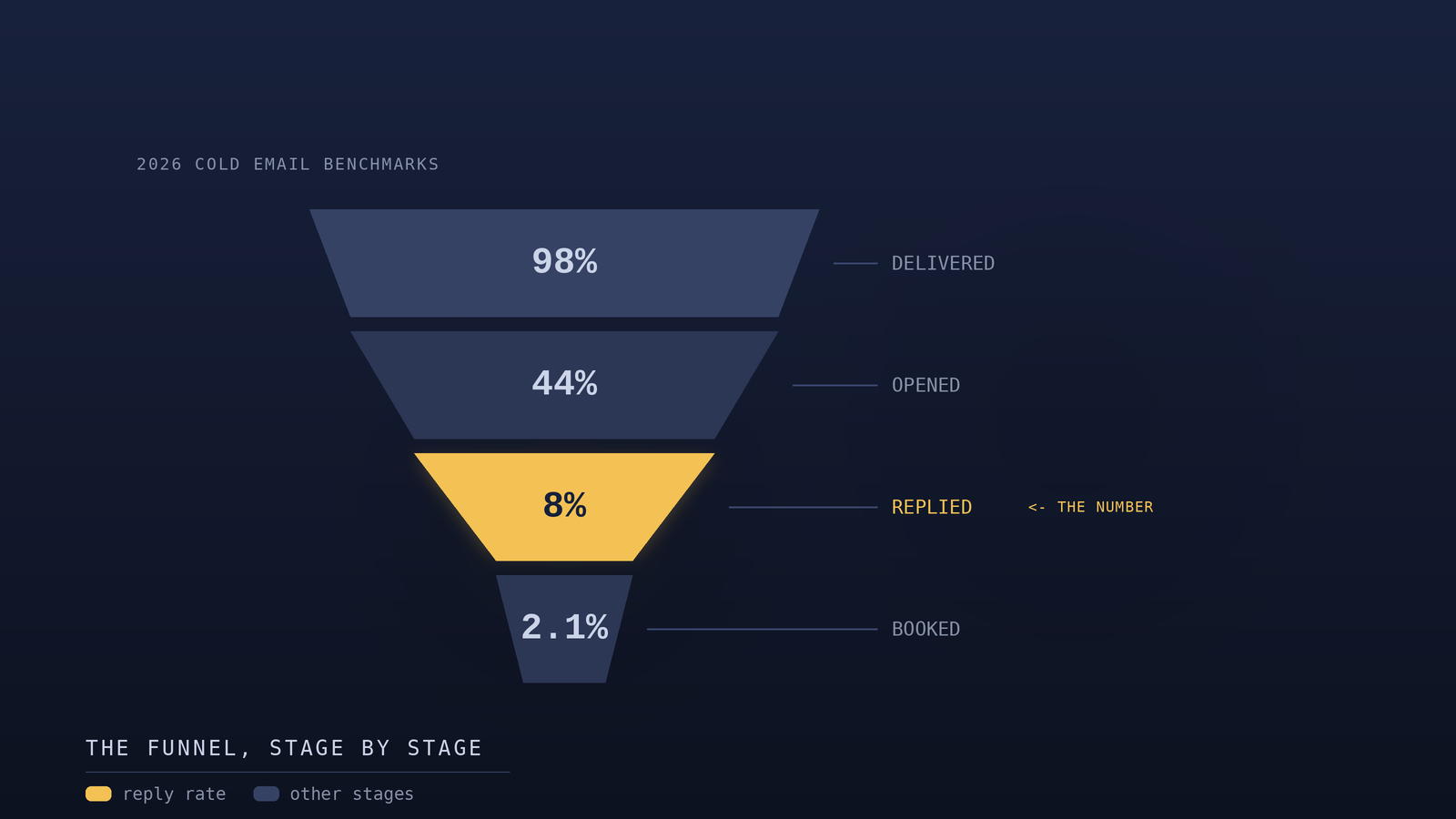
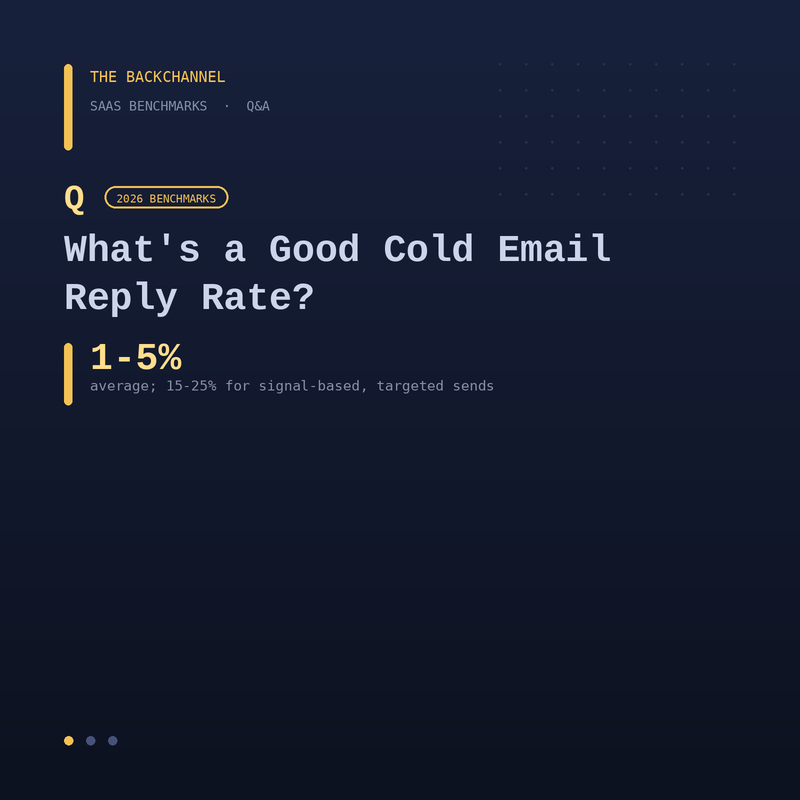
For reply rate, a broad but well-targeted cold email campaign to a clearly defined audience tends to produce healthy performance in the mid-single-digit range, with strong campaigns reaching into the higher single digits and exceptional campaigns typically those with sharp targeting and genuinely resonant messaging occasionally exceeding that. Campaigns reaching low-single-digit reply rates are underperforming relative to what's achievable, usually because of a targeting or messaging problem rather than a volume problem. The instinct to fix a low reply rate by sending more emails is almost always wrong; the fix is in the relevance, not the quantity.
For positive reply rate, healthy performance is a meaningful fraction of total replies you want most of your replies to be something other than rejections. When positive replies are a small minority of total replies, it usually means the targeting is off: you're reaching people who recognize the message enough to respond but aren't actually a fit, which generates rejections rather than interest. A high total reply rate with a low positive share is a warning sign, not a success.
For the segments that matter most, the numbers shift with personalization and audience. Highly targeted campaigns to senior buyers with genuinely relevant, specific messaging consistently outperform broad campaigns to generic audiences, often by multiples. This is the single most important pattern in current cold email performance: relevance and specificity beat volume and breadth, and the gap between the two approaches has widened as buyers have gotten better at filtering out anything generic. The campaigns that win in 2026 are the ones that feel like they were written for the specific person, because those are the only ones that reliably get past the filters buyers have developed.
What Has Changed
Understanding the current benchmarks requires understanding what has shifted to produce them. Several forces have reshaped cold email performance, and each one has implications for how you should run and measure your campaigns.
The first and most consequential change is the collapse of open-rate reliability. As privacy features have proliferated, open tracking has become progressively less accurate, to the point where open rate can no longer serve as a reliable optimization metric. This isn't a minor measurement quirk it has forced a fundamental shift in how cold email should be measured. Teams that still optimize primarily for open rate are optimizing for a number that no longer means what they think it means. The correct response is to demote open rate to a rough directional signal and elevate reply rate to the primary metric, which is where the optimization focus belongs anyway.
The second change is the rising sophistication of buyer filtering. Senior buyers in particular have received so much cold outreach that they've developed fast, accurate filters for anything that pattern-matches to a sales approach. The fake personalization, the manufactured urgency, the formulaic structure buyers recognize these instantly and discard the emails that use them. This has widened the gap between generic and genuinely relevant outreach dramatically, because the generic stuff increasingly doesn't get through at all while the genuinely relevant stuff still does. The bar for what counts as relevant has risen, and campaigns built on tactics that worked a few years ago underperform because those tactics are now exactly what buyers filter against.
The third change is increasing inbox competition. More companies are doing more outbound, which means the average buyer's inbox contains more cold email than ever. This crowding compresses the attention available to any single email and raises the premium on standing out through genuine relevance rather than clever tactics. In a crowded inbox, the email that gets a response is the one that immediately signals it's about something the recipient actually cares about and crowding makes that signal harder to send, because there's more competing for the same moment of attention.
The fourth change is the growing importance of deliverability and sender reputation. As email providers have gotten more aggressive about filtering unwanted mail, the technical health of your sending domain reputation, authentication, sending patterns, complaint rates has become a larger factor in whether your emails reach the inbox at all. A campaign with great messaging that lands in spam folders performs worse than a mediocre campaign that reaches the inbox, which means deliverability has become a prerequisite that gates everything else. Teams that neglect the technical foundation of their sending find that no amount of messaging improvement helps, because the messages aren't being seen.
The deliverability point deserves a concrete warning, because it's the failure mode that most often masquerades as a messaging problem. A team will see reply rates fall and conclude their copy has gone stale, when in fact their domain reputation has degraded and a growing share of their emails are silently landing in spam folders that no one ever opens. No messaging change can fix a deliverability problem, so the team iterates endlessly on copy while the real cause goes unaddressed. The diagnostic discipline here is to monitor deliverability metrics inbox placement, bounce rates, spam complaints as a separate track, so that when performance drops you can distinguish a messaging problem from a deliverability problem and fix the right thing. Mistaking one for the other wastes enormous effort on the wrong lever.
What These Changes Mean for How You Run Campaigns
The shifts above point clearly toward how cold email should be run in 2026, and the implications are consistent with each other. They all push in the same direction: away from volume and tactics, toward relevance and rigor.
First, optimize for reply rate and downstream pipeline, not open rate. Because open tracking is unreliable, building your testing and optimization around opens leads you astray. Make reply rate your primary metric, positive reply rate your quality check, and pipeline your ultimate measure, and you'll be optimizing for things that actually reflect performance rather than a number that privacy features have rendered meaningless.
Second, invest in relevance over volume. The widening gap between generic and relevant outreach means that the return on making your emails genuinely relevant has never been higher, while the return on simply sending more generic emails has never been lower. This is a reversal of the volume-centric approach that worked when inboxes were less crowded and buyers less filtered. The teams that win now are the ones that send fewer, more relevant emails to better-targeted audiences, because that's what gets past the filters and earns responses in a crowded inbox.
It's also worth being honest that the shift toward relevance has a cost most volume-focused teams underestimate: relevant outreach takes more effort per email, which means lower volume for the same headcount. This is a real tradeoff, not a free lunch, and the teams that navigate it well are the ones that accept the lower volume in exchange for dramatically higher per-email performance and better-qualified conversations. The mistake is trying to have both to keep volume high while claiming relevance which produces a watered-down hybrid that's neither genuinely relevant nor efficiently high-volume. In the current environment, you generally have to choose, and the evidence increasingly favors choosing relevance, because the return on a relevant email has risen as fast as the return on a generic one has fallen.
Third, treat deliverability as a foundation, not an afterthought. Because the technical health of your sending now gates whether your emails are seen at all, deliverability deserves deliberate, ongoing attention domain warmup, authentication, list hygiene, monitoring of complaint rates and sender reputation. This is unglamorous infrastructure work, but it's the foundation everything else rests on, and neglecting it caps the performance of even the best messaging.
Fourth, calibrate your expectations to your segment and your conditions. The benchmark ranges above are starting points, but where you should land depends on your audience, your deal size, your personalization level, and the current state of your sending reputation. The right way to use benchmarks is to locate yourself in the relevant context and ask whether you're performing well for your specific situation, not whether you're hitting a universal number that may not apply to you at all.
The Benchmark That Matters Most: Your Own Trend
For all the value of industry benchmarks, the most important benchmark for any cold email program is its own trend over time. External benchmarks tell you roughly where you stand relative to what's achievable; your own trend tells you whether you're getting better or worse, which is the thing you can actually act on.
This matters because the external factors that shape cold email performance are constantly shifting, which means a static external benchmark is always somewhat out of date. Your own program, measured consistently against itself, controls for those shifting factors automatically if your reply rate is climbing quarter over quarter while you hold your measurement consistent, you're improving, regardless of how you compare to some published average that may have been measured under different conditions. Conversely, a reply rate that's declining over time is a signal worth investigating even if it's still above the published benchmark, because the decline suggests something is degrading in your targeting, your messaging, or your deliverability.
So while it's worth knowing the industry ranges as orientation, the discipline that actually improves a cold email program is consistent measurement of your own performance over time, with deliberate experimentation to push the numbers in the right direction. Establish your baseline, test changes systematically, measure the effect on reply rate and pipeline, and keep what works. That internal feedback loop, run consistently, will do more for your cold email performance than any amount of comparison against external benchmarks because it's measuring the only thing you can actually control, which is whether your own program is getting better at reaching and resonating with the people you're trying to reach.
TRY BACKCHANNELS FREE
Your next customers are already in the database.
Backchannels gives you 225,000 verified software decision-makers. Filter to your exact ICP, preview matches for free, and push them straight into Salesforce or HubSpot. Pay per contact. No subscription, no contract.
Browse contacts freeNo credit card. Preview before you spend a credit.
No items found.
Final Thoughts
Cold email benchmarks decay fast. Open rate is broken, reply rate is king, and relevance now beats volume by multiples. The benchmark that matters most is your own trend over time.
Published
August 14, 2026
Writer
Joe Backchannels
Share


Most Wanted

12 min read

12 min read

June 2026