.png)
The Backchannel
The Cold Call Script That Books 3x More Meetings
Featured Blog

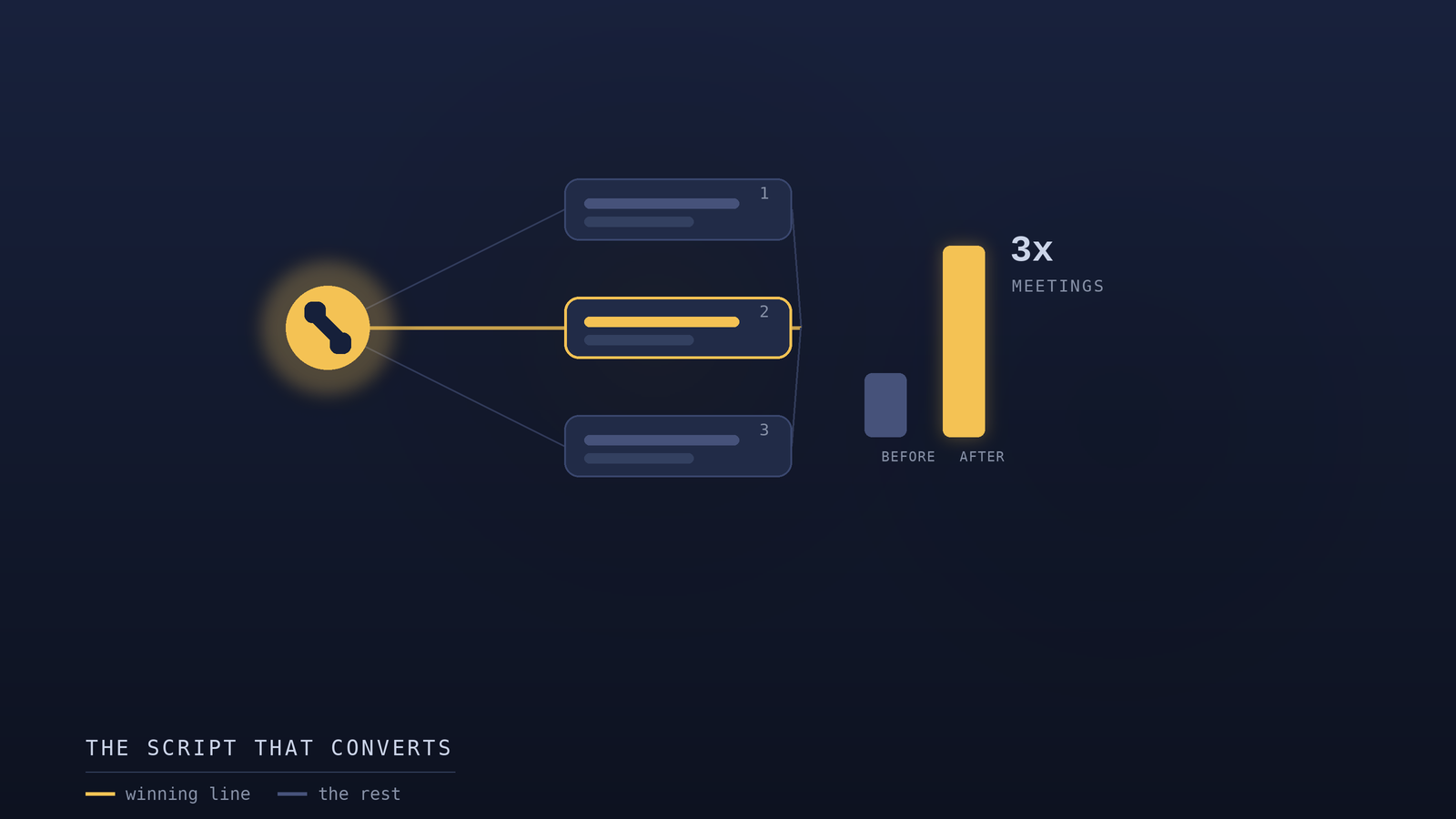
TL;DR: Most cold call scripts fail because they're seller-first they spend the opening 60 seconds on credentials and pitch before the buyer learns whether the call matters to them. The script that booked our team 3x more meetings inverts this using the PACT framework: Permission ("can I grab 27 seconds?"), Acknowledge (one sentence on why you're calling), Challenge (the specific pain), and Test ("is that on your radar right now, or is the timing off?"). The whole script is under 80 words. Here it is, plus how to handle the three most common responses.
What is the best cold call script structure?
The most effective cold call structure is buyer-first, not seller-first: establish relevance to the prospect in the very first sentence before introducing your company, product, or request. The PACT framework does this in four steps Permission (ask for a small, specific amount of time), Acknowledge (state in one sentence why you're calling), Challenge (name the specific pain as a statement), and Test (ask whether the pain is relevant right now). The complete script and the reasoning behind each step follow below.
The Script Paradox
The most common piece of advice given to SDRs about cold calling is to not sound scripted. Then the same people giving that advice hand them a script and tell them to memorize it. The result is the worst of both worlds: a rep who sounds like they're reading something while trying to sound like they're not, which produces a delivery that's stilted, unnatural, and immediately recognizable as the thing buyers have been trained to hang up on.
The solution to the script paradox isn't to abandon structure it's to internalize structure so deeply that it disappears. The best cold callers aren't winging it. They have a framework that's so well understood and so thoroughly practiced that it sounds like natural conversation. The framework is still there; it's just invisible.
This post is about the framework that's been booking our team three times more meetings than our previous approach, what it's built on, and how to develop the delivery that makes it work in practice.
Why Most Cold Call Scripts Fail
Before getting to what works, it's worth being precise about why most scripts don't.
The typical cold call script is built around the seller's agenda. It opens by establishing the seller's credibility ("I work with VP of Sales teams at companies like X and Y"), pivots to a value proposition ("We help teams like yours with Z"), and closes with a meeting request ("I'd love to grab 30 minutes to show you how this could work for your team"). Everything in this structure is about the seller. The buyer's situation doesn't enter the conversation until the seller decides to ask about it which is after they've already asked for the buyer's time, established their own credentials, and pitched their solution.
This structure fails because it violates the fundamental dynamic of human attention. People pay attention to things that are relevant to them. A cold call that spends the first 60 seconds establishing the seller's relevance is asking the buyer to wait through 60 seconds of irrelevance before finding out whether the call matters to them. Most buyers don't wait.
The scripts that work invert this structure. They establish relevance to the buyer in the first sentence before establishing the seller's credentials, before describing the product, before asking for anything. They're buyer-first rather than seller-first, and that inversion makes all the difference.
There's a simple way to understand the stakes. On a cold call, you have a handful of seconds before the buyer makes a keep-listening-or-hang-up decision, and they make it based on one question: "is this relevant to me?" A seller-first script spends those critical seconds answering a question the buyer didn't ask "who are you?" and by the time it gets to relevance, the buyer has already decided. A buyer-first script spends those same seconds answering the only question that matters, which is why it earns the rest of the call.
The PACT Framework
The framework we use has four elements. We call it PACT: Permission, Acknowledge, Challenge, Test.
Permission (The Opening)
Cold calling requires time that the buyer hasn't agreed to give. Acknowledging this directly, rather than pretending the call isn't what it is, disarms the immediate defensiveness that most cold calls trigger. But the way you ask for time matters enormously.
"Can I have two minutes of your time?" is the standard ask, and it performs poorly because it's vague and because two minutes of interruption is a larger commitment than most buyers want to make to an unknown caller. "Can I grab 27 seconds?" performs significantly better. The specificity is unusual enough to be disarming. The quantity is small enough to be genuinely reasonable. And the phrasing has an honesty to it 27 seconds suggests someone who actually knows how long they need, rather than someone fishing for attention with a lowball time estimate before launching into a lengthy pitch.
The oddly specific number also does something subtle: it interrupts the buyer's autopilot. A cold call triggers a reflexive script in the buyer's head "not interested, I'm busy" that fires before they've even processed what you said. "27 seconds" is unexpected enough to break that reflex for a moment, and that moment is all you need to deliver the next sentence.
Acknowledge (One Sentence on Why You're Calling)
After they've given you permission, acknowledge immediately and directly why you're calling. Not your product, not your company the specific problem you solve for people in their role. One sentence. No setup, no backstory, no preamble.
"I work with heads of sales at SaaS companies who are dealing with bad contact data their SDRs are spending more time cleaning lists than actually prospecting." That's the acknowledge. It tells them the category of problem you solve and the type of person you typically solve it for. They can immediately evaluate whether the description resonates with their situation.
Challenge (The Specific Pain)
Immediately follow the acknowledge with a statement of the specific pain in precise terms. This is where most scripts go wrong they describe benefits or solutions rather than problems. At this stage of the call, the buyer doesn't yet trust the caller enough to evaluate a solution. They can evaluate whether the pain described sounds familiar, which is a much lower-stakes assessment.
"Typically what I hear is that reps are building their own lists manually, bounce rates are high, and ramp time is 30% longer than it should be because they're not reaching anyone." That's the challenge. It's specific. It names real things that happen in real sales organizations. If the buyer is experiencing any of these things, the call has just become about something real to them.
The reason a pain statement outperforms a benefit statement at this moment comes down to trust. A benefit ("we can cut your ramp time by 30%") is a claim, and claims from a stranger invite skepticism the buyer's instinct is to doubt it. A pain ("reps are spending more time cleaning lists than prospecting") is an observation the buyer can verify against their own experience, with no trust required. You're not asking them to believe you. You're asking them to recognize themselves, and recognition builds the trust that makes them willing to hear a claim later.
Test (The Relevance Check)
Close with a question that tests whether the challenge you've described is relevant to the buyer right now. The specific phrasing of this question matters more than most people appreciate.
"Is that something on your radar right now, or is the timing just off?" This question is doing several things simultaneously. It's checking relevance without assuming it. It's giving the buyer an easy, face-saving exit ("timing's just off") that makes a positive response feel lower-stakes. And the phrase "right now" frames the question around timing rather than interest, which is easier to answer honestly because almost everyone would be interested in solving the pain you've described, but not everyone is prioritizing it at this specific moment.
The face-saving exit is the part most people underestimate. When you give someone an easy way to say no, you paradoxically make it easier for them to say yes because they no longer feel trapped, and the defensiveness that makes people end calls dissolves. A question with no exit ("would you be interested in learning more?") feels like a trap and gets a reflexive "no." A question with a built-in exit ("...or is the timing just off?") feels like a genuine, pressure-free inquiry and gets a genuine answer.
The Full Script
Assembled: "Hey [Name], this is [Your Name] from [Company]. I know this is a bit out of the blue can I grab 27 seconds?"
[They say yes or stay on the line]
"I work with heads of sales at SaaS companies who are dealing with bad contact data their SDRs spend more time cleaning lists than actually prospecting. Typically what I hear is that ramp time is 30% longer than it should be because reps aren't getting through to anyone. Is that something on your radar right now, or is the timing just off?"
That's the whole script. Under 80 words. No product name. No credentials. No case studies. No meeting request. Just a precise articulation of a real problem, delivered to someone who may or may not be experiencing it right now.
Notice what's deliberately absent: there's no meeting request in the script. This is intentional. The script's only job is to find out whether the pain is real and present for this buyer. If it is, the meeting request becomes a natural next step that the buyer is primed to accept; if it isn't, no meeting request would have worked anyway. Asking for the meeting too early before establishing that the pain is relevant is what makes the standard script feel pushy and earns the reflexive brush-off.
Handling the Three Most Common Responses
"Send me an email."
This is a deflection, not a rejection. The buyer isn't necessarily uninterested they're buying time or protecting their attention. The right response: "I will, absolutely. Can I ask one quick question first so I can make sure what I send is actually useful rather than generic?" This keeps the conversation open while acknowledging their preference. Then ask your most important diagnostic question.
The phrasing matters here too. By framing the question as a way to make the email more useful to them, you've given them a reason to stay on the line that serves their interest, not just yours. Most people will grant one quick question, and that question reopens the conversation you were about to lose.
"We already have something for that."
This is valuable information, not a dead end. The right response: "That makes sense a lot of teams I talk to do. What's the one thing about it you'd change if you could?" This question is disarming because it's genuinely curious and low-stakes to answer. The answer often reveals whether the current solution actually has gaps that create an opportunity, or whether the fit is genuinely solid and this isn't a prospect worth pursuing further.
This response also avoids the trap most reps fall into, which is immediately attacking the incumbent solution. Disparaging what they already use puts the buyer on the defensive they chose that tool, so criticizing it criticizes their judgment. Asking what they'd change lets them surface the dissatisfaction themselves, which is far more persuasive than anything you could assert.
"Not interested."
Before accepting this, try to understand whether it's a timing issue or a fit issue. "I hear you can I ask whether it's more that the timing isn't right, or that what I described doesn't actually apply to your situation?" The distinction matters for how you follow up. A timing objection is a future opportunity. A fit objection is genuine disqualification.
This single clarifying question is worth more than it appears, because it converts a dead "no" into usable intelligence. If it's timing, you've identified someone worth re-engaging in a quarter, and you can set that follow-up with their implicit permission. If it's fit, you've saved yourself the wasted effort of pursuing a prospect who was never going to convert, and you can remove them from the sequence with confidence rather than guilt.
The Practice Investment
The PACT framework sounds simple. Executing it in a way that sounds natural and confident under the pressure of a live cold call is not simple it requires deliberate practice. The reps who've gotten the most out of this framework are the ones who've role-played it extensively, recorded their own calls and reviewed the playback, and made specific adjustments to their delivery based on where the conversations go off-track.
A script is a starting point. The goal is to internalize it so thoroughly that you've stopped thinking about it and started thinking about the conversation. That transition from executing a framework to having a real conversation within the framework is where the 3x meeting rate lives.
The practice also matters because the framework only works when the delivery is relaxed. The same words delivered with audible nervousness rushing the 27-second ask, racing through the pain statement to get it over with lose most of their effect, because the buyer hears the anxiety and reads it as "salesperson." Delivered calmly, by someone who has said these words enough times to mean them, the identical script reads as a confident professional reaching out about something relevant. The words are necessary but not sufficient; the practice is what turns the words into something that works.
Frequently Asked Questions
What should you say in the first 10 seconds of a cold call?
Lead with relevance to the buyer, not your credentials. After a brief introduction, acknowledge the call is unexpected and ask for a small, specific amount of time "I know this is out of the blue, can I grab 27 seconds?" The oddly specific number breaks the buyer's reflexive brush-off and earns you enough attention to deliver a relevant pain statement.
Why do most cold call scripts fail?
They're seller-first. They spend the opening 60 seconds on the seller's credibility and product pitch before the buyer learns whether the call is relevant to them. Since buyers decide to keep listening based on relevance, a script that delays relevance loses them. Buyer-first scripts that lead with the prospect's specific pain perform dramatically better.
What is the PACT cold calling framework?
PACT is a four-step cold call structure: Permission (ask for a small, specific amount of time), Acknowledge (state in one sentence why you're calling), Challenge (name the specific pain as a verifiable statement, not a benefit claim), and Test (ask whether the pain is relevant right now, with a built-in face-saving exit). The full script is under 80 words and contains no pitch or meeting request.
How do you handle the "send me an email" objection?
Treat it as a deflection, not a rejection. Agree to send the email, then ask one quick diagnostic question framed as a way to make the email more relevant to them: "I will can I ask one quick question first so what I send is actually useful rather than generic?" This reopens the conversation you were about to lose.
Should a cold call script include a meeting request?
Not up front. The opening script's only job is to establish whether the pain is real and present for the buyer. If it is, the meeting becomes a natural next step the buyer is primed to accept. Asking for the meeting before establishing relevance is what makes most scripts feel pushy and triggers the reflexive brush-off.
TRY BACKCHANNELS FREE
Your next customers are already in the database.
Backchannels gives you 225,000 verified software decision-makers. Filter to your exact ICP, preview matches for free, and push them straight into Salesforce or HubSpot. Pay per contact. No subscription, no contract.
Browse contacts freeNo credit card. Preview before you spend a credit.
No items found.
Final Thoughts
The best cold call scripts don't sound like scripts. They sound like a direct, confident professional who has something specific and relevant to say. That's not talent it's the product of the right framework, practiced until it's internalized.
Published
August 14, 2026
Writer
Joe Backchannels
Share


Most Wanted

12 min read

12 min read

June 2026