.png)
The Backchannel
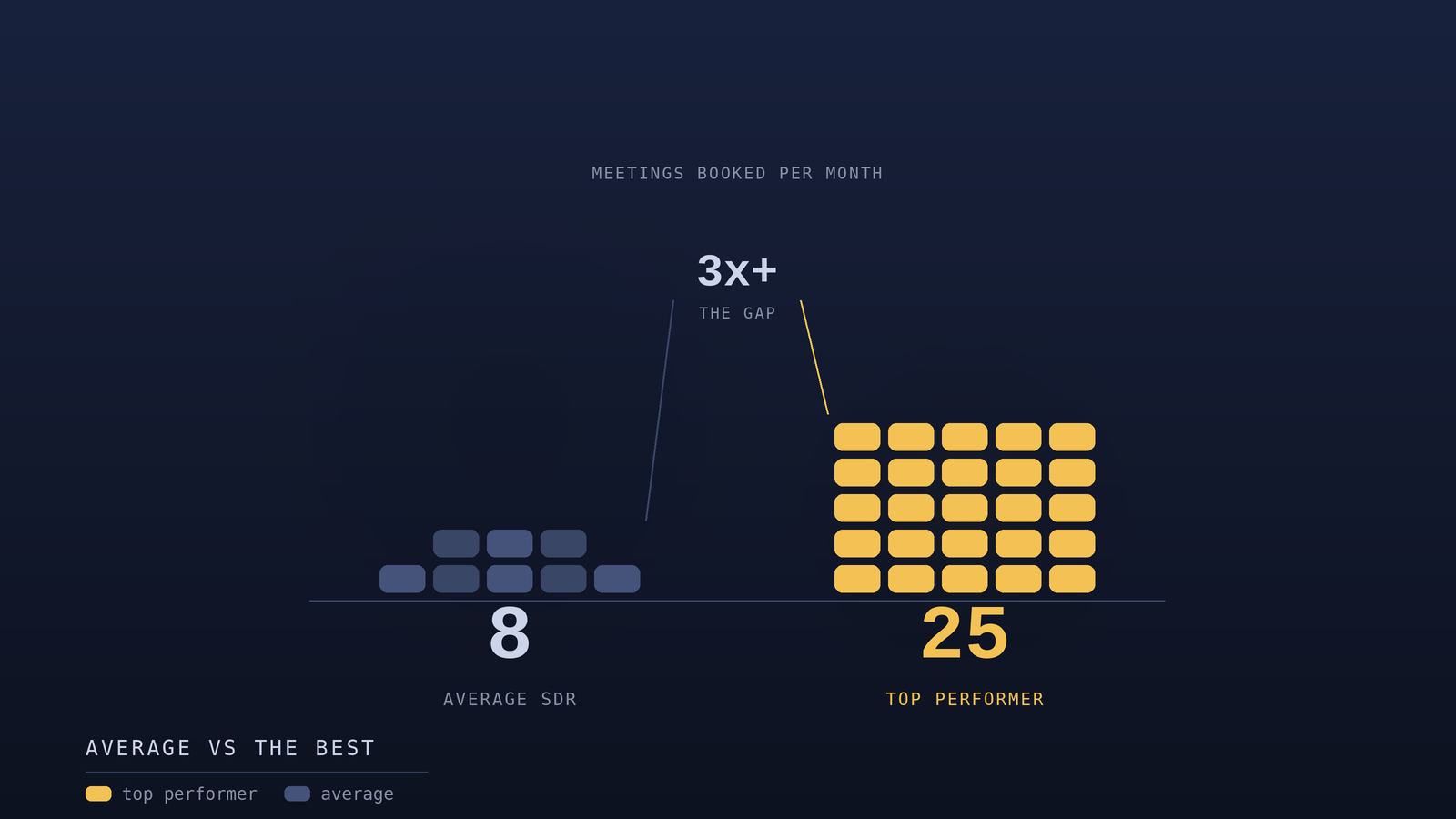
The Average SDR Books 8 Meetings a Month. Here's How Top Performers Book 25.
Featured Blog

The Gap That Isn't About Working Harder
The performance gap between an average SDR and a top one is enormous. An average SDR books somewhere around eight meetings a month. The top performers on the same team, selling the same product, into the same market, with the same tools, book three times that or more. When a gap that large appears between people who have access to identical resources, the natural explanation is effort the top performers must simply be grinding harder, making more calls, sending more emails, working longer hours.
That explanation is almost entirely wrong, and believing it leads teams to push average reps toward more activity, which rarely closes the gap and often makes it worse. The top performers are usually not working dramatically harder than their peers. In many cases they're working the same hours or fewer. What separates them isn't the volume of their effort but the structure of it what they spend their time on, how they prioritize, what they've systematized, and what they refuse to do. The gap is a gap in approach, not in hours, and that distinction matters enormously because approach is learnable while raw effort has a ceiling.
This post breaks down what top SDR performers actually do differently. None of it is about superhuman work ethic or natural charisma. It's a set of specific, replicable practices around targeting, timing, messaging, prioritization, and process that compound into a dramatically higher meeting count. Understanding these practices is the first step to closing the gap, because once you see that the difference is structural rather than innate, it stops being a mystery about talent and becomes a set of behaviors you can actually adopt.
They Spend Their Time on the Right Accounts
The single biggest difference between top performers and average reps is where they point their effort. Average reps tend to work their list more or less evenly, treating each account as roughly equivalent and working through them in whatever order they come. Top performers do something fundamentally different: they spend a disproportionate amount of their time identifying which accounts are most likely to convert, and then they concentrate their effort there.
This concentration is the highest-leverage decision an SDR makes, because the conversion probability across accounts varies enormously. Some accounts are in an active buying window, experiencing the exact pain the product solves, with the budget and authority to act. Others fit the profile on paper but have no current urgency and won't convert no matter how good the outreach is. An average rep spreads effort evenly across both kinds, which means a large fraction of their work goes to accounts that were never going to convert. A top performer identifies the high-probability accounts and pours their effort there, which means a much larger fraction of their work lands on accounts that can actually become meetings.
The mechanism behind this is research and signal-reading. Top performers invest time upfront in understanding which accounts show signs of being in-market a recent funding round, a new executive hire, a relevant job posting, a public expression of the pain they solve, a technology change that creates a need. These signals are visible to anyone willing to look, but average reps skip the looking in favor of getting straight to outreach volume. The top performer's upfront research time feels like a delay, but it pays for itself many times over by directing every subsequent hour of outreach toward accounts where it can actually work. The time spent choosing the right accounts is more valuable than the time spent working them, and top performers understand this while average reps don't.
It helps to make the math of this concrete, because it explains how the same number of hours produces such different results. Suppose an average rep and a top rep both make the same total number of touches in a month. If the average rep spreads those touches across accounts where, say, one in fifteen is genuinely in-market, while the top rep concentrates the same touches on accounts where one in four is in-market, the top rep is reaching roughly four times as many receptive accounts with identical effort. The meeting-count difference doesn't come from more work it comes from the same work landing on accounts that can actually convert. This is why account selection is the highest-leverage lever an SDR has: it multiplies the value of every subsequent hour without requiring a single additional hour.
They Reach Out at the Right Moment
Beyond choosing the right accounts, top performers are far better at timing reaching out when an account is most receptive rather than at a random moment in the account's life. Timing is one of the most underappreciated factors in SDR performance, because the same outreach to the same person can succeed or fail entirely based on when it lands.
Top performers build systems to catch accounts at moments of heightened receptivity. When a company announces a funding round, the window of receptivity opens, and a top performer is reaching out within that window rather than weeks later when the moment has passed. When a new executive starts in a relevant role, they have a brief period of high openness to new vendors and ideas, and a top performer reaches them during it. When a company posts a job that signals the exact pain the product addresses, a top performer responds while the pain is fresh and unaddressed. These trigger-based moments convert dramatically better than untriggered outreach, and the difference between top and average performers is largely whether they have a system to catch these moments and act on them quickly.
The reason timing matters so much is that buying readiness isn't constant it spikes around specific events and then fades. An account that's highly receptive this week because of a triggering event may be unreceptive next month when the moment has passed and attention has moved on. Average reps, working their list evenly and slowly, reach most accounts at random points that have nothing to do with the account's receptivity. Top performers, working from triggers, reach accounts disproportionately at the high-receptivity moments. Same outreach, same product, but landing at the moment when it's most likely to convert rather than at an arbitrary one. This timing advantage alone accounts for a large share of the performance gap.
There's an important corollary to the timing advantage that's easy to miss: speed of response matters as much as the trigger itself. A triggering event opens a window of receptivity, but that window is often shared a funding announcement, for instance, is visible to every vendor watching, and the receptive moment it creates is one that many competitors are racing to fill. The top performer who reaches the account within hours of the trigger captures the receptive moment before it's crowded with competing outreach; the rep who gets there two weeks later arrives after the prospect has already been flooded and the window has narrowed. So the timing advantage isn't just about reaching out around triggers rather than randomly it's about reaching out fast enough that the trigger's receptivity hasn't yet been consumed by everyone else who saw the same signal.
Their Messaging Is Relevant, Not Just Personalized
Top performers' outreach reads differently from average reps' outreach, but not in the way most people assume. The difference isn't more personalization in the superficial sense not more references to the prospect's alma mater or recent vacation. It's more relevance: outreach that connects specifically to a real problem the prospect is likely experiencing right now.
Average reps tend to fall into one of two traps. Either they send generic outreach that could go to anyone, which gets ignored because it signals no understanding of the prospect's situation. Or they add superficial personalization a reference to something public about the prospect that's personalized without being relevant, which buyers increasingly recognize as a technique rather than genuine understanding. Top performers do something different: they lead with a specific, resonant articulation of a problem the prospect is likely facing, drawn from a deep understanding of their ICP's actual daily reality. The outreach doesn't say "I noticed you went to State" it says "teams in your situation usually struggle with X," where X is something the prospect immediately recognizes as their own problem.
This relevance-over-personalization distinction is subtle but decisive. Personalization signals effort; relevance signals understanding, and understanding is what earns a response. When a prospect reads outreach that precisely names a problem they're actually dealing with, the response isn't "this person looked me up" it's "this person gets my situation." That feeling of being understood is what makes a prospect willing to take a meeting, and it comes from knowing the ICP's problems deeply rather than from researching the individual superficially. Top performers invest in understanding the problem space their buyers live in, which lets them write outreach that resonates with any prospect in that space, rather than investing in surface research about individuals.
They Protect Their Highest-Value Time
Top performers manage their time and energy differently from average reps, in ways that have nothing to do with working more hours and everything to do with protecting the hours that matter most. They recognize that not all working time is equally valuable, and they organize their day to spend their best hours on their highest-value activities.
The most important version of this is protecting prime calling and outreach windows. There are certain times of day when prospects are most reachable and most receptive, and top performers guard those windows fiercely, refusing to fill them with administrative work, internal meetings, or low-value tasks that could be done at any other time. Average reps let their prime hours get consumed by whatever lands on their calendar, which means their best selling time gets spent on things that don't require it, and their actual outreach happens during the leftover hours when prospects are harder to reach. The top performer's discipline about when they do what is a major source of their advantage.
They also batch their work to minimize the cost of context-switching. Constantly shifting between research, writing, calling, and administrative tasks is cognitively expensive and erodes the quality of each activity. Top performers tend to batch similar work a block for research, a block for calls, a block for writing which lets them stay in a single mode and work more effectively within it. Average reps interleave these activities throughout the day, paying the context-switching cost repeatedly and doing each task less well than they would in a focused block. This isn't about working more; it's about extracting more from the same hours by organizing them intelligently.
They Systematize Everything That Can Be Systematized
Perhaps the deepest difference between top and average performers is that top performers turn their successes into repeatable systems, while average reps treat each day as a fresh improvisation. When a top performer finds something that works a message that resonates, a sequence that converts, a way of handling a common objection they capture it and reuse it, so they're not reinventing it each time. Over months, this accumulation of systematized knowledge compounds into a large advantage.
This systematization shows up everywhere in a top performer's work. They have templates for the outreach patterns that work, which they adapt rather than rewriting from scratch. They have a clear, repeatable process for researching and prioritizing accounts, so that decision doesn't consume fresh energy each time. They have practiced responses to the objections they hear repeatedly, so they're never caught flat-footed by a predictable pushback. Each of these systems takes effort to build, but once built, it makes every future instance faster and better. The top performer is effectively compounding their own learning, while the average rep keeps solving the same problems from scratch.
The reason systematization produces such a large advantage is that it frees cognitive capacity for the parts of the job that genuinely require it. When the repeatable parts of the work are systematized, the rep's mental energy goes to the parts that actually need human judgment the nuanced conversation, the unusual situation, the genuinely novel account. Average reps spend their finite mental energy re-solving routine problems, leaving less for the parts that matter. Top performers automate the routine and concentrate their judgment where it counts. This is the same principle that makes any expert more efficient than a novice: not working harder, but having systematized the routine so thoroughly that effort flows to where it creates the most value.
There's one more practice that quietly separates top performers, and it's the willingness to stop to disqualify accounts and walk away from outreach that isn't working. Average reps often equate persistence with diligence, continuing to work accounts that have shown no signal long past the point of usefulness, because stopping feels like giving up. Top performers are ruthless about cutting accounts that aren't responding and redirecting that effort toward fresh, higher-probability targets. This refusal to pour effort into dead ends is the mirror image of their account-selection discipline: just as they concentrate effort on the right accounts at the start, they withdraw effort from the wrong ones as soon as the evidence says so. The result is that almost none of their working time is wasted on accounts that won't convert, which is itself a major source of the leverage that produces the higher meeting count.
How to Close the Gap
The encouraging implication of all this is that the gap between average and top SDR performance is closable, because it's built from learnable practices rather than innate talent. An average rep who adopts these practices can move toward top performance, and the path to doing so is reasonably clear.
Start with account prioritization, because it's the highest-leverage change. Rather than working your list evenly, invest time upfront in identifying which accounts show signs of being in-market, and concentrate your effort there. This single shift from even effort to concentrated effort on high-probability accounts often produces the largest improvement, because it stops the waste of pouring outreach into accounts that were never going to convert. Then add timing discipline: build a way to catch accounts at moments of heightened receptivity, and reach out within those windows rather than at random points.
Then work on relevance and systematization in parallel. Deepen your understanding of your ICP's actual problems so your outreach can lead with genuine relevance rather than superficial personalization, and start capturing what works into reusable systems so you stop re-solving the same problems each day. Protect your prime outreach hours from low-value work, and batch your activities to minimize context-switching. None of these changes requires working more hours; all of them are about working the same hours more intelligently.
The meeting-count gap between average and top performers looks like a talent gap, but it's really a gap in approach in where effort is pointed, when outreach lands, how messaging resonates, how time is protected, and what gets systematized. Each of these is a deliberate practice that any rep can adopt. The top performers aren't working three times as hard to book three times the meetings. They're working with three times the leverage, and leverage is something you build rather than something you're born with. That's the real lesson hidden inside the performance gap: the difference is structural, which means it's available to anyone willing to restructure how they work.
TRY BACKCHANNELS FREE
Your next customers are already in the database.
Backchannels gives you 225,000 verified software decision-makers. Filter to your exact ICP, preview matches for free, and push them straight into Salesforce or HubSpot. Pay per contact. No subscription, no contract.
Browse contacts freeNo credit card. Preview before you spend a credit.
No items found.
Final Thoughts
Top SDRs don't book 3x the meetings by working 3x harder they work with 3x the leverage. Better account selection, timing, relevance, and systematization are all learnable, not innate.
Published
August 14, 2026
Writer
Joe Backchannels
Share


Most Wanted


12 min read

12 min read

June 2026