.png)
The Backchannel
The ABM Strategy That Turned 10 Target Accounts Into 7 Customers
Featured Blog

TL;DR: Most "ABM" is just personalized outbound with a list. Real ABM applies an order of magnitude more resources to a handful of carefully chosen accounts. We ran a true play against 10 accounts, started 9 conversations, and closed 7 customers in six months for ~$7,400 in spend and 180 hours, producing a CAC of $1,057 versus our blended $2,650. The difference came from disciplined account selection, deep account-intelligence research, coordinated three-channel presence, and account-specific content. Here's the full playbook.
What is the difference between ABM and personalized outbound?
Real account-based marketing applies coordinated, high-intensity resources deep research, multi-channel presence, and custom content to a small set of carefully selected accounts, with the goal of creating the conditions for a sale rather than just finding the right contact to email. Personalized outbound, which many teams mislabel as ABM, is standard outbound with slightly better targeting and merge fields. The resource intensity of true ABM is roughly an order of magnitude higher per account, and so are the results. The full breakdown of how to run it follows below.
ABM Done Wrong Is Just Expensive Outbound
Account-based marketing has a reputation problem. Not because the strategy is flawed it isn't but because it's almost universally implemented incorrectly. Most companies that claim to run ABM programs are actually running what might be called ABM-theater: a list of target accounts, a slightly-more-personalized email sequence, some LinkedIn ads targeted to those company domains, and a label that says "ABM" on the program regardless of how much it resembles their standard outbound motion.
The result is that the program underperforms, the team concludes that ABM doesn't work for their company or category, and they abandon it in favor of going back to volume-based outbound. What they've actually learned is that expensive outbound with better targeting doesn't perform dramatically better than regular outbound which is true, and not what ABM is.
Real ABM is something meaningfully different: the coordinated application of significant resources time, research, content, multi-channel presence, and genuine creative investment to a small number of carefully selected accounts with the goal of creating the conditions for a sale rather than simply identifying the right contact to email. The resource intensity is an order of magnitude higher than standard outbound. So are the results.
Here's exactly how we ran a true ABM play that converted 7 of 10 target accounts into paying customers within six months.
Account Selection: The Most Consequential Decision
The first and most important decision in any ABM program is which accounts to target. Most teams approach this by filtering their CRM or a list tool for accounts that match their ICP, generating a list of 50 or 100 companies, and calling it their ABM target list. This is necessary but not sufficient for a true ABM play, because it doesn't differentiate between accounts that match your ICP profile and accounts where a real opportunity exists right now.
Our criteria for selecting the 10 accounts in this campaign went beyond ICP match. We required: clear, identifiable signal of current pain, not just theoretical fit we needed specific evidence that these accounts were experiencing the problem we solve right now, not that they fit the profile of companies that generally experience it. We required strong ICP fit across all relevant dimensions: size, industry, tech stack, stage, and deal velocity. We required at least one warm connection inside the account a mutual customer, a LinkedIn connection, a previous relationship that gave us a starting point. And we required estimated ACV that justified the significant investment we were planning to make.
We turned down accounts that had excellent ICP fit but didn't meet all four criteria. This felt overly conservative at the time. In retrospect, the discipline was the most important decision we made. ABM only works when the accounts are genuinely ready to buy, and readiness requires more than profile match.
The reason account selection matters more than any other decision in ABM is simple arithmetic. In volume outbound, a bad account is cheap you've spent a few minutes and a few emails on it before moving on. In ABM, a bad account is enormously expensive, because you're about to invest dozens of hours and real budget into it. A wrongly chosen account doesn't just fail to convert; it consumes resources that one of your other nine accounts needed. With only 10 accounts, every selection error costs you 10% of your entire program. This is why the discipline to turn down good-but-not-ready accounts is the highest-leverage discipline in the entire motion.
Building the Account Intelligence File
Before any outreach went out to any of the 10 accounts, we spent two to three hours per account building what we called an Account Intelligence File. This was a single document capturing everything relevant to the account: the company's stated strategic priorities based on their website, recent press releases, and executive LinkedIn posts; a complete stakeholder map including the likely economic buyer, champion, technical evaluator, and known blockers; their full technology stack; any third-party intent data showing research in our category; known pain points surfaced through job postings, Glassdoor reviews, and public employee commentary; and all mutual connections between our team and anyone at the account.
This file became the single source of truth for every touchpoint with the account. Every email, every LinkedIn message, every direct mail piece was built from the specific intelligence in this file not from generic category-level assumptions about what companies like theirs typically care about, but from specific knowledge about what this company and these individuals were actually dealing with.
The quality of this research was the differentiator between our ABM play and "personalized outbound." Generic personalization references public information. Real account intelligence surfaces things that signal genuine understanding: a specific concern expressed in a job description, a strategic priority mentioned in an executive's recent conference talk, a technology gap implied by their hiring pattern. When outreach references this kind of information, it communicates something that no amount of email copy optimization can communicate: that there's a real human being who has genuinely paid attention to your situation.
There's a compounding benefit to this research that isn't obvious upfront: the intelligence file makes every subsequent touch cheaper and better. The two to three hours invested before the first email pays off across every channel and every message for the rest of the campaign, because each touchpoint draws from the same deep well of understanding rather than requiring fresh research. The research is a fixed cost that amortizes across dozens of interactions, which is part of why the per-customer economics of ABM end up better than they look at first glance.
The Three-Channel Coordinated Approach
For each of the 10 accounts, we ran simultaneous activity across three channels over a 60-day period: LinkedIn advertising targeted to specific roles at the account using LinkedIn's company-level targeting; direct mail sent to the identified economic buyer; and personalized email sequences to each relevant stakeholder, written specifically for their role and the concerns most likely to be relevant to their part of the decision.
The channels were coordinated in both timing and message. The LinkedIn ads began two weeks before any direct outreach, running content directly relevant to the specific pain we'd identified through our account intelligence. The direct mail arrived during week three of the campaign. The email sequences began in week two and continued throughout.
The purpose of this multi-channel coordination isn't to overwhelm the account with contact. It's to create a presence that feels consistent across multiple surfaces what some call "surround sound." When a VP of Sales sees a relevant LinkedIn post on Monday, receives a piece of direct mail on Wednesday, and gets a specific email on Friday that references a challenge their company is visibly dealing with, each touchpoint reinforces the others. They feel like they're encountering you rather than being targeted by you, which is a fundamentally different experience and produces a fundamentally different response.
The deeper mechanism behind surround sound is what it signals about credibility. A single cold email is easy to dismiss as one of hundreds it carries no weight. But when the same company shows up across three different channels with a consistent, relevant message, the buyer's perception shifts from "a vendor is emailing me" to "this company seems to be everywhere in my space." Multi-channel presence manufactures the impression of market prominence, and prominence creates trust. The coordination isn't about contact frequency; it's about engineering the perception that you're an established, serious player worth taking a meeting with.
The Account-Specific Content Play
For three of the ten accounts the ones with the highest estimated ACV and the clearest buying signal we created account-specific content: a four-to-six page document we called an "Account Teardown." This document analyzed the account's current approach to the problem we solve based entirely on public information identified specific gaps and opportunities, and offered concrete recommendations they could act on regardless of whether they ever worked with us.
We sent this document as our opening move with these accounts. Not a product pitch, not a case study, not a request for a meeting. A piece of analysis that demonstrated we understood their specific situation better than any vendor they were likely to be talking to. The implicit message was: imagine working with a team that understands your business at this level. The explicit message was: here's something useful, no strings attached.
All three accounts we sent this to responded within one week. Two became customers within 90 days. The third closed four months later. The return on the investment of creating account-specific content roughly eight hours per document was among the highest ROI investments we've made in any part of our GTM motion.
The reason the Account Teardown works so well is that it inverts the normal vendor-prospect dynamic. In a typical sales interaction, the vendor asks the prospect to invest time explaining their situation so the vendor can eventually propose a solution. The teardown reverses this: the vendor does the work first, demonstrating understanding before asking for anything. This triggers a powerful reciprocity effect someone who has just received a genuinely useful, effortful analysis feels a natural pull to engage in return. But more than reciprocity, it serves as proof of capability. Anyone can claim they'll understand your business deeply; the teardown demonstrates it before the relationship has even started, which is worth more than any number of assurances in a pitch deck.
The Results
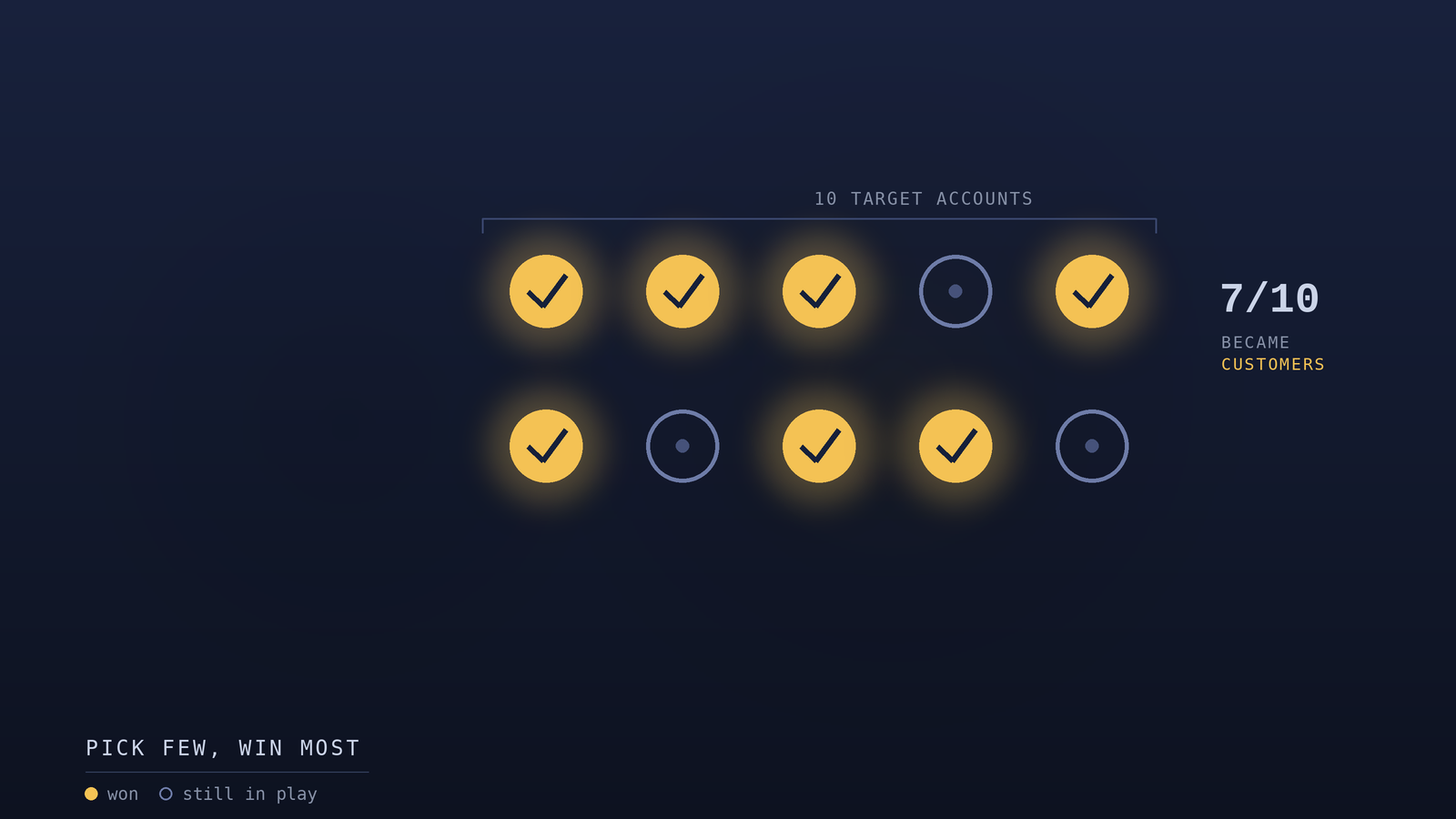
10 accounts targeted. 9 meaningful conversations initiated from a cold or near-cold starting point within 60 days of campaign launch. 7 customers closed within six months. Total campaign investment: approximately 180 hours of team time across sales and marketing, and $7,400 in advertising, direct mail production, and content creation. Total ACV from the 7 customers: $312,000. CAC per customer: $1,057. For context, our blended CAC across all channels during the same period was $2,650.
The precision of ABM didn't just improve win rates. It made acquisition dramatically more efficient on a per-customer basis. The resource intensity of ABM is real we genuinely invested more per account than in any standard outbound motion. But the per-customer CAC was less than half our standard average, because the conversion rate at every stage of the funnel was dramatically higher when we started from a foundation of genuine account knowledge and coordinated multi-channel presence.
This is the counterintuitive economics at the heart of ABM, and it's worth stating plainly because it's so often misunderstood. ABM costs far more per account than volume outbound, which makes it look expensive and inefficient on the surface. But CAC is not calculated per account it's calculated per customer. When your conversion rate from targeted account to closed customer is 70% instead of the low single digits typical of cold outbound, the much higher per-account cost is spread across far more wins, and the per-customer cost drops below what cheaper, lower-converting channels can achieve. ABM looks expensive and is actually efficient, which is exactly the opposite of how most teams instinctively evaluate it. The intensity is the point, not the problem.
How to Run Your First ABM Play
If you want to apply this, start small and resist the temptation to scale prematurely. Choose 10 accounts using strict criteria not just ICP fit, but current pain signal, a warm connection, and ACV high enough to justify real investment, and be willing to reject good accounts that don't clear all the bars. Build a genuine intelligence file on each before any outreach goes out; this research is the foundation everything else draws from. Coordinate at least two or three channels so your presence reinforces itself rather than arriving as isolated touches. And for your highest-value accounts, invest in account-specific content that proves your understanding before you ask for anything. Run it for a defined window, measure CAC per customer rather than cost per account, and let the conversion economics not the per-account spend tell you whether to expand the program.
Frequently Asked Questions
What is account-based marketing (ABM)?
ABM is a go-to-market strategy that concentrates coordinated resources deep research, multi-channel outreach, and custom content on a small set of carefully selected high-value accounts, with the goal of creating the conditions for a sale rather than just reaching the right contact. True ABM invests roughly an order of magnitude more per account than volume outbound, and converts at dramatically higher rates as a result.
How is ABM different from regular outbound?
Regular outbound applies light effort across many accounts; ABM applies intensive, coordinated effort across few. The most common mistake is "ABM-theater" a target list plus slightly personalized emails and some LinkedIn ads which is just outbound with better targeting. Real ABM includes deep per-account research, multi-channel coordination, and often account-specific content, producing far higher conversion per account.
How do you select accounts for ABM?
Go beyond ICP fit. The strongest criteria combine: a clear signal of current pain (not just theoretical fit), strong fit across size/industry/stack/stage, at least one warm connection inside the account, and an ACV high enough to justify the heavy investment. With only a handful of accounts, every selection error is costly, so the discipline to reject good-but-not-ready accounts is essential.
Does ABM have a lower or higher CAC than outbound?
Per account, ABM costs much more. Per customer, it's often far cheaper. In our campaign, ABM produced a CAC of $1,057 versus a $2,650 blended average because the conversion rate from targeted account to closed customer was about 70%, spreading the higher per-account cost across many more wins. CAC is measured per customer, which is why intensive ABM can be the most efficient channel.
What is an ABM "account teardown" and why does it work?
An account teardown is a short, account-specific analysis of a target company's current approach to the problem you solve, with concrete recommendations they can use whether or not they buy. Sent as an opening move instead of a pitch, it works by proving your understanding before asking for anything triggering reciprocity and demonstrating capability. In our play, all three accounts that received one responded within a week.
TRY BACKCHANNELS FREE
Your next customers are already in the database.
Backchannels gives you 225,000 verified software decision-makers. Filter to your exact ICP, preview matches for free, and push them straight into Salesforce or HubSpot. Pay per contact. No subscription, no contract.
Browse contacts freeNo credit card. Preview before you spend a credit.
No items found.
Final Thoughts
Real ABM is surgical, resource-intensive, and when executed precisely, produces win rates that volume-based outbound can't touch. 10 accounts. 7 customers. The math speaks for itself.
Published
August 14, 2026
Writer
Joe Backchannels
Share


Most Wanted

12 min read

12 min read

June 2026