.png)
The Backchannel
10 SaaS Companies With Wild Sales Efficiency (And Their Numbers)
Featured Blog


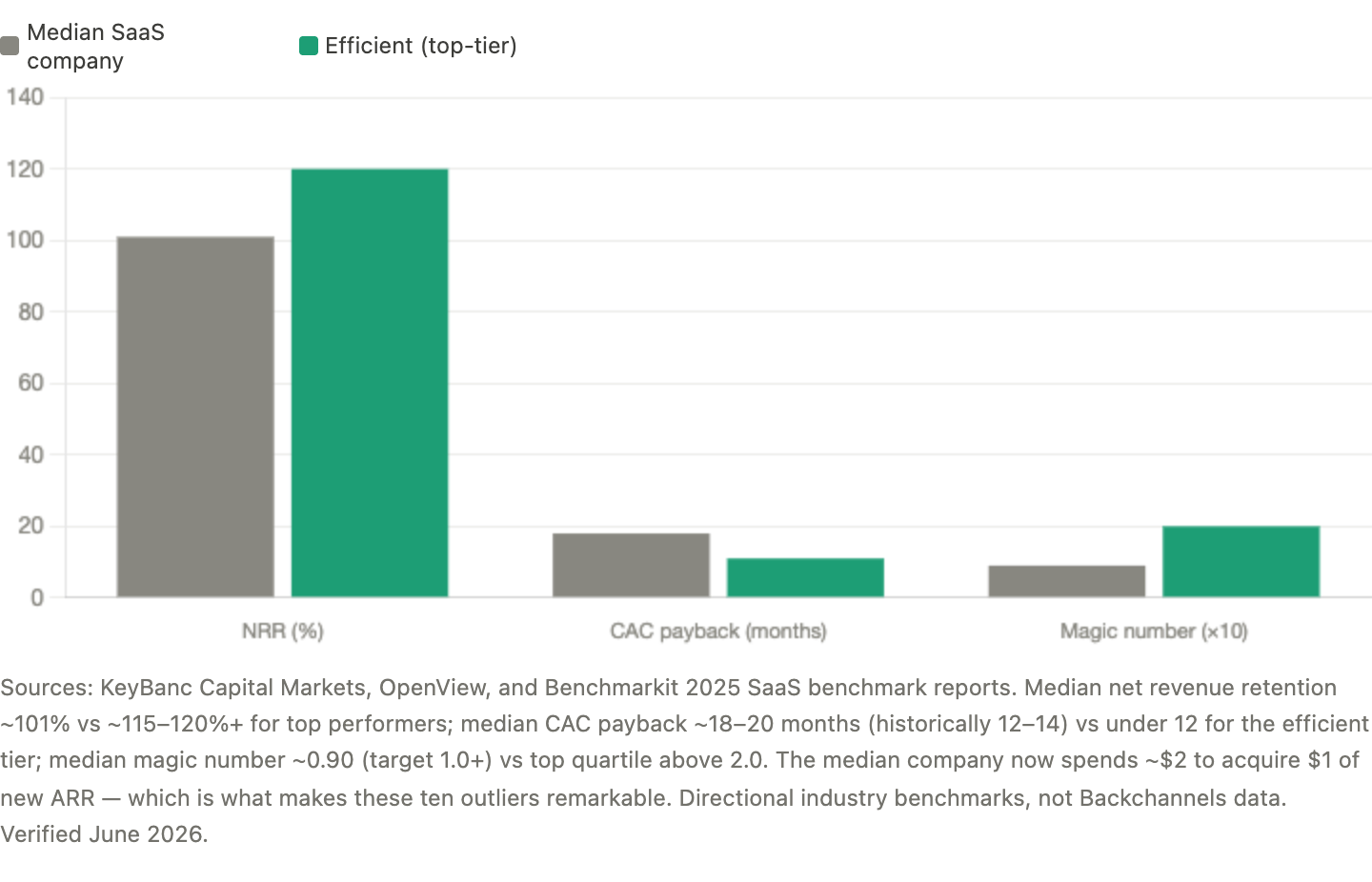
Sales efficiency is the metric that separates companies that grow sustainably from companies that grow expensively. You can buy growth pour money into sales and marketing and watch revenue climb but if every dollar of new revenue costs you two dollars to acquire, you haven't built a business, you've built a treadmill. The companies worth studying are the ones that grow and keep the cost of that growth low. That's efficiency, and in 2026's capital environment it matters more than raw growth ever did.
The way most people measure this is with a few related numbers: the magic number (net new recurring revenue divided by prior-period sales and marketing spend), CAC payback (how many months of revenue it takes to recover the cost of acquiring a customer), and the LTV-to-CAC ratio (the lifetime value of a customer relative to what it cost to land them). The details differ, but they all answer the same question: how much does it cost this company to grow, and is that cost going down or up?
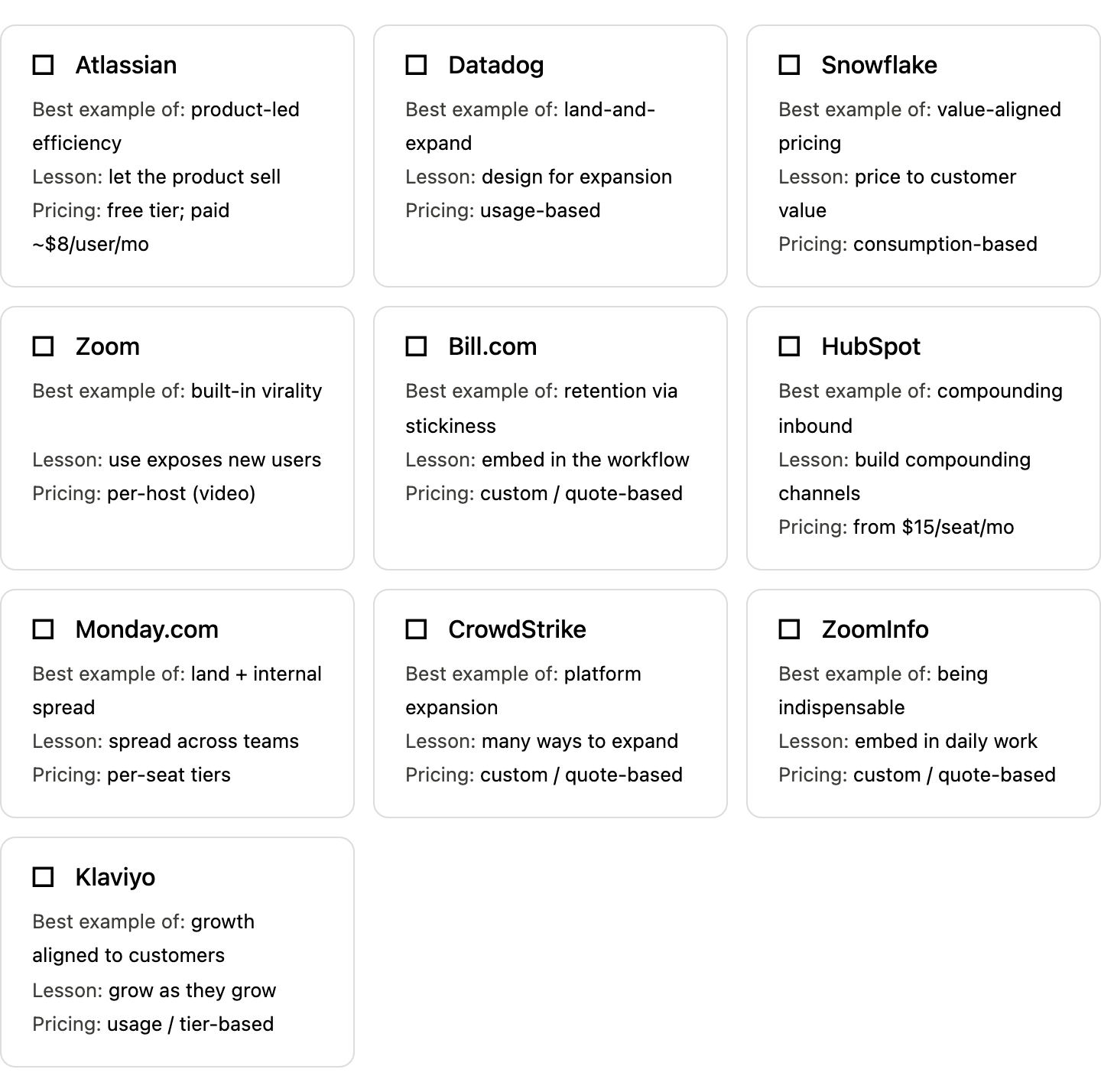
Below are ten SaaS companies associated with unusually strong sales efficiency, the kind of numbers that earned them that reputation, and what made the efficiency possible. As noted above, treat the figures as directional rather than exact. At the end, I'll cover the lever that underpins almost all sales efficiency reaching the right buyers at the right time and how we think about it at Backchannels.
Source 1, Source 2, Source 3, Source 4
1. Atlassian
Atlassian is the textbook example of sales efficiency, because for much of its history it grew explosively while spending remarkably little on traditional sales. The company became known for a model where products spread through self-serve adoption and word of mouth, keeping customer acquisition costs far below what a comparable sales-led company would spend. The kind of efficiency this produced growth with minimal sales spend made it an outlier among software companies.
What made Atlassian's numbers possible was a product-led model that removed the salesperson from much of the buying process. When customers can discover, try, and adopt a product without a sales rep, the cost of acquiring them drops dramatically. Atlassian's efficiency wasn't a sales tactic it was a structural choice to let the product do the selling, which kept acquisition costs low even at scale.
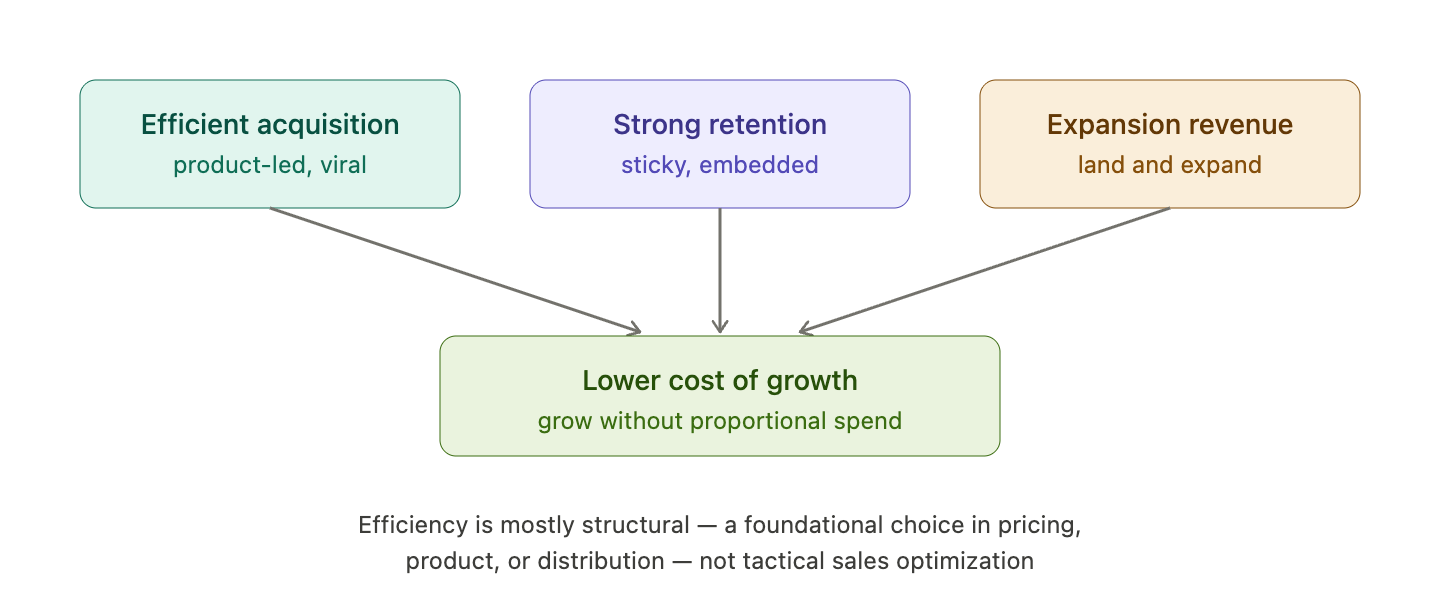
The takeaway for your team is that the most powerful lever on sales efficiency is often structural. If you can let your product drive adoption and reduce the cost of acquiring customers, your efficiency improves at a level no amount of sales optimization can match. Reducing the cost of acquisition is as important as increasing revenue.
2. Datadog
Datadog is associated with strong sales efficiency driven by an exceptional land-and-expand motion. The company became known for efficient growth where existing customers expanded their spending significantly over time, producing the kind of net revenue retention well above 100% that means the customer base grows in value even without new logos. That expansion is one of the most efficient forms of growth there is.
What made Datadog's efficiency possible was a product portfolio designed for expansion and a usage-based model that grew with the customer. When existing customers expand on their own as they use more, growth comes without the full acquisition cost of a new customer, which dramatically improves efficiency. Expansion revenue is efficient precisely because you've already paid to acquire the account.
The takeaway for your team is that expansion is one of the most efficient growth levers available. Growing revenue within existing customers avoids much of the cost of acquiring new ones, improving your overall efficiency. Designing for expansion and tracking how much of your growth comes from existing customers is central to building an efficient business.
3. Snowflake
Snowflake is associated with strong efficiency despite selling complex products to large enterprises, largely because of extraordinary net revenue retention. The company became known for customers expanding their consumption dramatically over time, producing some of the highest expansion rates in software. That kind of expansion where customers routinely grow their spending well beyond their initial commitment is a powerful efficiency driver.
What made Snowflake's numbers possible was consumption-based pricing aligned with growing customer value. As customers used more, they spent more, creating natural expansion that didn't require the full cost of new acquisition. The efficiency came from a pricing model where the company grew automatically as its customers succeeded, turning customer growth directly into revenue growth.
The takeaway for your team is that your pricing model directly shapes your efficiency. A model where revenue grows naturally as customers derive more value creates efficient expansion without constant new acquisition. Aligning your pricing with customer value can turn your existing customer base into an efficient, compounding growth engine.
4. Zoom
Zoom is associated with remarkable sales efficiency during its growth, driven by a product that spread virally and largely sold itself. The company became known for efficient customer acquisition, with the kind of short CAC payback periods that come from a product where each use exposed new potential customers. That viral dynamic kept acquisition costs low even as growth accelerated.
What made Zoom's efficiency possible was a product whose very use was a form of marketing. Every meeting brought new participants into contact with the product, creating organic acquisition that didn't carry the full cost of traditional sales and marketing. The efficiency came from built-in virality the product generated its own demand as a byproduct of being used.
The takeaway for your team is that products which naturally expose new users as they're used can achieve exceptional efficiency. If using your product introduces it to potential new customers, you build in a low-cost acquisition channel. Designing for that kind of organic exposure is one of the most efficient growth levers available.
5. Bill.com
Bill.com is associated with strong efficiency built on a model where customers tend to stay for a long time and the product becomes deeply embedded in their operations. The company became known for the kind of long customer lifetimes and strong retention that produce healthy LTV-to-CAC ratios, because a customer who stays for years is far more valuable relative to what it cost to acquire them.
What made Bill.com's efficiency possible was a product that became deeply embedded in customers' financial workflows, making it sticky and long-lasting. When customers stay for many years because the product is woven into how they operate, their lifetime value grows large relative to acquisition cost, improving efficiency. The stickiness drove retention, and retention drove efficiency.
The takeaway for your team is that retention is a powerful and often underappreciated efficiency lever. A customer who stays longer is worth more relative to what you spent to acquire them, improving your LTV-to-CAC ratio. Making your product sticky and increasing customer lifetime can improve efficiency as much as reducing acquisition costs.
6. HubSpot
HubSpot is associated with strong efficiency driven by its content and inbound engine, which generates demand at a lower cost than paid acquisition. The company became known for efficient customer acquisition supported by a compounding content asset that attracts prospects organically. That inbound engine kept acquisition costs lower than they would be for a company reliant on paid channels.
What made HubSpot's efficiency possible was a content engine that compounds over time, attracting prospects without the linear cost of advertising. Content published years ago continues generating leads, creating an efficient acquisition channel that improves as the asset grows. The efficiency came from building a demand engine that doesn't reset its costs every quarter the way paid acquisition does.
The takeaway for your team is that compounding channels like content improve efficiency over time. Unlike paid acquisition, which costs the same every quarter, a content engine becomes more efficient as it grows. Investing in compounding demand channels is a long-term efficiency play that pays off as the asset matures.
7. Monday.com
Monday.com is associated with strong efficiency built on a model that combines efficient acquisition with significant expansion within accounts. The company became known for landing customers efficiently and then growing those accounts substantially as usage spread across teams, producing the kind of expansion that improves overall efficiency. That combination of efficient landing and strong expansion is a powerful efficiency formula.
What made Monday.com's efficiency possible was a product that spread within organizations as more teams adopted it, driving expansion without proportional acquisition cost. When a product lands in one team and spreads to others, the expansion comes efficiently because much of the acquisition cost was already paid. The efficiency came from a product designed to spread internally once it gained a foothold.
The takeaway for your team is that combining efficient acquisition with strong internal expansion creates powerful efficiency. Landing a customer and then growing within the account as the product spreads improves your overall economics. Designing your product to spread within organizations is an efficient path to growth.
8. CrowdStrike
CrowdStrike is associated with strong efficiency in the enterprise security market, driven by high retention and substantial expansion through a platform model. The company became known for the kind of net revenue retention and module expansion that come from customers adopting more of the platform over time. That expansion across a growing platform is an efficient growth engine.
What made CrowdStrike's efficiency possible was a platform where customers adopted additional modules over time, expanding their spending without the full cost of new acquisition. As customers added more of the platform, revenue grew efficiently from the existing base. The efficiency came from a platform strategy that gave customers many ways to expand, turning each customer into a growing source of efficient revenue.
The takeaway for your team is that a platform with multiple expansion paths drives efficient growth. When customers can adopt more of what you offer over time, you grow efficiently from your existing base. Building multiple expansion opportunities into your offering creates an efficient, compounding growth engine.
9. ZoomInfo
ZoomInfo is associated with strong efficiency built on a data product that's deeply integrated into customers' sales and marketing workflows. The company became known for the kind of efficient growth that comes from a product customers rely on continuously, producing strong retention and expansion. That reliance drove the kind of recurring, expanding revenue that underpins efficient growth.
What made ZoomInfo's efficiency possible was a product that became essential to how customers run their go-to-market, making it sticky and prone to expansion. When customers depend on a product daily and expand their usage as they get more value, growth comes efficiently from the existing base. The efficiency came from being deeply embedded in customers' workflows, which drove both retention and expansion.
The takeaway for your team is that becoming essential to your customers' workflows drives efficiency through retention and expansion. A product customers rely on continuously is sticky and prone to growth, improving your economics. Making your product indispensable to how customers operate is a powerful efficiency lever.
10. Klaviyo
Klaviyo is associated with strong efficiency built on a model where the product's value grows with the customer's own success. The company became known for efficient growth driven by customers who expand their usage as their businesses grow, producing expansion that scales with customer success. That alignment between customer growth and revenue is an efficient dynamic.
What made Klaviyo's efficiency possible was a model where the product's value and the customer's spending grew as the customer's own business grew. When your revenue scales with your customers' success, you grow efficiently alongside them without constant new acquisition. The efficiency came from an alignment where helping customers succeed directly produced expanding, efficient revenue.
The takeaway for your team is that aligning your growth with your customers' success creates efficient expansion. When your revenue grows as your customers grow, you build an efficient engine where helping them succeed grows your business too. Designing that alignment into your model turns customer success directly into efficient growth.
What these ten companies have in common
The clearest pattern across all ten is that efficiency comes as much from retention and expansion as from acquisition. Nearly every company on this list is known for keeping customers a long time and growing their spending over time the net revenue retention story. Efficient growth isn't only about acquiring customers cheaply; it's about making each customer worth more over time, which many of these companies do exceptionally well.
The second commonality is that the biggest efficiency gains tend to be structural. Atlassian's product-led model, Zoom's virality, Snowflake's consumption pricing these aren't sales optimizations, they're structural choices that fundamentally lowered the cost of growth. The companies with wild efficiency usually made a foundational decision that gave them an efficiency advantage no amount of tactical tuning could replicate.
The third pattern is alignment between the company's growth and the customer's value. Consumption pricing, expansion models, products that grow with the customer these create dynamics where the company grows efficiently as its customers succeed. That alignment turns customer success directly into efficient revenue, which is one of the most durable forms of efficiency there is.
How to do this yourself, without their resources
Underneath every efficiency story above is a foundation that's easy to overlook: efficient growth starts with reaching the right buyers at the right time. The cost of acquiring a customer is driven enormously by how well you target chase the wrong accounts and your acquisition costs balloon, while reaching well-matched buyers at the right moment makes every part of the funnel more efficient. That targeting efficiency is exactly the problem we built Backchannels to solve.
Backchannels is a buyer database with buying signals layered on top, designed to improve the efficiency of your acquisition by ensuring your effort goes to the right accounts. Instead of spending sales and marketing resources on poorly matched prospects, you can define your ideal profile, find the accounts that genuinely fit, and reach them when they're showing signs of being in-market so your acquisition cost goes toward the prospects most likely to convert. When we focus our own go-to-market this way, concentrating effort on well-matched accounts at the right time, the efficiency improves at the most fundamental level: we're not wasting spend on accounts that were never going to convert, which is the single biggest source of inefficiency in most sales motions.
The practical path is to attack efficiency on every lever these companies use, starting with targeting. On the acquisition side, reach the right buyers at the right time so your acquisition cost is spent efficiently that's where Backchannels helps. On the retention side, make your product sticky and essential so customers stay longer, improving their lifetime value. On the expansion side, design ways for customers to grow their usage and spending over time, so you grow efficiently from your existing base. And wherever possible, make structural choices pricing, product design, distribution that fundamentally lower your cost of growth. Backchannels handles the targeting foundation, ensuring the acquisition part of your efficiency equation starts with the right accounts.
TRY BACKCHANNELS FREE
Your next customers are already in the database.
Backchannels gives you 225,000 verified software decision-makers. Filter to your exact ICP, preview matches for free, and push them straight into Salesforce or HubSpot. Pay per contact. No subscription, no contract.
Browse contacts freeNo credit card. Preview before you spend a credit.
No items found.
Final Thoughts
The bottom line Wild sales efficiency isn't about spending more on sales it's about lowering the cost of growth through structural advantages, strong retention, and efficient expansion. The ten companies above, with the kind of efficiency numbers that made them stand out, all built dynamics where growth came without proportional cost: product-led adoption, consumption pricing, expansion models, and products that grow with the customer. You don't need their scale to apply the thinking. Reach the right buyers efficiently, retain customers by becoming essential, expand within your existing base, and make structural choices that lower your cost of growth. It all starts with targeting getting your acquisition effort in front of the accounts most likely to convert, at the right time which is the foundation of efficiency and exactly what Backchannels is built to give you.
Published
September 9, 2026
Writer
Joe Backchannels
Share


Most Wanted


12 min read

12 min read

June 2026