.png)
The Backchannel
10 SaaS Companies That Built Outbound Sales Machines From Scratch
Featured Blog


Every SaaS company that runs a serious outbound motion started with nothing no list, no playbook, no reps, no idea whether cold outreach would even work for their product. The ones that built something durable didn't get there by accident. They made deliberate choices early about who to target, how to reach them, and how to turn a few scrappy wins into a repeatable system that could scale past the founders.
That origin story is worth studying precisely because it's the stage most teams are stuck in. It's easy to look at a mature outbound org with hundreds of reps and assume the machine was always there. It wasn't. Someone sat down with a blank spreadsheet, picked a hundred accounts, wrote the first awkward emails, and slowly figured out what worked. The companies below all went through that, and the patterns in how they did it are the closest thing to a blueprint that exists.
Below are ten SaaS companies known for building outbound from the ground up, what they got right in the early days, and how you can apply the same thinking whether you're sending your first cold email or trying to make your motion repeatable. At the end, I'll cover how we think about the foundation underneath all of this at Backchannels because the hardest part of building outbound from scratch is knowing who to point it at.
1. Salesforce
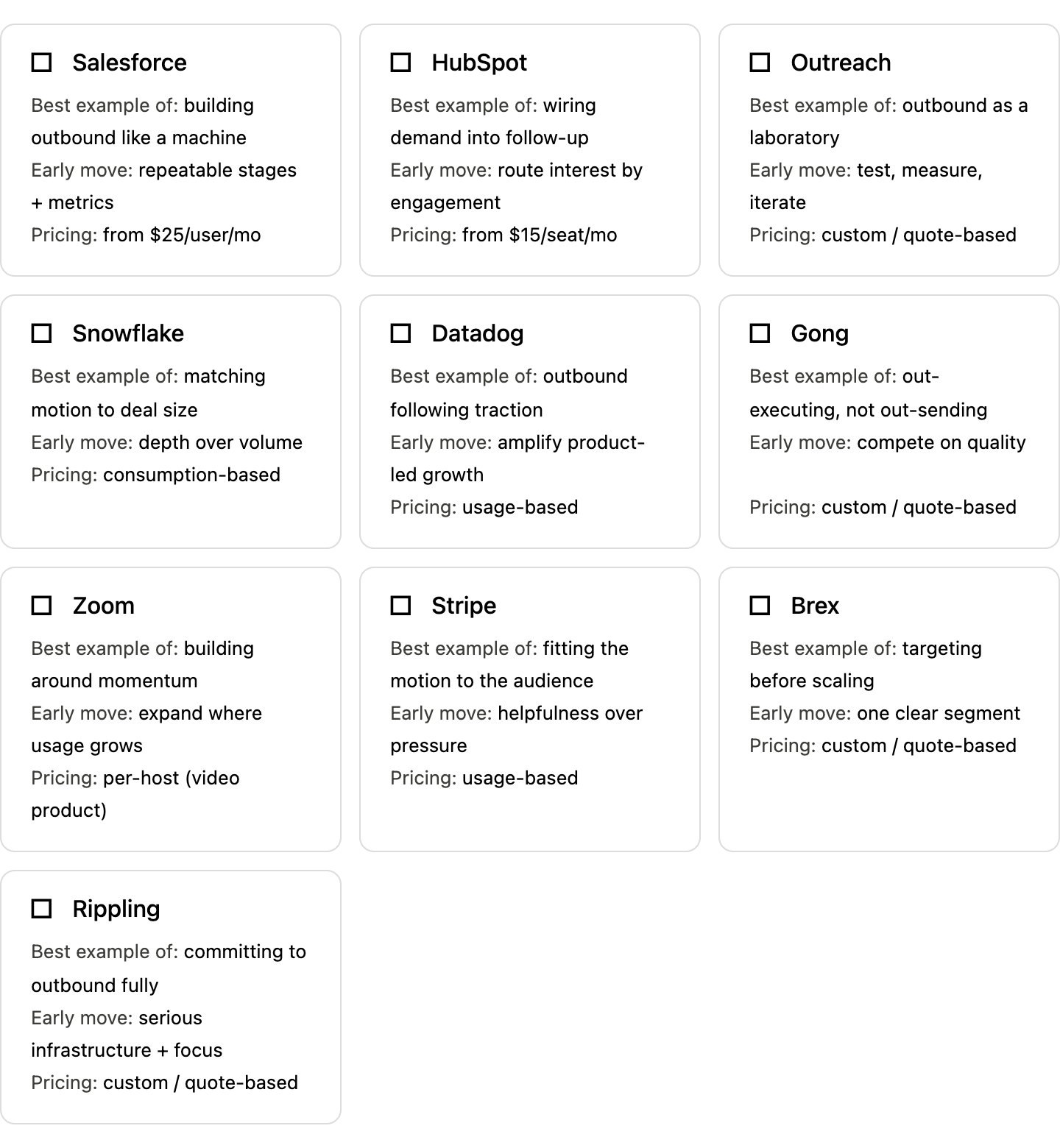
Salesforce is the obvious starting point, because in many ways it wrote the modern outbound playbook. In its early days it combined aggressive outbound sales with a then-novel product delivery model, and it built a sales culture that treated pipeline generation as a discipline rather than an afterthought. The company demonstrated that software could be sold proactively, at scale, by a structured sales organization.
What's instructive about Salesforce's early motion is the insistence on process. Rather than relying on a few star sellers, they built repeatable stages, clear metrics, and a system that new reps could be dropped into and made productive. That obsession with process is what let them scale outbound from a scrappy operation into a global sales machine.
The takeaway for your own team is that outbound becomes a machine only when it's built like one. The first version will be messy, but the goal from day one should be to notice what works and turn it into a repeatable step. A documented process that a new hire can follow is the difference between a team that scales and one that depends on heroics.
2. HubSpot
HubSpot is famous for inbound, but the part of its story that gets overlooked is how deliberately it built a sales engine to convert all that inbound interest. The company paired its content-driven demand with a structured sales motion, effectively building an outbound-style follow-up machine on top of an inbound top of funnel. The result was a system where marketing created interest and sales systematically pursued it.
What makes HubSpot worth studying is the integration of the two motions. They didn't treat lead generation and sales as separate worlds; they built a handoff where behavioral signals from marketing fed directly into sales prioritization. That tight loop is what made their growth so efficient reps weren't guessing who to call, they were following the interest.
For your team, the lesson is to connect whatever demand you generate to a systematic follow-up motion. Even if your top of funnel is small, the discipline of routing interested prospects into a defined sales process and prioritizing by engagement turns scattered attention into actual pipeline. Don't let a warm signal sit; build the machine that acts on it.
3. Outreach
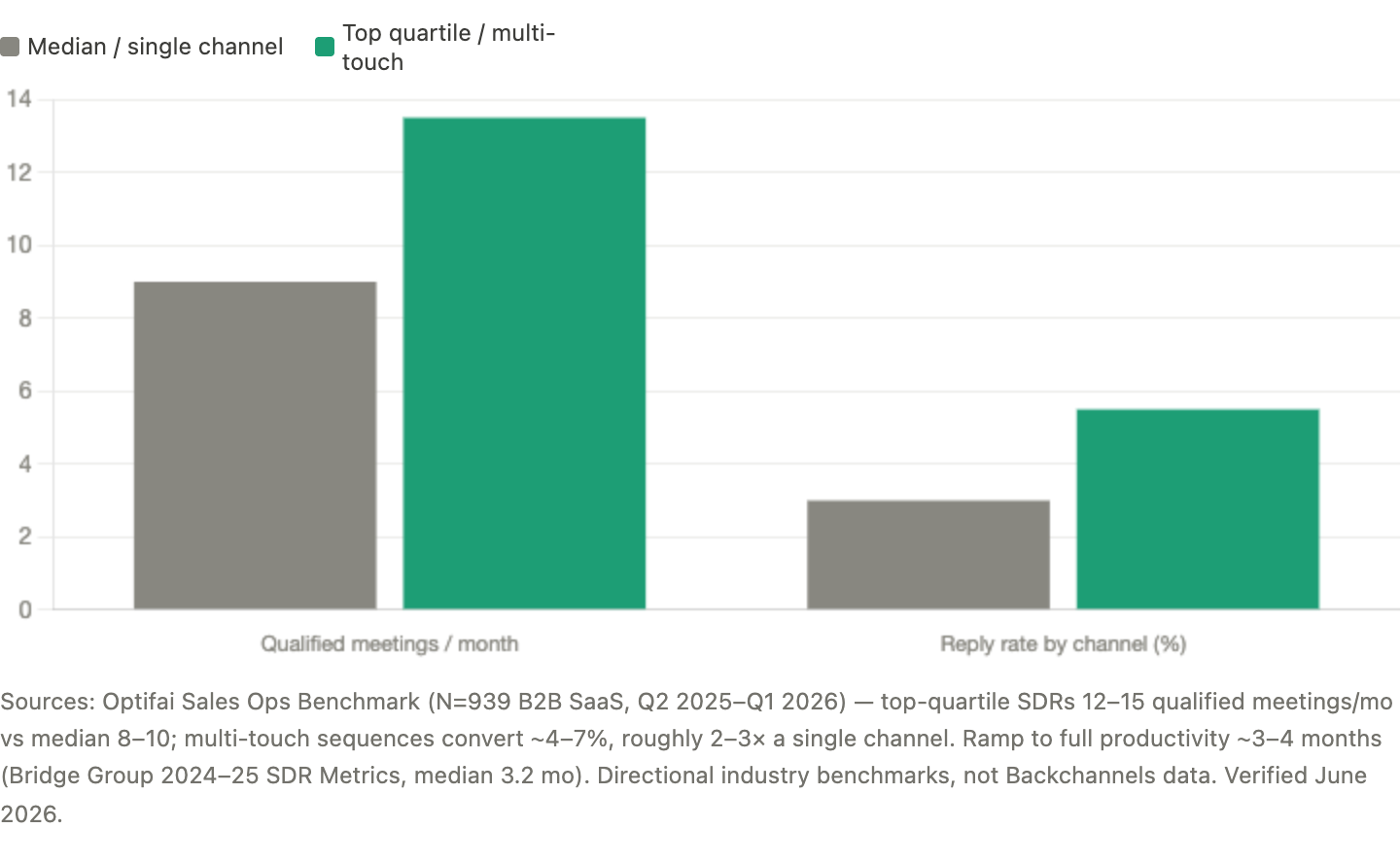
Outreach built its own outbound machine while building the software others use to build theirs which gives its origin story a particular credibility. As a young company, it had to practice the sales engagement discipline it was selling, running structured, multi-touch sequences and refining them based on hard data about what actually produced replies and meetings.
The reason Outreach is instructive is that it treated its own outbound as a laboratory. Every sequence was a hypothesis, every result was data, and the motion improved continuously because it was measured continuously. This is the opposite of the "set it and forget it" approach that dooms most outbound they built a culture of constant iteration from the start.
The applicable lesson is to treat your outbound as something you experiment with, not something you set once. Track which messages and sequences produce results, kill what doesn't work, and double down on what does. The teams that build durable machines are the ones that learn from every send, turning outbound into a system that gets sharper over time.
4. Snowflake
Snowflake built an enterprise sales machine aimed at large, high-value accounts, and its early outbound reflected the discipline that selling to big companies requires. Rather than casting a wide net, it focused on a defined set of high-value targets and built a motion designed to penetrate them methodically. The approach was precise rather than broad.
What's worth studying is how Snowflake aligned its outbound to the reality of enterprise buying. Big deals involve many stakeholders and long cycles, so the machine they built emphasized account focus, multi-threading, and patience over volume. They understood that for their market, reaching the right twenty accounts deeply mattered more than reaching two thousand shallowly.
For your team, the takeaway is to match your outbound machine to the size and shape of the deals you're chasing. If you sell to large accounts, build for depth and focus rather than volume. The right structure depends entirely on your market, and copying a high-volume motion when you sell complex enterprise deals (or vice versa) is a common and costly mismatch.
5. Datadog
Datadog built an outbound motion that complemented a strong product-led foundation, and its early go-to-market is a lesson in combining self-serve adoption with proactive sales. As developers adopted the product organically, the company layered in outbound to expand within and beyond those accounts, building a machine that amplified product-led growth rather than fighting it.
The reason Datadog is instructive is the harmony between motions. Plenty of companies treat product-led and sales-led growth as either/or, but Datadog showed how outbound can accelerate a product that's already spreading on its own. Their reps targeted accounts where adoption signals indicated opportunity, making the outbound efficient because it followed real traction.
The lesson for your team is that outbound doesn't have to replace your other growth motions it can amplify them. If people are already finding and using your product, build an outbound motion that targets where that adoption is happening. Reaching out where there's already a foothold is far more efficient than starting every conversation completely cold.
6. Gong
Gong built its outbound machine in a crowded market, and it did so by pairing disciplined execution with a strong, data-driven point of view. From early on, the company's outbound reflected the same insight-led philosophy as its product messages grounded in specifics, sequences built on evidence, and a brand voice that stood out in a sea of generic sales emails.
What makes Gong worth studying is that it differentiated through quality in a category where everyone was doing outbound. Rather than trying to out-volume competitors, Gong out-executed them better targeting, sharper messaging, and a memorable voice. That focus on doing outbound well, not just doing more of it, is what let a newer entrant build a machine that punched above its weight.
For your team, the takeaway is that you can build a strong outbound motion even in a competitive market by competing on quality rather than quantity. Sharper targeting and better messaging will beat raw volume, especially when your prospects' inboxes are already full of mediocre outreach. Build the machine to be good, not just big.
7. Zoom
Zoom built a sales machine alongside a product that spread largely on its own merits, and its early go-to-market is a study in supporting viral adoption with structured outbound. As the product gained traction through word of mouth and self-serve signups, Zoom layered in a sales motion to convert and expand the accounts where usage was growing, building a machine that captured value the product was already creating.
The reason Zoom is instructive is the discipline of building outbound that follows product momentum. They didn't need to manufacture demand from nothing they needed a machine to systematically pursue the demand the product generated. That meant targeting accounts showing real usage and building a motion to expand them, which is a very different and more efficient starting point than pure cold outbound.
The lesson for your team is to build your outbound around wherever you have natural momentum. If your product spreads through usage or referrals, your machine's job is to systematically capture and expand that, not to start from zero every time. Following existing momentum makes the whole motion more efficient and easier to scale.
8. Stripe
Stripe built its go-to-market with the same care it brought to its product, and its early motion reflects a deep respect for its developer audience. Rather than aggressive cold outreach, Stripe focused on being genuinely useful and lowering the friction of adoption, building a motion that fit how developers actually wanted to discover and adopt tools.
What's worth studying is how Stripe matched its outbound to its audience's preferences. Developers are skeptical of traditional sales tactics, so Stripe built a motion around helpfulness, documentation, and word of mouth rather than pressure. The machine they built worked because it respected the people on the other end, earning trust in a community that's quick to reject anything that feels like a hard sell.
For your team, the takeaway is to build your outbound motion around how your specific audience wants to be approached. A machine that ignores your buyers' preferences will struggle no matter how well-built it is. Understand what your audience responds to and what they're allergic to and design the motion to fit, especially if you're selling to a skeptical or technical crowd.
9. Brex
Brex built an outbound machine targeting a specific, well-defined segment, and its early motion is a lesson in the power of precise targeting. Rather than trying to sell to everyone, Brex focused tightly on a particular type of company that fit its product perfectly, and built outbound designed to reach and resonate with exactly that profile.
The reason Brex is instructive is that the precision of its targeting made its outbound efficient. When you know exactly who your product is for, every part of the machine the list, the message, the timing gets sharper, because it's all aimed at a clearly defined audience with a clearly relevant need. That focus let Brex build pipeline quickly in its target segment rather than spreading effort thin.
The applicable lesson is to define your target segment precisely before you scale your outbound. A machine aimed at a clear, well-understood profile will dramatically outperform one aimed at everyone. The narrower and more accurate your targeting, the more every message lands and the easier the entire motion becomes to build and run.
10. Rippling
Rippling built an outbound machine known for its aggressiveness and precision, and its early go-to-market reflects a willingness to invest heavily in outbound as a primary growth engine. The company built a structured, high-output motion aimed at a clear market, treating outbound as a core competency to be built deliberately rather than a channel to dabble in.
What makes Rippling worth studying is the commitment to outbound as a discipline. They didn't treat it as a side experiment they built serious infrastructure, process, and focus around it, which is what allowed the motion to scale. That seriousness, combined with precise targeting, is a big part of why their outbound became a genuine growth machine rather than a minor contributor.
For your team, the takeaway is that building a real outbound machine requires real commitment. Dabbling produces dabbling results. If outbound is going to be a meaningful growth channel for you, it deserves deliberate investment in process, targeting, and iteration the companies that treat it seriously are the ones that build something that lasts.
What these ten companies have in common
Strip away the differences and a few shared principles emerge. First, every one of these companies treated outbound as a system to be built deliberately, not a set of activities to wing. The specifics varied some built for enterprise depth, some amplified product-led momentum but all of them approached outbound as infrastructure, with process and iteration baked in from the start.
Second, targeting came before scale in every case. None of these companies succeeded by blasting the widest possible audience. They defined who their product was for, often narrowly, and built their machine around reaching that specific profile. The precision of the targeting is what made the rest of the machine efficient.
Third, the best machines fit their context. Snowflake built for enterprise, Stripe built for developers, Datadog amplified product-led growth each motion matched the company's market and audience rather than copying a generic template. The lesson isn't to imitate any single playbook, but to build the one that fits your product, your buyers, and your motion.
How to do this yourself, without their resources
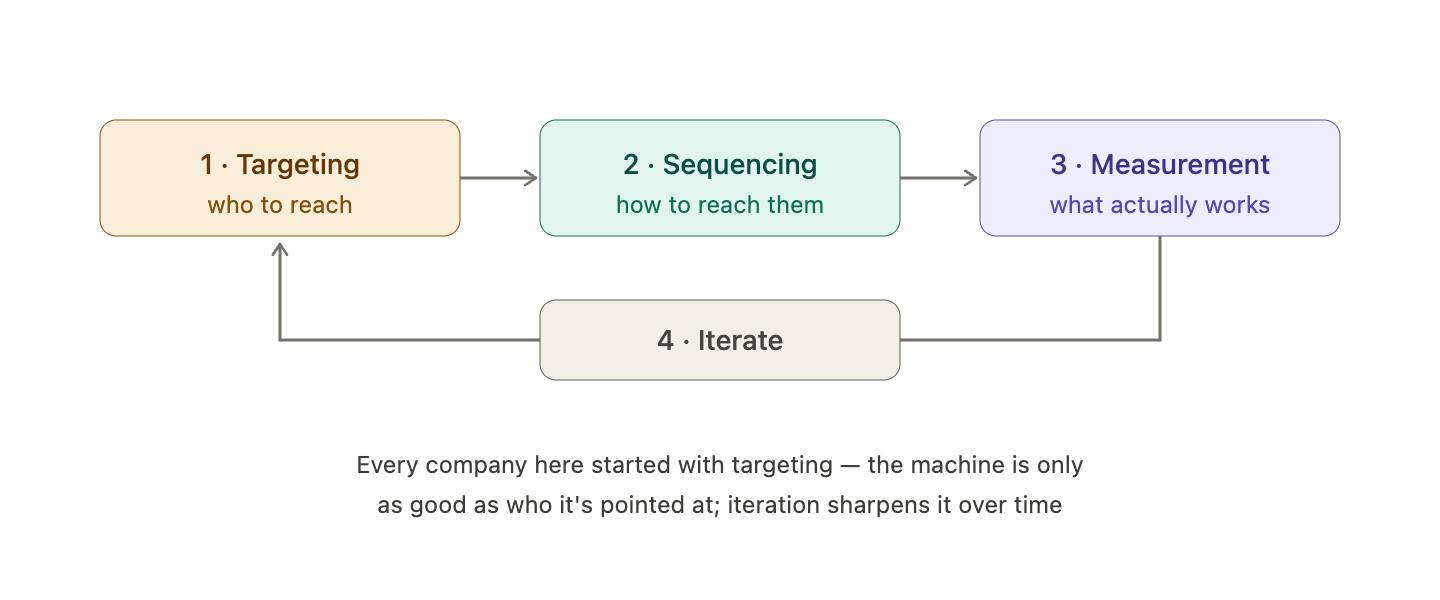
Here's the common thread underneath all ten stories, and the thing most teams underestimate when building outbound from scratch: the machine is only as good as the targeting it's built on. Every company above started by figuring out exactly who to reach. That's the foundation and it's also the part that's hardest to get right when you're starting with a blank spreadsheet. This is precisely the problem we built Backchannels to solve.
Backchannels is a buyer database with buying signals layered on top, designed to be the foundation a from-scratch outbound motion stands on. Instead of manually assembling a target list and guessing who fits, you can define your ideal profile and pull the accounts that genuinely match then see which of them are showing signs of being in-market right now. When we built our own outbound, having that foundation in place is what let us skip the most painful part of starting from zero: we knew who to point the machine at from day one, so every subsequent decision about messaging and sequencing was built on solid ground rather than guesswork.
The practical path mirrors what these ten companies did. Start by defining your target profile as precisely as you can the narrower and more accurate, the better, as Brex and Snowflake show. Then build your list around that profile rather than around everyone you could theoretically sell to. Layer in timing by prioritizing the accounts showing real signals. And only then build out your sequences and messaging, treating the whole thing as a system you measure and refine, the way Outreach and Salesforce did. Backchannels handles the foundation the targeting and signal layer so the machine you build from scratch is pointed in the right direction from the very first email.
TRY BACKCHANNELS FREE
Your next customers are already in the database.
Backchannels gives you 225,000 verified software decision-makers. Filter to your exact ICP, preview matches for free, and push them straight into Salesforce or HubSpot. Pay per contact. No subscription, no contract.
Browse contacts freeNo credit card. Preview before you spend a credit.
No items found.
Final Thoughts
The bottom line Every outbound machine was built from nothing by someone willing to be deliberate about it. The ten companies above didn't stumble into scalable outbound they made early choices about targeting, process, and fit that compounded into something durable. That's an encouraging truth if you're at the blank-spreadsheet stage, because it means the machine is buildable, not magic. Start with precise targeting, build a system you can measure and improve, and match the motion to your market and audience. Do that, and you'll be following the same path these companies walked turning a scrappy first attempt into a real outbound engine. And the foundation that makes it all work, knowing exactly who to reach and when, is exactly what Backchannels is built to give you from the start.
Published
August 19, 2026
Writer
Joe Backchannels
Share


Most Wanted

12 min read

12 min read

June 2026