.png)
The Backchannel
10 Companies That Use Buying Signals to Time Their Outreach Perfectly
Featured Blog

Most outbound fails for a boring reason: it shows up at the wrong time. The message is fine, the targeting is roughly right, but the prospect simply isn't in the market the week the email lands so it gets archived in half a second. The teams that consistently beat this aren't smarter writers. They've just figured out when to reach out, by reading the signals that tell them a buyer is moving.
A buying signal is any observable event that suggests an account is more likely to need what you sell, right now. A funding round. A new VP of Sales. A spike in hiring for a specific role. A competitor's tool showing up in their stack. A surge of people from one company reading your pricing page. None of these guarantee a deal but each one shifts the odds, and stacked together they tell you which 50 accounts out of 5,000 deserve a message this week.
We spent time studying how the best go-to-market teams actually operate, and a pattern emerged: the companies with the most efficient pipelines treat timing as a first-class input, not an afterthought. Below are ten of them, what signal they've built their motion around, and most importantly how you can copy the underlying idea without their budget or headcount. At the end, I'll show you how we approach this at Backchannels, because reading signals at scale is precisely the problem we built the product to solve.
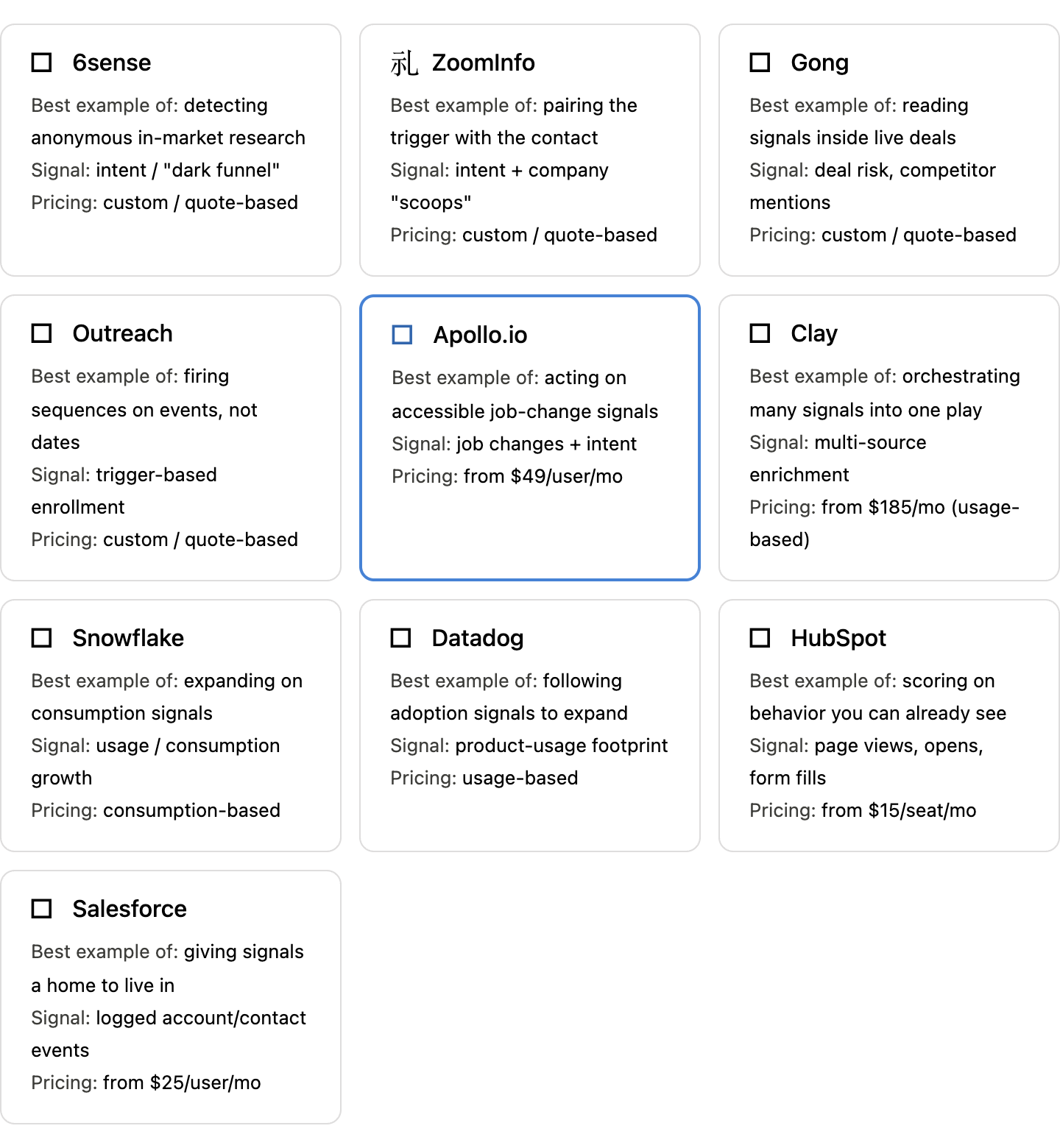
Comparison Table
Source 1, Source 2, Source 3, Source 4, Source 5
1. 6sense
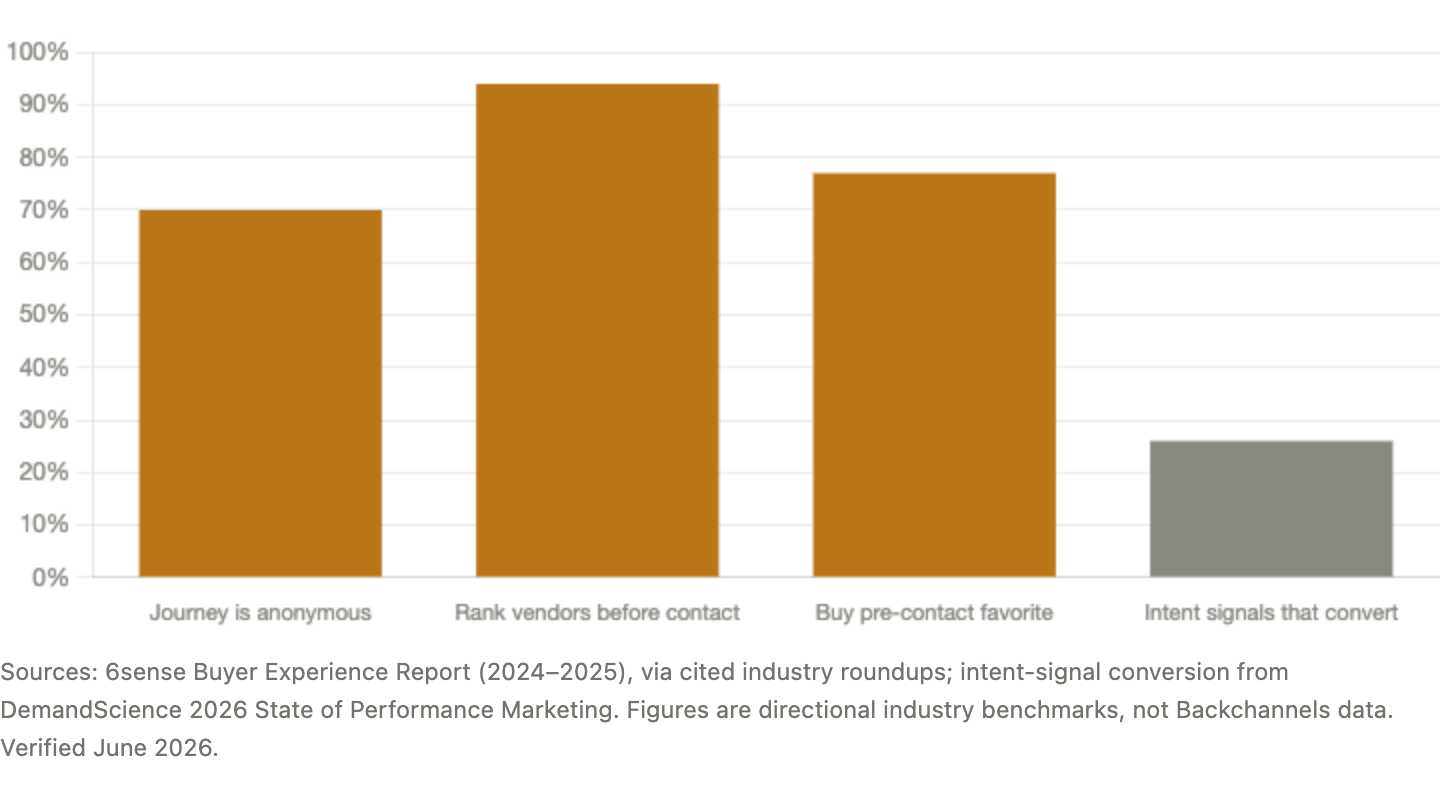
6sense is almost the patron saint of signal-based selling, because intent data is the product. Their whole premise is that the majority of a buyer's research happens anonymously the "dark funnel" long before anyone fills out a form. By aggregating intent signals across the web and matching them back to accounts, they try to tell sales teams which companies are quietly in-market before those companies ever raise their hand.
What makes 6sense instructive isn't the technology, it's the philosophy: they assume the buyer is already shopping and the seller's job is to detect it, not to create demand from a cold start. Their own go-to-market reportedly leans hard on this prioritizing accounts showing research spikes and routing reps to the ones with the strongest signals first.
The takeaway for a smaller team is the mindset shift. Stop treating every account in your ICP as equally ready. At any given moment, a small slice of your market is actively researching a solution like yours, and the rest aren't. If you can identify even a rough version of that slice through hiring activity, technology changes, or engagement on your site you can spend your limited outbound hours on the accounts most likely to respond, instead of spraying the whole list.
2. ZoomInfo
ZoomInfo built a category on the idea that better data beats more effort. Beyond contact information, they layer in intent signals and "scoops" early indicators like a company planning an initiative, reorganizing a department, or evaluating new vendors. The pitch to their customers is essentially: don't guess who's in-market, let the data tell you.
What's worth studying is how they combine who with when. A list of accurate contacts is useful, but a list of accurate contacts at companies that just triggered a relevant event is dramatically more valuable. ZoomInfo's success is a reminder that the signal and the contact are two halves of the same workflow knowing a company is hiring twenty SDRs is useless if you can't reach the VP of Sales who now has a problem to solve.
For your own motion, the lesson is to never separate the trigger from the target. When you spot an event worth acting on, you need the path to a human attached to it immediately, or the moment passes. The teams that win here have made "signal detected" and "here's who to contact" a single step rather than two disconnected research projects.
3. Gong
Gong captures and analyzes sales conversations, and in doing so surfaces a different class of signal: the ones hiding inside your existing pipeline. Which deals went quiet. Which mentioned a competitor. Which had a champion who stopped showing up to calls. These are buying signals too just pointed at deals already in motion rather than cold accounts.
The reason Gong belongs on this list is that it expands the definition of "signal" beyond prospecting. Timing isn't only about when to start a conversation; it's about when to re-engage, when to escalate, and when to walk away. A deal that's slipping often broadcasts that fact through subtle changes in behavior, and the teams that catch those changes early can intervene while they still have a chance.
You can apply a low-tech version of this without conversation intelligence. Build the habit of reviewing your open pipeline for behavioral changes weekly who's gone dark, whose engagement dropped, which accounts suddenly went quiet after being active. Those shifts are signals, and acting on them quickly is often higher-leverage than finding net-new accounts.
4. Outreach
Outreach is a sales engagement platform, and its core contribution to signal-based selling is triggers the idea that sequences shouldn't fire on a calendar, they should fire on events. Instead of "day three, send email two," the smarter motion is "when this account does X, start this play."
This matters because most outbound cadences are blind to what the prospect is actually doing. A sequence that keeps marching forward while ignoring a reply, a website visit, or a job change feels robotic precisely because it is. Outreach's trigger-based approach reflects a more honest model of selling: the buyer's behavior should dictate the seller's next move, not a rigid schedule decided in advance.
For your team, the principle is to make your follow-up responsive. Even if you're working out of a spreadsheet, the difference between "I follow up every Tuesday" and "I follow up the day after they visited our site" is the difference between noise and relevance. Let the prospect's actions set the tempo.
5. Apollo.io
Apollo combines a large prospecting database with engagement tooling, and it's become especially associated with acting on practical, accessible signals job changes chief among them. When a champion who loved your product moves to a new company, that's one of the highest-converting signals in B2B, because you're reaching a warm advocate at the exact moment they're rebuilding their stack.
What Apollo illustrates is that you don't need exotic intent data to play this game. Some of the best signals are mundane and public: someone changed jobs, a company opened a new office, a team posted a role that implies they're scaling a function you support. These events are visible to anyone paying attention, and they convert because they map to a real, time-bound need.
The applicable lesson is to pick two or three signals you can actually track and build a repeatable play around each. Job changes are a perfect starting point. When someone in your world moves, you already have a reason to reach out, a warm relationship to lean on, and near-perfect timing all without a single dollar of intent data.
6. Clay
Clay has become the darling of modern outbound teams because it makes signal orchestration accessible. It lets operators pull data from many sources, enrich accounts and contacts, and trigger personalized outreach based on whatever combination of signals they define. In practice, it's the connective tissue that turns scattered events into an actual workflow.
The reason Clay is on this list is that it represents where outbound is heading: away from static lists and toward dynamic, signal-driven systems that a single operator can run. The teams using it well aren't sending more email they're sending email that's triggered by specific, layered conditions, so each message has a reason to exist. "You just raised a round and you're hiring for this role" is a very different opener than "I wanted to introduce our platform."
For your own motion, the takeaway is that the tooling to do this is no longer reserved for big teams. You can assemble a signal-based workflow yourself, defining the triggers that matter for your market and letting them drive who gets contacted. The barrier now is clarity about which signals matter, not access to the machinery.
7. Snowflake
Snowflake's growth is a case study in acting on consumption signals. Its business model ties revenue to usage, which means expansion is driven by watching how customers actually use the product and engaging when usage patterns indicate readiness for more. The signal isn't external intent it's behavior inside the account.
This is worth studying because it reframes "outreach" as something you do to existing customers, not just prospects. A customer whose usage is climbing toward a threshold, or who just started using a new part of the product, is signaling an expansion opportunity as clearly as a cold account signals a new deal. The companies that grow efficiently treat these internal signals as triggers for proactive, well-timed conversations.
For your team, the lesson is to mine your own product and account data for signals, not just the open web. Who's approaching a plan limit? Who onboarded a new department? Who's using you more this month than last? Those patterns tell you exactly when to reach out to grow an account and that outreach lands because it's anchored to something real the customer is already doing.
8. Datadog
Datadog is a land-and-expand machine, and much of that expansion is powered by product-usage signals. A team adopts one product, usage grows, adjacent teams start poking at other modules, and those behavioral signals tell the sales org where the next expansion conversation should happen. The motion is less about cold prospecting and more about reading the footprint of adoption inside an account and following it.
What makes Datadog instructive is the discipline of expanding along signals rather than guessing. When one team's usage spikes or a new product gets trialed inside an existing customer, that's a precise, time-bound indicator of intent and engaging at that moment converts far better than a generic upsell push on a calendar.
You can apply this even without sophisticated usage analytics. Pay attention to where adoption is spreading inside your accounts new users from a different team, a new use case appearing, a sudden jump in activity. Each of those is a signal that the moment is right to expand the relationship, and timing your outreach to those moments beats forcing the conversation when nothing has changed.
9. HubSpot
HubSpot helped popularize the behavioral signal as the backbone of inbound. Email opens, page views, form fills, content downloads each action a prospect takes feeds a picture of intent, and lead scoring turns that picture into a priority order. The reps don't chase everyone equally; they chase the people whose behavior says they're warming up.
The reason HubSpot belongs here is that it democratized this idea for companies of every size. You don't need an enterprise data platform to know that someone who visited your pricing page three times this week is more ready than someone who downloaded one ebook six months ago. The behavioral trail is right there, and acting on it is mostly a matter of deciding to.
For your team, the applicable move is to score and prioritize based on behavior you can already see. Whoever is engaging most with your site, your content, and your emails should be at the top of today's outreach list. It's the simplest signal to capture and one of the most reliable, because the prospect is telling you, through their actions, that they're paying attention.
10. Salesforce
Salesforce is the foundation much of modern signal-based selling was built on, because it gave teams a place to capture account and contact signals in the first place. Field history, activity tracking, account changes, and the vast ecosystem of integrations meant that for the first time, the events surrounding a deal could be logged, surfaced, and acted on systematically rather than living in a rep's memory.
What's worth taking from Salesforce isn't a specific feature it's the principle that signals are only useful if they're captured somewhere you'll actually see them. A buying signal that no one records is a missed opportunity. The teams that operationalize timing have a system where relevant events get logged and surfaced to the right person at the right moment, so acting on them becomes routine rather than dependent on someone happening to notice.
The lesson for your motion is to build a home for your signals, however simple. If a trigger event has nowhere to live, it won't drive action. Even a basic system that captures the events that matter and puts them in front of the right rep will outperform a team relying on memory and luck.
What these ten companies have in common
Strip away the logos and the same idea runs through all of them: the best-timed outreach is a response to something the buyer did, not a message sent on a schedule decided in advance. Whether the signal is external intent, a job change, consumption growth, or behavior on your own site, the winning pattern is to detect the moment and act while it's live.
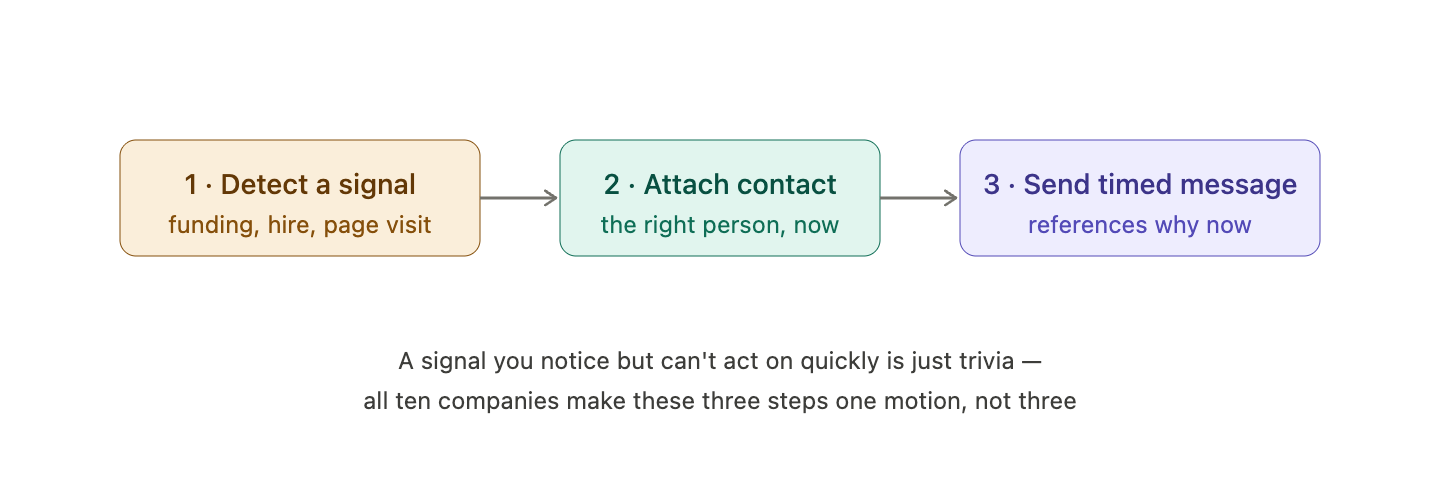
The second commonality is that signals are only as valuable as the workflow attached to them. Every company on this list pairs detection with action the trigger and the contact and the message live in one motion, not three disconnected steps. A signal you notice but can't act on quickly is just trivia.
And the third, quieter lesson: most of these signals are accessible. You don't need a nine-figure data budget to know that a company just raised a round, posted a telling job, or visited your pricing page repeatedly. The events that predict buying are often hiding in plain sight. The constraint for most teams isn't access it's not having a system to catch the signals and turn them into well-timed outreach.
How to do this yourself, without their budget
This is the gap we built Backchannels to close. Reading buying signals at scale used to require stitching together intent data, enrichment, and a CRM, then hiring an ops person to keep it all running. For most teams, that's out of reach so they fall back on static lists and calendar-based cadences, and their outbound lands at the wrong time.
Backchannels gives you a buyer database with the signals layered on top, so you can find the accounts that are actually moving and reach the right person without assembling a stack yourself. Instead of working a frozen list of 5,000 accounts, you can surface the slice showing real activity this week the hiring spikes, the role changes, the engagement patterns and point your outreach there. When we run our own outbound this way, prioritizing accounts by live signals instead of working alphabetically, we consistently see reply rates several times higher than blasting the full list, because every message has a reason to exist.
The practical starting point is simple. Pick two or three signals that genuinely map to need in your market a funding event, a key hire, a technology change, a surge of engagement. Build one repeatable play for each: the trigger, the person to reach, and the message that references why now. Then work those plays before you touch your cold list. You'll be doing exactly what the ten companies above do, just at the scale that fits your team and Backchannels is what makes the detection part practical when you don't have an ops team to build it.
TRY BACKCHANNELS FREE
Your next customers are already in the database.
Backchannels gives you 225,000 verified software decision-makers. Filter to your exact ICP, preview matches for free, and push them straight into Salesforce or HubSpot. Pay per contact. No subscription, no contract.
Browse contacts freeNo credit card. Preview before you spend a credit.
No items found.
Final Thoughts
The bottom line Perfect timing isn't a personality trait or a stroke of luck. It's a system: detect a signal, attach a contact, send a message that earns the moment. The companies that have made this systematic from intent-data pioneers to consumption-driven giants all share the same underlying belief that the buyer's behavior should set the tempo of the sale. You don't have to match their resources to adopt their thinking. Start with the signals you can actually see, build a small number of plays around them, and let those plays take priority over cold volume. Reach people when something has changed in their world, and outreach stops feeling like an interruption and starts feeling like good timing because it is.
Published
August 17, 2026
Writer
Joe Backchannels
Share


Most Wanted


12 min read

12 min read

June 2026