.png)
The Backchannel
10 B2B Companies With the Best Cold Outreach We've Ever Seen
Featured Blog

Cold outreach has a bad reputation, and most of it is deserved. The average B2B inbox is a graveyard of templated "quick question" emails, fake-personalized openers, and breakup messages from reps who never had a relationship to break up. So when a company actually does cold outreach well when a message makes you stop, read, and reply instead of archive it stands out precisely because it's so rare.
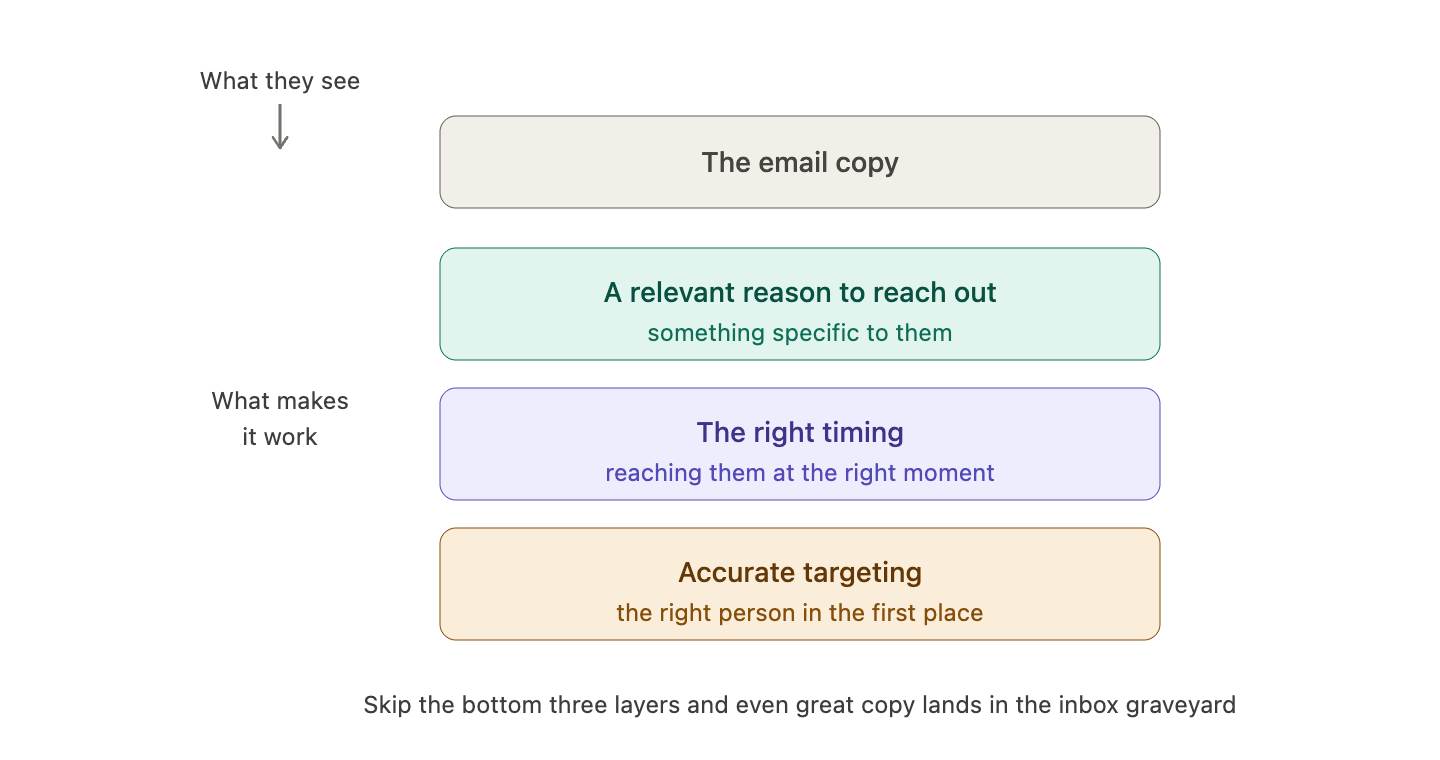
We've spent a lot of time studying outbound, both as practitioners and as targets of it, and a handful of companies consistently get it right. Not because they've discovered some secret template, but because they understand something most teams miss: great cold outreach isn't about the message at all. It's about the research, the targeting, and the timing that happen before a single word gets written. The message is just where that work becomes visible.
Below are ten B2B companies whose cold outreach is worth studying, what specifically makes their approach work, and how you can apply the underlying principle without copying their scripts. At the end, I'll walk through how we think about the foundation that makes all of this possible at Backchannels because the best outreach in the world fails if it's pointed at the wrong people at the wrong time.
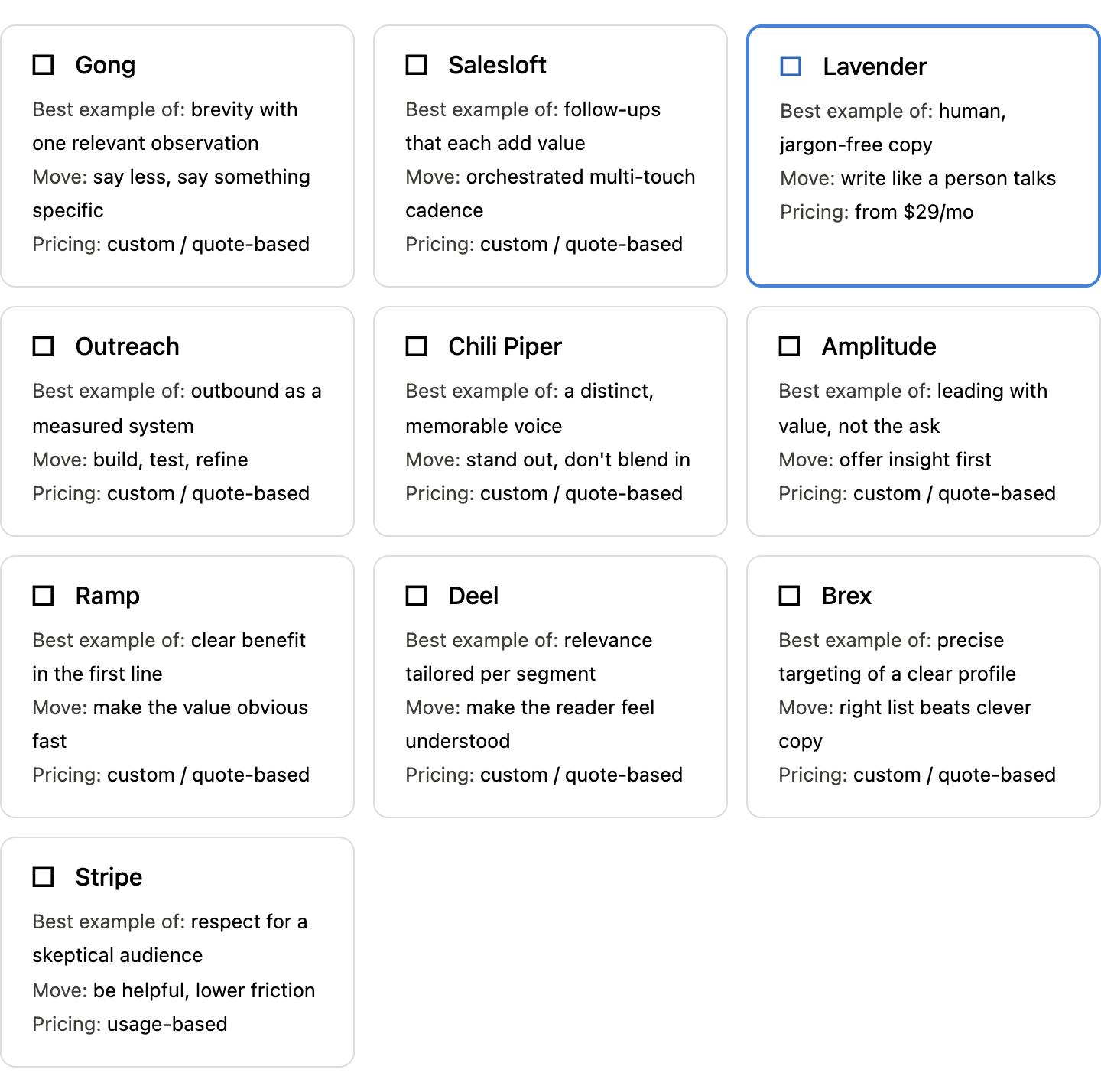
Comparison Table
1. Gong
Gong's outbound is frequently cited as a gold standard, and the reason is discipline. Their reps don't send walls of text. They lead with a specific, relevant observation, keep the message short, and make the ask absurdly easy to say yes to. There's a confidence to it they're not begging for a meeting, they're offering a reason one might be worth your time.
What makes Gong instructive is that their outreach reflects their product philosophy: they sell on data and insight, and their cold emails carry the same tone. Rather than making vague claims, they reference patterns and specifics that signal they've actually thought about the recipient's world. The brevity isn't laziness it's respect for the reader's time, which is itself a form of personalization.
The takeaway for your team is to cut ruthlessly. Most cold emails are too long, too hedged, and too focused on the sender. A short message with one relevant observation and one easy ask will almost always outperform a paragraph of features. Write less, say something specific, and make the next step trivial.
2. Salesloft
Salesloft has built much of its reputation on the idea of the well-orchestrated multi-touch cadence, and their own outreach reflects that craft. It's not a single email hoping to land it's a sequence of touches across channels, each one adding a little context rather than just "bumping" the last. The follow-ups feel like a continuation of a thought, not a robotic nudge.
What's worth studying is how they avoid the most common follow-up sin: the empty "just checking in" that adds nothing. Each touch in a good Salesloft-style cadence earns its place by introducing a new angle, a new piece of value, or a new reason to engage. The persistence works because it's persistence with substance, not persistence for its own sake.
For your own outreach, the lesson is to make every follow-up carry weight. Before you send a "checking in" message, ask what new information or angle it offers. If the answer is nothing, don't send it rewrite it until it gives the reader a reason to care. A sequence that builds is far more effective than one that just repeats.
3. Lavender
Lavender, an email-writing tool, has to walk the walk their outbound is studied because the quality bar is part of the brand. Their messages tend to be concise, human, and free of the cliché phrasing that makes most cold emails instantly recognizable as cold emails. They read like a person wrote them to another person.
The reason Lavender belongs here is that they demonstrate the power of sounding human. So much cold outreach fails because it's written in a strange corporate dialect no real person uses in conversation. By stripping out the jargon and writing the way people actually talk, the message slips past the reader's spam-filter instinct and gets read as a genuine note.
The applicable lesson is to read your cold emails out loud before sending. If you wouldn't say it that way to someone's face, rewrite it. Conversational, jargon-free language signals that a human is on the other end, and that alone separates you from the vast majority of outbound that lands in the same inbox.
4. Outreach
Outreach, fittingly for a sales engagement platform, treats outbound as a system rather than a series of one-off sends. Their approach emphasizes consistency and structure well-defined sequences, clear value in each touch, and a process that can be measured and improved over time. It's outreach as a repeatable engine, not a scramble.
What makes them instructive is the operational mindset. The best outbound teams don't reinvent their message every morning; they build a structure, test it, and refine it based on what actually gets replies. This lets them improve systematically rather than relying on a few talented reps having good days. The system is the asset, not any single email.
For your team, the takeaway is to treat outreach as something you build and tune, not something you improvise. Define your sequences, track what works, and iterate. Even a simple, documented process will outperform ad-hoc sending, because it lets you learn from every message instead of starting from scratch each time.
5. Chili Piper
Chili Piper is known for outreach with personality. Their brand has an irreverent, playful streak, and their outbound carries that voice rather than flattening it into generic professionalism. In a sea of identical, beige cold emails, a message with genuine character and a sense of humor cuts through simply by being different.
The reason they're worth studying is that they prove differentiation can come from voice alone. When every competitor is sending the same polite, forgettable message, a distinct personality becomes a competitive advantage. It makes the company memorable, and memorability is half the battle in a channel where most messages are forgotten the instant they're read.
The lesson for your own outreach is to let some personality through. You don't have to be a comedian, but you also don't have to sound like a press release. A message that sounds like it came from a real, distinct human with a point of view and a bit of warmth will be remembered when the templated ones blur together.
6. Amplitude
Amplitude, a product analytics company, is known for outreach grounded in relevance and value rather than pressure. Their approach tends to lead with insight something genuinely useful to the recipient rather than a hard pitch. The outreach feels like it's trying to help you think about a problem, not just trying to book a meeting on the calendar.
What's instructive here is the value-first posture. When the opening move is to offer something useful a relevant observation, a helpful framing, a piece of insight the recipient is far more likely to engage, because the message respects them as a professional rather than treating them as a target. The pitch comes later, after a little trust has been established.
For your team, the takeaway is to lead with value, not the ask. Open with something the reader benefits from even if they never reply. That generosity changes the dynamic of the entire conversation, turning cold outreach from an interruption into the start of a genuinely useful exchange.
7. Ramp
Ramp's outreach is notable for its directness and clarity about value. As a company built around saving businesses money and time, their messaging tends to make the benefit concrete and immediate rather than abstract. There's little fluff the outreach gets to the point about why the recipient should care, fast.
The reason Ramp is worth studying is that they understand attention is scarce and the value proposition has to land quickly. A reader skimming their inbox will give a cold email a second or two at most, so leading with a clear, tangible benefit dramatically improves the odds of getting past that first glance. Vague value propositions die in that two-second window; concrete ones survive.
The applicable lesson is to make your value obvious and specific in the first line. Don't bury the reason you're worth a reply under throat-clearing and pleasantries. Tell the reader plainly what's in it for them, and do it before they decide to move on.
8. Deel
Deel scaled globally, and its outbound reflects an understanding of relevance across very different markets and contexts. Their outreach tends to be tailored to the recipient's specific situation the kind of relevance that signals the sender actually understands who they're talking to, rather than blasting one identical message to the entire world.
What makes Deel instructive is that they show the value of contextual relevance at scale. Reaching a wide audience and staying relevant to each segment usually feel like opposing goals, but the companies that solve it segment thoughtfully and tailor their message to each group's reality. The recipient feels understood, and that feeling is what earns the reply.
For your team, the takeaway is to segment your outreach and tailor it to each group's actual context. A message that reflects the recipient's specific industry, role, or situation will always outperform a generic one. You don't need infinite personalization you need enough relevance that the reader thinks "this is about me."
9. Brex
Brex, like several fast-scaling fintech companies, built outbound that pairs precise targeting with a clear, benefit-led message. Their outreach tends to focus tightly on a well-defined audience companies that fit a specific profile and speaks directly to the priorities of that profile rather than casting a wide, shallow net.
The reason Brex belongs here is the targeting discipline. The best cold outreach often isn't about a cleverer message at all; it's about choosing exactly the right people to send it to. When the targeting is sharp, even a straightforward message lands, because it's reaching people for whom the offer is genuinely relevant. Precision in who often beats cleverness in what.
The lesson for your own motion is to invest as much in your target list as in your copy. A great message sent to the wrong audience fails, while a decent message sent to a perfectly chosen audience succeeds. Narrow your focus to the accounts that truly fit, and your outreach gets easier and more effective at the same time.
10. Stripe
Stripe earned a reputation for treating its customers developers with unusual respect, and that ethos extends to how it reaches out. Rather than aggressive, high-pressure tactics, Stripe's approach tends toward being genuinely helpful and meeting its audience where they are. The outreach respects the recipient's intelligence and time.
What's worth studying is that Stripe shows respect itself is a strategy. Developers are notoriously allergic to traditional sales pressure, so Stripe built trust by being useful and low-friction rather than pushy. That respect earned goodwill that aggressive tactics never could, and it became a durable advantage in a community that talks to itself constantly.
For your team, the takeaway is to respect your audience, especially if they're skeptical of being sold to. Lead with helpfulness, lower the friction of engaging, and resist the urge to apply pressure. In the long run, being the company that treated people well is worth more than squeezing a few extra meetings out of an aggressive sequence.
What these ten companies have in common
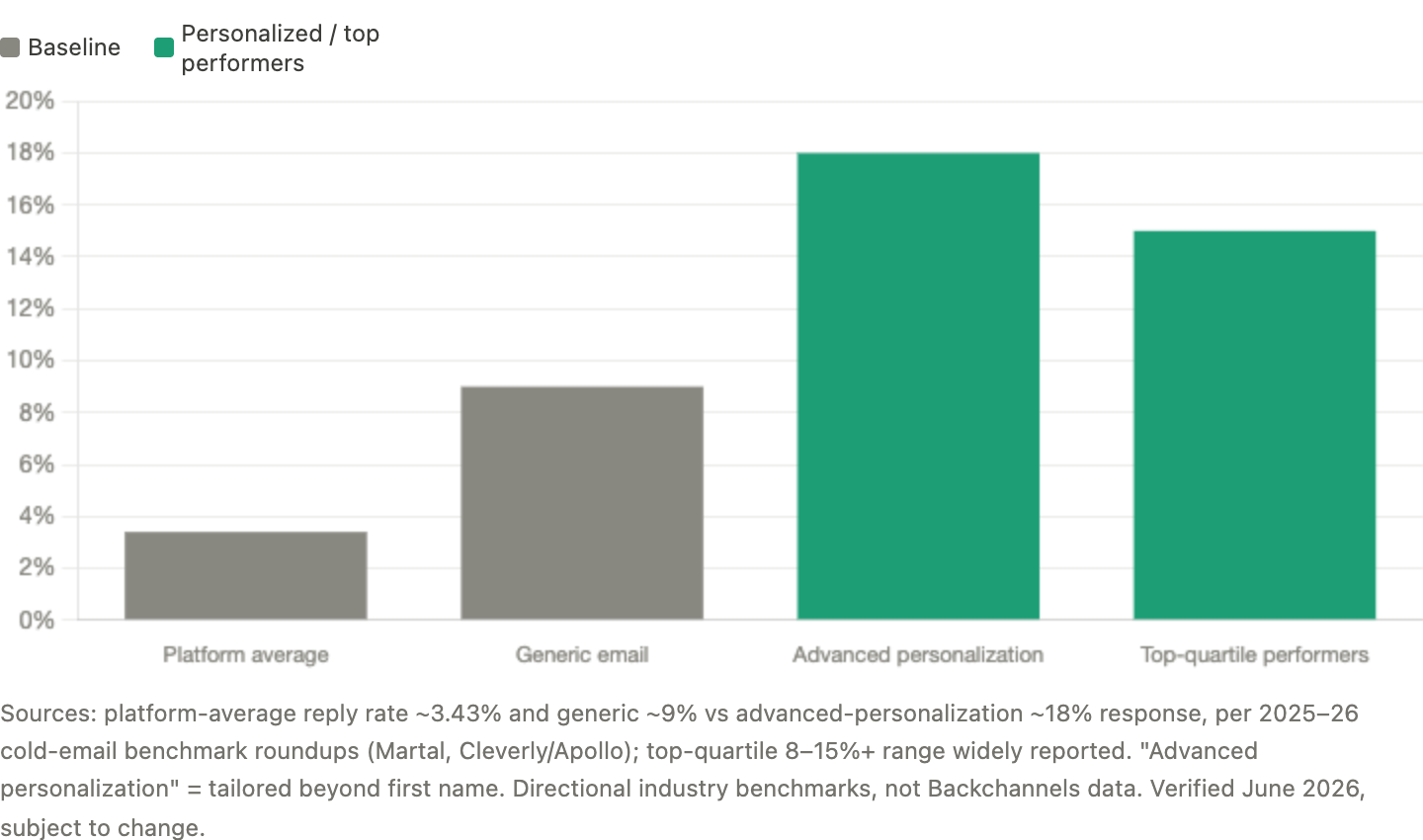
Look past the individual tactics and the same foundation appears in every one: great cold outreach is built on relevance, respect, and restraint. The messages that work are short, sound human, lead with value, and reach people for whom the offer is genuinely relevant. None of these companies wins by sending more they win by sending better.
The second pattern is that the visible message is the smallest part of the work. Brevity, voice, and a clear value proposition matter, but they only pay off when the targeting underneath is right. Brex and Deel make this explicit: choosing the right audience and understanding their context does more for reply rates than any clever turn of phrase. The copy is the tip of the iceberg.
And the third commonality is consistency. Outreach worth studying is a system defined, measured, and refined not a daily improvisation. The companies above treat outbound as a craft they get better at over time, which is why their quality is repeatable rather than occasional.
How to do this yourself, without their resources
Here's the uncomfortable truth underneath every example above: you can write the best cold email in the world, and it will still fail if it's pointed at the wrong person at the wrong moment. The reason most outbound underperforms isn't bad copy it's bad targeting and bad timing. And that's exactly the problem we built Backchannels to solve.
Backchannels is a buyer database with buying signals layered on top, so before you write a single message, you can see who actually fits your profile and who's showing signs of being in-market right now. Instead of blasting a generic list, you can narrow to the accounts that match the way Brex and Deel do and reach them when something has changed in their world. When we run our own outbound this way, leading with tight targeting and good timing rather than volume, the copy almost writes itself, because we already know exactly who we're talking to and why now. Reply rates climb not because the words got cleverer, but because the message finally has the right reader.
The practical starting point mirrors what the ten companies above do. First, get your targeting right: define your ideal profile precisely and build a list of accounts that genuinely fit, rather than everyone you could theoretically sell to. Second, add timing: look for the signals that suggest an account is moving, and prioritize those. Third and only third write the message, keeping it short, human, value-led, and specific to the reader. Backchannels handles the first two steps, the ones that actually determine whether your outreach works, so the message you write lands in front of the right person at the right time.
TRY BACKCHANNELS FREE
Your next customers are already in the database.
Backchannels gives you 225,000 verified software decision-makers. Filter to your exact ICP, preview matches for free, and push them straight into Salesforce or HubSpot. Pay per contact. No subscription, no contract.
Browse contacts freeNo credit card. Preview before you spend a credit.
No items found.
Final Thoughts
The bottom line The best cold outreach doesn't feel like cold outreach. It feels like a relevant, well-timed note from someone who understands your world and respects your time. The ten companies above achieve that through brevity, voice, value, and above all precise targeting proof that the craft is real and learnable. But don't mistake the message for the method. The reason their outreach works is the research and targeting that happen before the writing starts. Nail down who you're reaching and when, keep the message short and human, and your cold outreach will stop looking like everyone else's because it will finally be built on the right foundation.
Published
August 18, 2026
Writer
Joe Backchannels
Share


Most Wanted

12 min read

12 min read

June 2026